
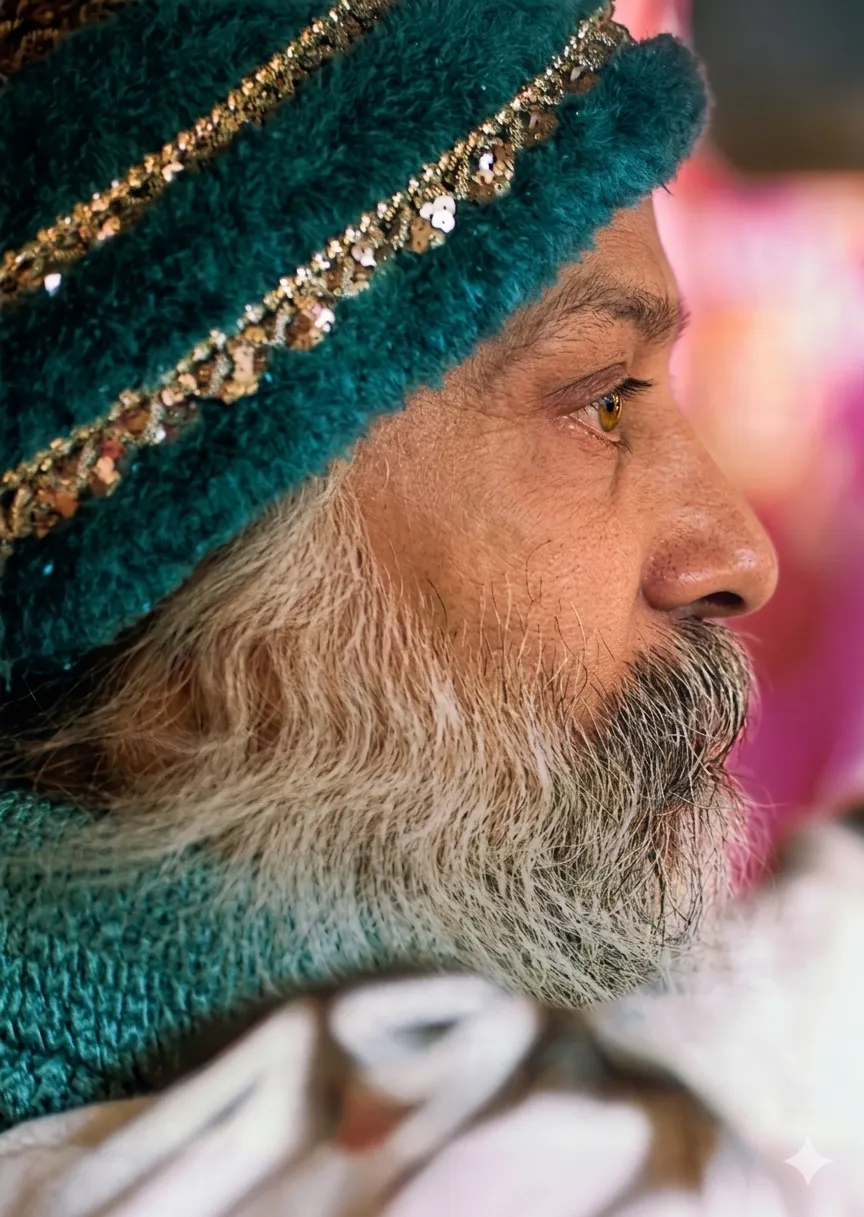
According to Osho, sannyas as a blissful phenomenon is not world-denial but total acceptance: an inner, courageous experiment where awareness flowers, roles are play-acted without doerhood, and the unnecessary drops by itself. Bliss includes the world and God, needs no outer symbols like ochre, and naturally guides one away from harmful involvement while fulfilling real responsibilities lightly.
Sannyas means living joyfully and aware, accepting life as it is, doing what’s needed playfully, and letting go of what isn’t.
From the Discourses
Passages where Osho speaks to this question — each links to the complete discourse.
Enlightenment comes just like grass growing -- by itself! No effort from your side is needed. All that is needed is a complete withdrawal of all efforts, as if you are not -- that's what is meant by silence. Sannyas is a suicide, effacing yourself completely, totally, categorically, not leaving even a small trace behind. The moment you are completely gone truth arrives, and arrives with such splendour and beauty, with such bliss and benediction, with such ecstasy, that it is impossible to imagine it. Then he talked of pleasure and of bliss, of how the former is what people know through relationships with others, while bliss needs the climate of aloneness. People are acquainted only with pleasure. Pleasure happens in relationship. The other is needed, the other is an absolute necessity, without the other pleasure cannot happen.
This shore is familiar; altough there is misery we have become familiar with it. We have lived together for so long that it is almost difficult to say goodbye to it. We are "married" to misery. It needs great courage to divorce misery because it is divorcing the known, the familiar, the accustomed, the conventional. It is divorcing that which nobody else is divorcing. The whole crowd is living in it. One has to learn how to be alone; for miles and miles there is nobody. One has to learn how to be alone; hence bliss needs courage, the courage to die to the past and be reborn. Sannyas is a great leap into the unknown. Gather yourself together for a great journey. Yes, there is risk but with risk is life. Yes, there is insecurity but insecurity is adventure.
Bliss is possible only to those who know how to trust, who know how to be surrendered, who know how to be loyal, obedient. Bliss is possible only when your heart says yes, when the no completely disappears from your being -- because no is darkness, yes is light; no is ego, yes is egolessness. No is the way of the unconscious man; yes is the way of the awakened one. Sannyas is nothing but a discipline of saying yes totally to all that is, forgetting the language of no. Then great harmony arises; all conflict disappears. All conflict is because of our no-saying. No is fight, war. Yes is love. Yes is deep accord with the totality. Bliss is another name of that accord, that harmony. (to Anand Jan) One can get bliss only if one deserves it, if one is worthy.
September 28, 1970 was a memorable day. At Manali in the Himalayas, Osho initiated His first group of sannyasins. This event was followed by this special evening discourse, on the significance of Neo Sannyas. To me, sannyas does not mean renunciation; it means a journey to joy bliss. To me, sannyas is not any kind of negation; it is a positive attainment. But up to now, the world over, sannyas has been seen in a very negative sense, in the sense of giving up, of renouncing. I, for one, see sannyas as something positive and affirmative, something to be achieved, to be treasured. It is true that when someone carrying base stones as his treasure comes upon a set of precious stones, he immediately drops the baser ones from his hands. He drops the baser stones only to make room for the newfound precious stones. It is not renunciation.
I start with bliss. The old religious approach was to start with contentment, and they used to say -- and it has been said in many scriptures of the world -- that the contented person is blissful. I say just the opposite is true, the blissful person is contented. And one who is not blissful, his contentment is bogus. So start by being blissful. And it will not be very difficult for you. It will be very simple and very easy. You are almost ready to take the jump! How long will you be here? -- One month. -- Be here. Good. (As Paritosh rises to leave Osho says:) Haridas, help him so he does not take the jump too soon! (much laughter) In India we make small earthen lamps. The poor people use those earthen lamps, they are the cheapest.