
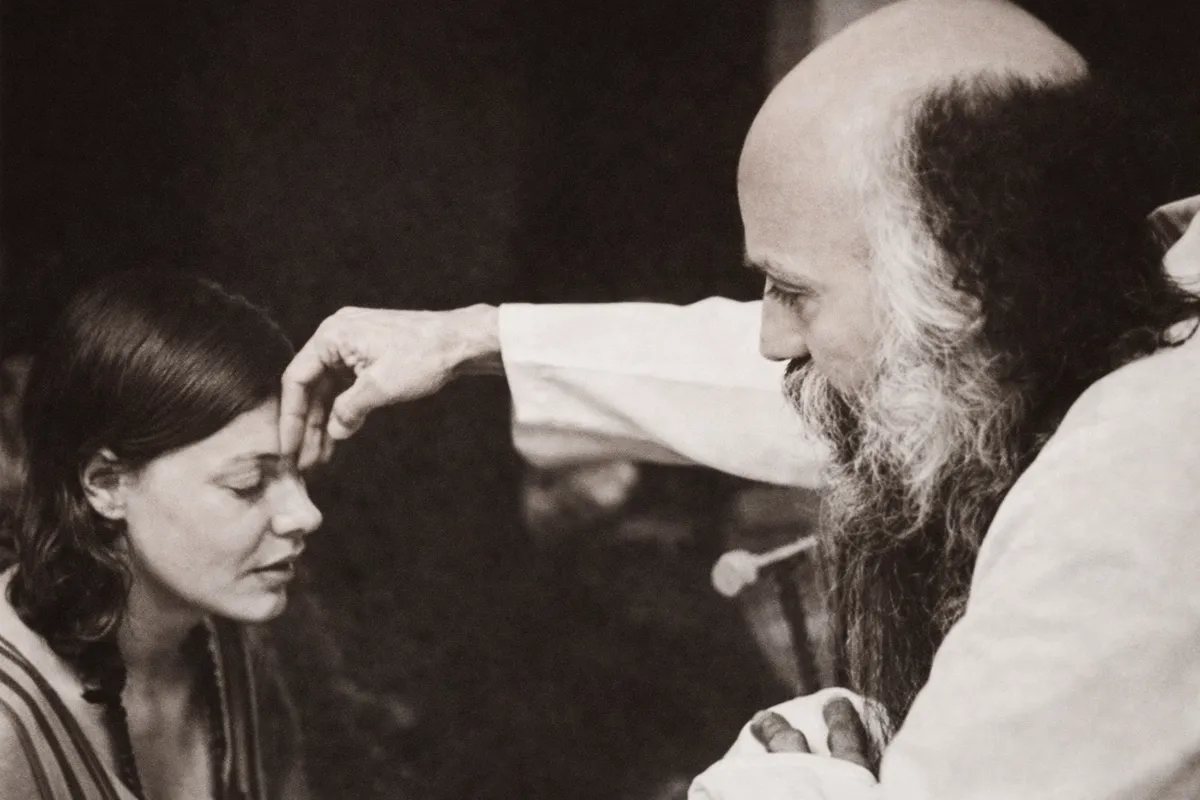
It says life goes better when different energies cooperate and celebrate together instead of fighting.
From the Discourses
Passages where Osho speaks to this question — each links to the complete discourse.
Osho, what is raas? Though he is Rasbihari, Sri Krishna is also called a brahmachari—what is the essence of that? In today’s modern society, what significance would the raas-lila have? Please shed light.
To understand raas, the first necessity is to see that life itself is raas. As I have said, all of life is the meeting of opposing forces. The joy of life is hidden in the union of opposites. The whole bliss and mystery of life is concealed in the meeting of opposites. So first it is proper to understand the metaphysical, the cosmic meaning of raas; then we can understand its reflection in Krishna’s life. Raise your eyes and look around—what else is happening but raas? Clouds racing across the sky, rivers rushing toward the sea, seeds traveling toward flowers, bumblebees singing, birds chirping, human beings loving, positive and negative electricity attracting, the ceaseless play and love-story of woman and man—if we look at this vast expanse, nothing is happening but raas. Raas has a profoundly cosmic meaning. It has vast metaphysical dimensions. First, in the orchestration of this world,…
ओशो, रास क्या है? रासबिहारी होते हुए भी श्रीकृष्ण ब्रह्मचारी कहलाए, इसका मर्म क्या है? आज के आधुनिक समाज में रासलीला का क्या महत्व होगा? कृपया इस पर प्रकाश डालें।
रास को समझने के लिए पहली जरूरत तो यह समझना है कि सारा जीवन ही रास है। जैसा मैंने कहा, सारा जीवन विरोधी शक्तियों का सम्मिलन है। और जीवन का सारा सुख विरोधी के मिलन में छिपा है। जीवन का सारा आनंद और रहस्य विरोधी के मिलन में छिपा है। तो पहले तो रास का जो मेटाफिजिकल, जो जागतिक अर्थ है, वह समझ लेना उचित है; फिर कृष्ण के जीवन में उसकी अनुछाया है, वह समझनी चाहिए। चारों तरफ आंखें उठाएं तो रास के अतिरिक्त और क्या हो रहा है? आकाश में दौड़ते हुए बादल हों, सागर की तरफ दौड़ती हुई सरिताएं हों, बीज फूलों की यात्रा कर रहे हों, या भंवरे गीत गाते हों, या पक्षी चहचहाते हों, या मनुष्य प्रेम करता हो, या ऋण और धन विद्युत आपस में आकर्षित होती हों, या स्त्री और पुरुष की निरंतर लीला और प्रेम की कथा चलती हो, इस पूरे फैले हुए विराट को अगर हम देखें तो रास के अतिरिक्त और कुछ भी नहीं हो रहा है।
Questioner: how is it that krishna is called a celibate in spite of his being a man of joyous dance and sensuous celebration? What is the place and relevance of raasleela -- the dance of celebration -- in modern society?
The significance of raas, the dance of celebration, is everlasting, it issues from the fundamental principle of life. This fundamental principle says that men and women are incomplete in themselves, they are fragments of a single whole. And they become whole and healthy only in close togetherness, in union with each other. If this togetherness happens unconditionally, it will complete the two in an extraordinary and unearthly way. On the other hand, if the union is conditional, if it has a motive, it is bound to lead to enormous difficulty and trouble in the process of its completion. However, so long as men and women exist on this earth, the raas will continue to be in vogue in many shapes and sizes. Maybe it does not attain the height and depth it had with Krishna, but if we grow in understanding and wisdom it is not impossible. More or less…
Osho, the question was about the chakra—Sudarshan—and about Panchajanya. And regarding the rasa-lila—yathā arbhaka sva-pratibimba vibhramaḥ? So what is the interpretation of the rasa-lila?
In truth, those who composed the poetry labored greatly with words. The very life of poetry is the word. And they worked on words with chisel and hammer for centuries. Now, Krishna’s discus has been named Sudarshan. It is a carrier of death, and yet it is named Sudarshan—“beautiful to behold.” Death is not beautiful to see, nor is it pleasing in form. But in Krishna’s hand even death becomes beautiful. That is all it means. We could not give the atom bomb the name Sudarshan. It is as destructive as the atom itself. Its strike is unfailing; the death it brings is certain. Once released, it returns only after killing. Where death is absolutely certain, would we still call that weapon Sudarshan? And yet it has been so named. In the hands of a man like Krishna, even death becomes Sudarshan. In the hands of a man like Hitler,…
ओशो, इस प्रकार नया शरीर मिलने भर से अतीत के संस्कारों व मन वाला सूक्ष्म शरीर भी बदल जाता है क्या?
वह अपने आप नहीं बदल जाता, लेकिन कृष्ण जैसे आदमी के हाथ से मरने का मौका मिले तो उसमें बहुत फर्क पड़ता है। सभी को नहीं मिलता, बहुत पुण्य कर्मों के फल से मिलता है। साधारणतः नहीं बदल जाता। अगर एक आदमी मरता है, तो शरीर ही बदलता है, उसके भीतर का और कुछ भी नहीं बदलता। लेकिन कृष्ण जैसे आदमी के हाथ से मरना बड़ी भारी घटना है, क्योंकि कैटेलेटिक एजेंट मौजूद है। उस आदमी की मौजूदगी में यह घटना घट रही है तुम्हारे मरने की, और तुम्हारे शरीर के छूटते ही उस आदमी के व्यक्तित्व से जो सूक्ष्मतम किरणों का जाल फैलता है, वह तुममें एब्जार्व हो जाएगा, उसे तुम पकड़ पाओगी, वह तुम पी जाओगी। जो तुम्हारा शरीर बाधा दे रहा था कृष्ण से मिलने से, वह बीच से हट जाएगा तो कृष्ण से मिलना आसान हो जाएगा। उस मिलन में बहुत कुछ होगा। वह मिलन अर्जुन के लिए ऐसे ही हो पाता है क्योंकि अर्जुन इस शरीर के बाहर छलांग लगा पाता है। हम प्रेम में शरीर के बाहर छलांग लगा लेते हैं। शत्रुता में हम शरीर के बाहर नहीं छलांग लगाते, शरीर के भीतर शरीर को दुर्ग की तरह बना कर बैठ जाते हैं।
Visarjan means dissolution, dissolution into the divine, immersion in the divine, the state of being lost.... One has to learn how to disperse oneself, how to come to a point where one is not. Only then god is. You and god cannot exist together; that's not possible. That's why so many people go on missing god -- because they are asking for the impossible: they want to remain themselves and they want to see god. God can be seen only when you are not. That nothingness can encounter god, not you. So the whole process of sannyas is the process of visarjan, dispersion. Slowly, slowly, one loses, goes on losing, goes on losing. The more one loses, the more one understands how beautiful it is not to be. Then more courage arises, a little bit more.
Questioner: what are the distinguishing virtues of krishna that make him relevant to our time? What is his significance for us? Please explain.
Up to now, man's mind has thought of and looked at life in fragments -- and thought dialectically. The religious man denies the body and accepts the soul. And what is worse, he creates a conflict, a dichotomy between the body and spirit. He denies this world, he accepts the other world, and thus creates a state of hostility between the two. Naturally our life is going to be sad and miserable if we deny the body, because all our life's juice -- its health and vitality, its sensitivities and beauty, all its music -- has its source in the body. So a religion that denies and denounces the body is bound to be anemic and ill, it has to be lackluster. Such a religion is going to be as pale and lifeless as a dry leaf fallen from a tree. And the people who follow such a religion, who…