
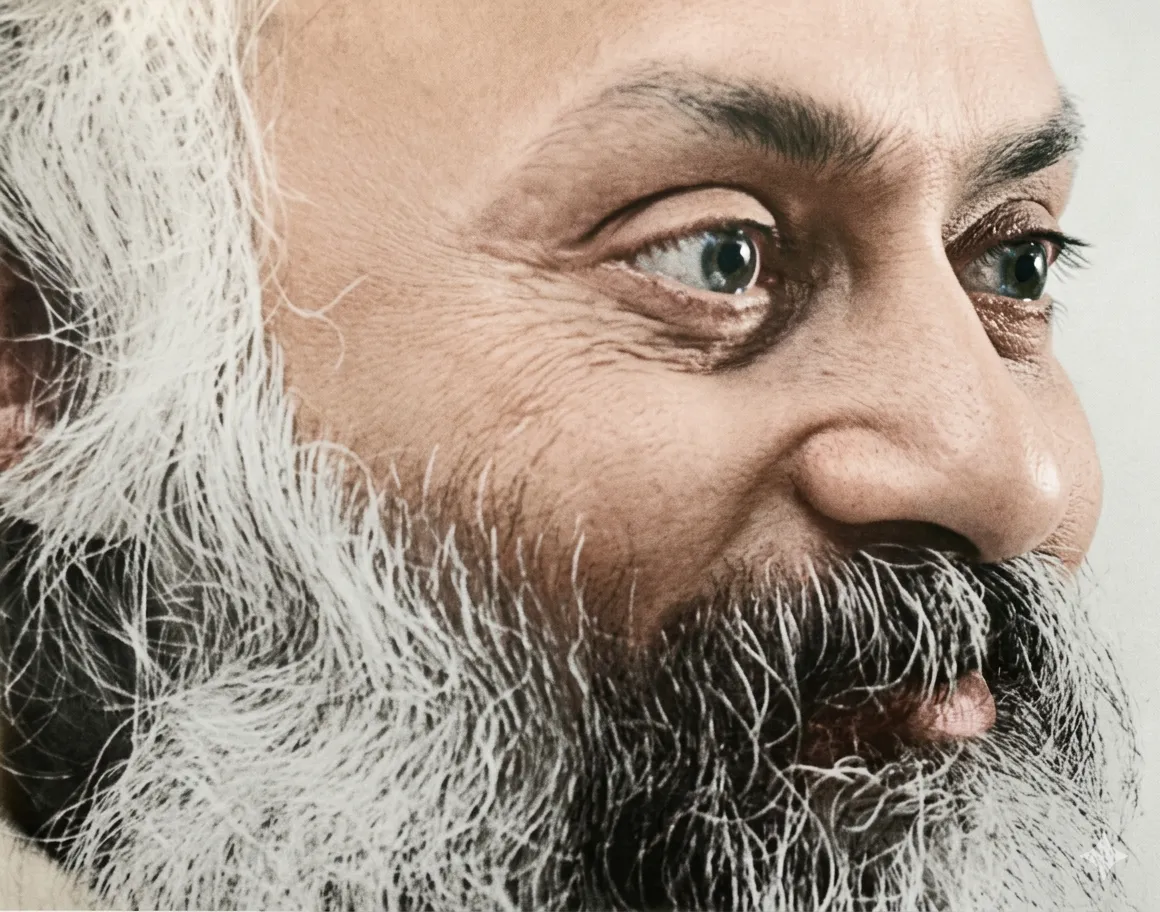
People listen to him because he’s real, not a pretend holy man repeating old stories to get your money.
From the Discourses
Passages where Osho speaks to this question — each links to the complete discourse.
Osho, just seeing sadhus and saints makes me bristle, even angry. I see nothing in them but hypocrisy. But with you—God knows what you’ve done—reverence wells up! What is the secret of your influence?
Buddha asked, “What are you doing?” They said, “This is not killing; not violence. The souls of these animals will go to heaven.” Buddha joked, “Then why not kill your parents? Send them to heaven. The door is open—why send animals? Send your parents, your wife, your children. Send everyone—and then go yourself! But don’t send these animals. They don’t want to go—they’re writhing, they want to run. They are pleading for mercy. They cannot speak—look into their eyes, they are beseeching. They are bleating: ‘Let us go.’ They don’t want heaven—and you are sending them. The yajman who is funding this sacrifice wants heaven—send him!” Clever folks have always been around. Tricks kept running; we kept bearing them. Sin and merit are difficult to determine. On one side are people along the Amazon who eat humans—and it is no sin to them. On the other side are the Quakers…
दूसरा प्रश्न: ओशो, साधु-संतों को देख कर ही मुझे चिढ़ होती है और क्रोध भी आता है। मैं तो उनमें सिवाय पाखंड के और कुछ भी नहीं देखता हूं। पर आपने न मालूम क्या कर दिया है कि श्रद्धा उमड़ती है! आपके प्रभाव का रहस्य क्या है?
तो बुद्ध ने कहा कि यह तुम क्या कर रहे हो? तो उन्होंने कहा कि यह कोई हत्या नहीं है, हिंसा नहीं है। ये जो पशु-पक्षी काटे जाएंगे, इन सबकी आत्माएं स्वर्ग चली जाएंगी। तो बुद्ध ने बड़ा मजाक किया है! और बुद्ध ने कहा: तो फिर अपने माता-पिता को क्यों नहीं काटते? स्वर्ग ही भेज दो। यह अवसर मिला, स्वर्ग भेजने का द्वार खुला और तुम इन पशु-पक्षियों को भेज रहे हो? माता-पिता को भेज दो! पत्नी-बच्चों को भेज दो! फिर सबको भेज कर खुद भी चले जाना! मगर इन पशु-पक्षियों को तो न भेजो। ये तो जाना भी नहीं चाहते। ये तो तड़प रहे हैं। ये तो भागना चाहते हैं। ये तो कहते हैं कि क्षमा करो! बोल नहीं सकते। जरा इनकी आंखें तो देखो, गिड़गिड़ा रही हैं। मिमिया रहे हैं; ये कह रहे हैं कि हमें जाने दो। ये तो स्वर्ग जाना नहीं चाहते, इनको तुम भेज रहे हो। और जो जाना चाहते हैं...। जिस यजमान ने यह करवाया है यज्ञ, वह स्वर्ग जाना चाहता है, उसी को भेज दो। खूब चालबाज लोग दुनिया में थे। चालबाजियां चलती रहीं। चालबाजियां हम सहते रहे। …
Question: OSHO, ALL THE OTHER MASTERS SEEM LIKE PYGMIES. WHAT IS YOUR SECRET? ... Jesus had known about it. While he was traveling in Egypt and India perhaps he visited Kashmir, visited the samadhi of Moses. He knew about Kashmir; he escaped from Israel to Kashmir. His grave is just by the side of Moses'. It describes everything -- his personality, his name. It was his Hebrew name of course because he never knew that he was going to be called Jesus; he was Joshua. So nobody can say that grave is new, because it calls him Joshua and states that a young man called Joshua arrived here and lived here until the age of one hundred and twelve years with his disciples. The place where Jesus lived, Pahalgam, is named after him, because he used to call himself the shepherd. In Kashmiri, Pahalgam means village of the shepherd.
Question: OSHO, I HAVE READ YOUR LITERATURE; I HAVE HEARD YOU. YOUR LANGUAGE HAS HYPNOTIC CHARM AND IS VERY CLEAR. SOMETIMES YOU SPEAK ON MAHAVIRA, SOMETIMES ON KRISHNA OR BUDDHA AND SOMETIMES YOU TELL ABOUT JESUS AND MOHAMMED AS WELL. YOU DIVULGE THE SECRETS OF THE GITA IN A MOST INSPIRING MANNER, YOU GIVE DISCOURSES ON THE UPANISHADS AND THE VEDAS, AND YOU WOULD NOT HESITATE TO GO TO TEMPLES OR CHURCHES TO GIVE DISCOURSES. ALL THE SAME, YOU MAINTAIN THAT YOU ARE NOT INFLUENCED BY ANY OF THE PERSONAGES MENTIONED ABOVE. YOU SAY THAT YOU HAVE NOTHING TO DO WITH THEM AND YOU DO NOT AGREE WITH THEM. CONTINUOUSLY, YOU CRITICIZE AND SHATTER TO PIECES THE ANCIENT RELIGIOUS BELIEFS AND SCRIPTURES. WHAT IS YOUR PURPOSE? DO YOU WANT TO ESTABLISH YOUR OWN RELIGION? DO YOU WANT TO SHOW THAT YOU HAVE LIMITLESS KNOWLEDGE?
Question: Osho, I have read your writings and listened to you. Your voice is very captivating and your words very clear. Sometimes you speak on Mahavira, sometimes you discuss Krishna, sometimes you talk about Buddha, and sometimes you say much about Christ and Mohammed as well. You offer an exceptionally powerful exegesis of the Gita; you do not miss analyzing the Vedas and Upanishads; you even go and preach in churches. And yet you say from the outset that you are not influenced by any of the above figures—that you have nothing to do with them, that you do not “accept” them. On the other hand, you keep striking at ancient beliefs and scriptures, you criticize religions. Then what is it—do you want to start your own sect or doctrine? Or are you wanting to declare that your knowledge is vast? Or do you want to confuse people?
Which philosophers influenced you, and which one is closest to you?
I don't like the word `influence'. I have not been influenced by anybody, and I don't want to influence anybody, because that is only a subtle name for spiritual slavery. But there are a few great human beings I have loved. Socrates comes first, because his devotion to truth is absolute and total. He is ready to accept death, but not ready to accept any condition. And the conditions were such that anybody would think they were acceptable. The judges themselves must have felt... Socrates argued so well, and his opponents had nothing to say, but because it was a city-state and a city democracy, everybody had the power to vote, and the mob was unable to understand what Socrates was saying. It went over their heads. They were all in favor that Socrates should be poisoned. But the magistrates gave Socrates three alternatives. They said, "You can leave Athens…