
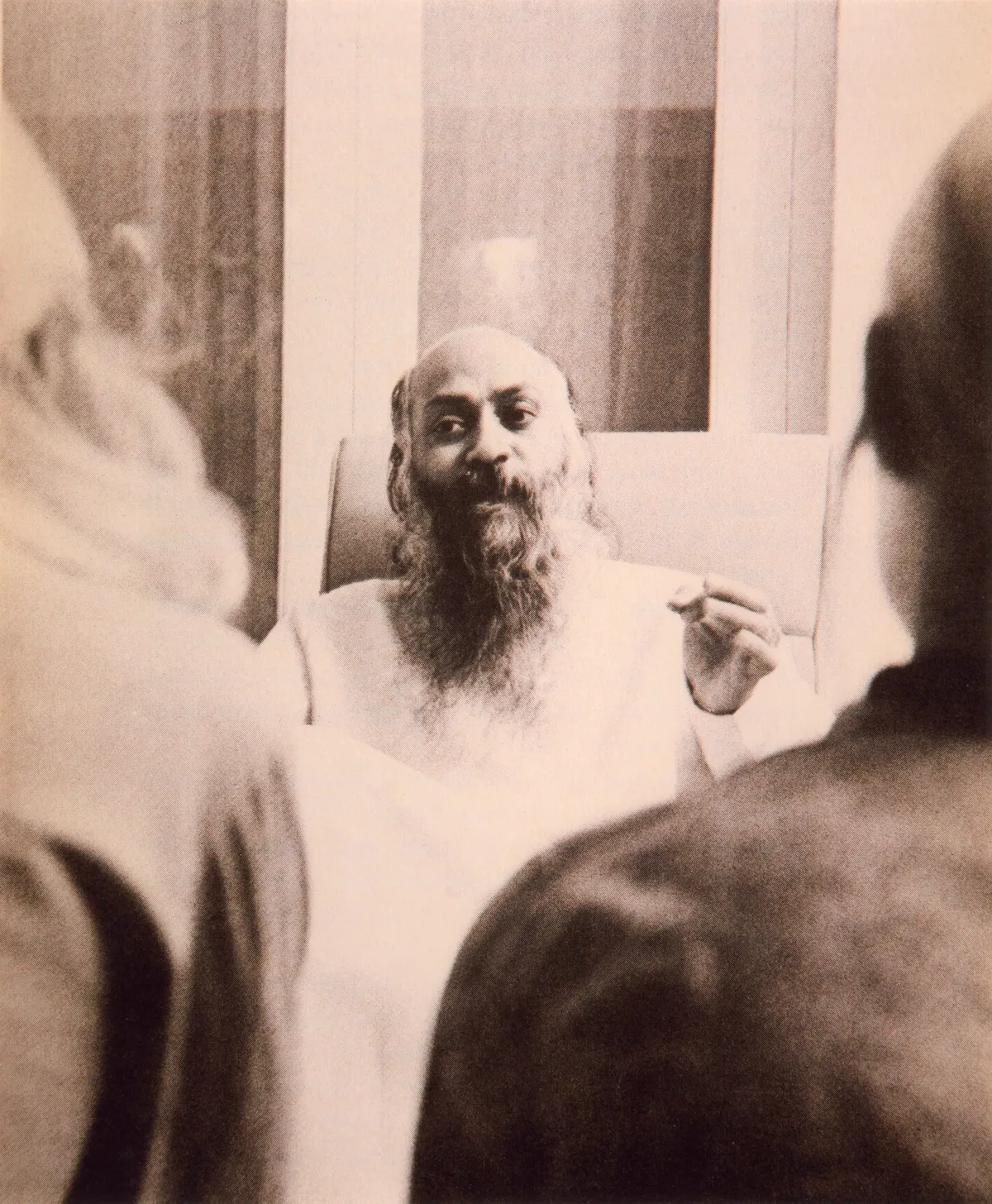
Real gratitude is a warm glow that comes from inside for no reason, not a ‘thank you’ to someone for giving you what you wanted.
From the Discourses
Passages where Osho speaks to this question — each links to the complete discourse.
The cloud represents a few things. One: it represents absolute freedom. It is not tethered to anything. It is completely free, it floats in freedom. That's how a sannyasin has to be: Like a cloud, untethered. Secondly, the cloud has no fixed form. It is not static It is constantly moving and changing. Not even for the consecutive seconds is it the same. That represents something very essential: Life is movement; only death is not a movement. Only dead thins don't change Things which are alive are constantly changing. That's how a sannyasin has to be: Always on the move, changing REaching for newer horizons Exploring for newer pastures. A sannyasin is as unpredictable as a cloud; Nobody can say what form It is going to take next moment. And thirdly, the cloud has no ego of its own.
Beloved Osho,
YOU'VE SAID MEDITATION IS A FLOWERING. AND FOR US, THE PERFUME OF THE FLOWER IS GRATITUDE. IS THERE ANYTHING WE CAN DO FOR YOU? Yes. Meditation, compassion and gratitude. Whenever you are meditative, you feel blissful; whenever you are in compassion, you feel ecstatic. And then gratitude arises -- not towards anyone in particular, gratitude just arises. It is not towards me or towards Jesus, or Zarathustra or Buddha, it is simply gratitude. You feel so grateful just for being here, just for being alive, just for being able to be meditative, just for being able to be in compassion. You feel simply grateful. That gratefulness is not towards anybody, it is towards the whole. If you feel grateful towards me it is a gratitude of the mind. If you meditate and if you flower in compassion you will feel simply grateful, not grateful towards me. Then there is no…
Beloved Osho, some time ago, in answer to my question as to whether enlightenment is the only way a disciple can express gratitude to her master, I heard you say that nothing could express the gratitude. I realized then that gratitude is something that we usually feel almost burdened with, and so we seek to find an outlet for it so that we are relieved of a debt. As the disciple can't express her gratitude -- and what would the master do with it anyway? -- it seems to me that it could become a kind of quality in someone that could transform them. Would you please comment?
In existence, there is nothing which is a noun. You say this is a tree, but have you ever thought? -- while you are saying this is a tree, the tree is bringing new leaves, old leaves are falling; new flowers are blossoming, old flowers are disappearing. It is not a dead thing; hence, it cannot be a noun. It is a living entity, it is changing constantly. The word `tree' gives a false idea, as if there is something unchanging. It will be better to call it a `treeing' -- because the tree is continuously moving. The river is `rivering' -- it is a movement, it is not stale, it is not dead. In other words, the existence does not consist of dead matter, it consists of living energy. There is nothing permanent except change. If you can, with awareness, change your burdens into wings, your treasures into fragrances,…
Osho, in a previous talk you said you prefer shaktipat to be as close to grace as possible. Doesn’t that imply that the method of shaktipat admits gradual refinement and development? In other words, is qualitative progress also possible in the process of shaktipat?
From one who has attained the seventh body, shaktipat becomes the purest—the purest. Yet it is still not grace. The purest state of shaktipat is reached at the seventh body—no further. On that side there is no veil now; for the one in the seventh there is no veil—he is one with the void. But on your side there is a veil. You will still take him to be a person. Your veil will now provide the final obstruction. From his side there is none, but for you he remains a person. The sense of personhood toward the medium is also an obstacle Understand: if I attain the seventh state, it is my affair that I know I am the void—but you? You will know me as a person. And your notion that I am a person becomes the last veil. That veil will fall only when the happening befalls…
प्रश्न: ओशो, पिछली एक चर्चा में कहा था आपने कि आप पसंद करते हैं कि शक्तिपात जितना ग्रेस के निकट हो सके उतना ही अच्छा है। इसका क्या यह अर्थ न हुआ कि शक्तिपात की पद्धति में क्रमिक सुधार और विकास की संभावना है? अर्थात क्या शक्तिपात की प्रक्रिया में क्वालिटेटिव प्रोग्रेस भी संभव है?
सातवें शरीर को उपलब्ध व्यक्ति से शक्तिपात शुद्धतम हो जाएगा। शुद्धतम हो जाएगा। ग्रेस फिर भी नहीं होगा। शक्तिपात की शुद्धतम स्थिति सातवें शरीर पर पहुंच जाएगी--शुद्धतम। जो, शक्तिपात जहां तक पहुंच सकता है, वहां तक पहुंच जाएगी। लेकिन उस तरफ से तो कोई पर्दा नहीं है अब, सातवें शरीर को उपलब्ध व्यक्ति की तरफ से कोई पर्दा नहीं है, उसकी तरफ से तो अब वह शून्य के साथ एक हो गया, लेकिन तुम्हारी तरफ से पर्दा है। तुम तो उसको व्यक्ति ही मानकर जीओगे। अब तुम्हारा पर्दा आखिरी बाधा डालेगा। अब उसकी तरफ से कोई पर्दा नहीं है, लेकिन तुम्हारे लिए तो वह व्यक्ति है। माध्यम के प्रति व्यक्ति-भाव भी बाधा समझो कि मैं अगर सातवीं स्थिति को उपलब्ध हो जाऊं, तो यह मेरी बात है कि मैं जानूं कि मैं शून्य हूं, लेकिन तुम? तुम तो मुझे जानोगे कि एक व्यक्ति हूं। और तुम्हारा यह खयाल कि मैं एक व्यक्ति हूं, आखिरी पर्दा हो जाएगा। यह पर्दा तो तुम्हारा तभी गिरेगा जब निर्व्यक्ति से तुम पर घटना घटे। …
Gratitude is the essence of prayer
Doubt is a perfectly adequate method for extrovert enquiries, it is the right method. I am not against doubt. It has tremendous importance. The whole edifice of science stands on it: doubt and doubt, unless you stumble upon something that you cannot doubt. But still that is only a hypothesis. That means you are still not going to trust it absolutely. Who knows? -- tomorrow some new facts may turn up, so keep the doors open for doubts. For the time being, use it hypothetically; for the time being this is true, but only for the time being. Science never comes to truth, only to approximations, hypotheses. Religion is a totally different endeavour: it begins in trust. It needs faith, such faith that no doubt ever arises. Not that one has to repress doubt; if you repress it, it will be there. One has to watch, one has not to…