
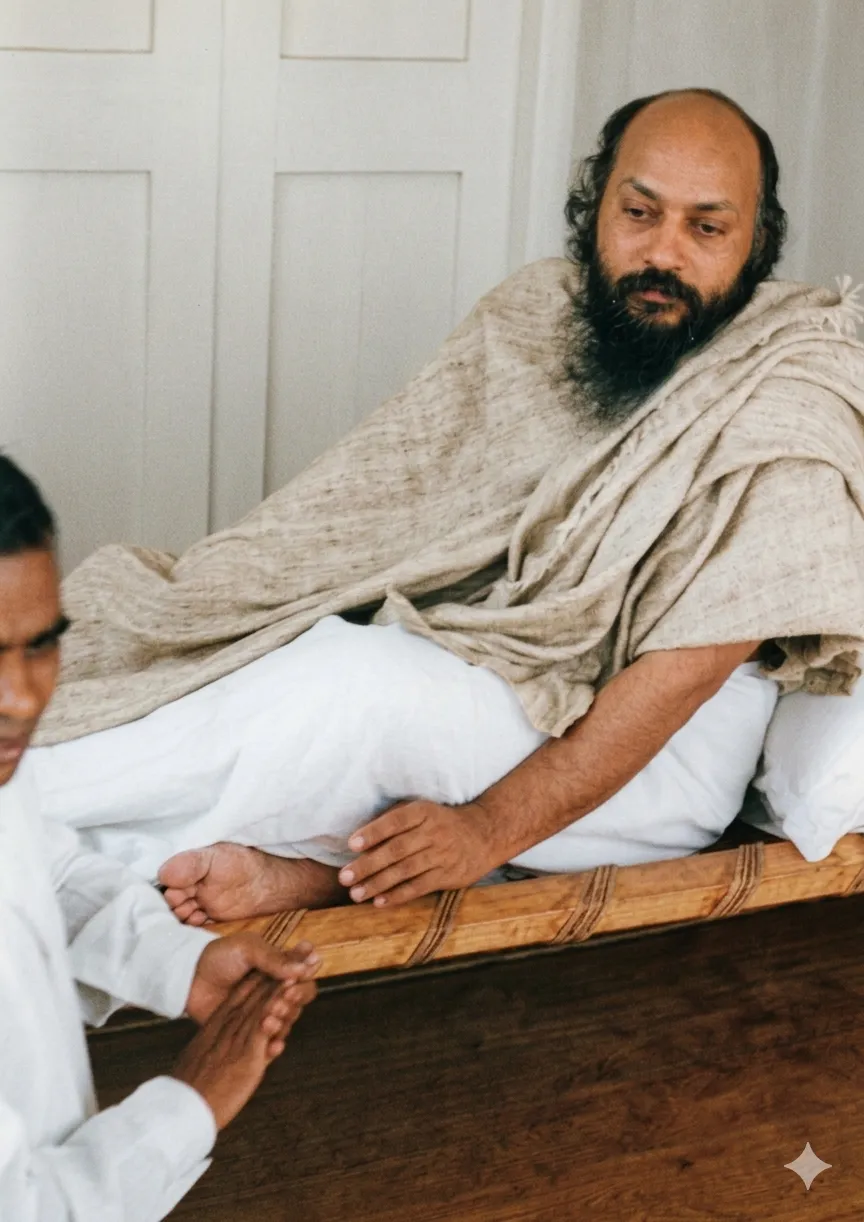
According to Osho, orange (ochre) robes are not essential for enlightenment but are a conscious device: loose, light, ochre clothing supports a meditative, peaceful mind. Colors filter solar energies; each color repels its own frequency. After long experiment, ochre was chosen to shield from stimulating, sexual ‘red’ energies and to create an inner coolness and purity helpful for sannyas.
Orange, loose clothes don’t make you spiritual, but they help keep you cool and calm by filtering out stirring red energies so meditation is easier.
From the Discourses
Passages where Osho speaks to this question — each links to the complete discourse.
Questioner: what is the meaning of wearing orange clothes as a sannyasin?
It is not accidental that a book on sexology like the KAMASUTRA was not written in a country with a cold climate. It is the same with TALES OF THE ARABIAN NIGHTS; it is the product of a tropical climate. People living in tropical climates are more sexual because of the sun. Therefore people who were working on sannyas from many directions thought that sexuality could be calmed if the red color were kept away from sannyasins' bodies -- hence ochre was selected. You can ask why ochre was selected and not red. Pure red could well have been selected; it would have been more effective in calming sexuality. But there was a difficulty in choosing red, true out-and-out red; it would have totally prevented red from entering the body. But the body needs some amount of red rays to keep fit, so it would have been bad for the…
Osho, what does it mean to wear saffron clothes?
Clothes do not make one a sannyasin—but a sannyasin too has his own kind of clothes. Clothes do not make one a sannyasin, yet a sannyasin may have his own robes. Clothes are a very ordinary thing, but not utterly meaningless. What you wear has many meanings. Why you wear it also has many meanings. One man wears loose clothes. Wearing loose clothes in itself makes no difference, but why does a person choose loose clothes? And why does another choose tight clothes? These are indicators of the person. If a man is very calm, he will not like tight clothes. A taste for tight clothes hints that the person may be quarrelsome, restless, aggressive, sensual. Loose clothes are not suitable for fighting. That is why you cannot dress a soldier in loose clothes; you can dress only a monk in them. A soldier should wear tight clothes—the work is…
I wonder about colors. No beginning, no end, but emptiness. What about orange, the color of the sun, and the sannyasins?
SANNYAS is the ultimate game -- the last, the final. Beyond it there is no game. It had to be very colorful. The householder, the grihasth, plays a game but it is in black and white. Poor. A sannyasin is playing a game but not in black and white. It is colorful. A sannyasin has to become a rainbow because the moment you know that everything is empty everything becomes possible; because that emptiness has in it all. To me, sannyas is not renunciation against indulgence. No. It is renunciation in indulgence. sannyas is not leaving the world; it is living in the world as if you are out of it -- it is an 'as if' phenomenon. You live in the world but you are not in it; you move in the world, but never, never, do you take a single step in it; you remain in the world…
A friend has asked, “Why are ochre robes necessary for sannyas?”
If you want to dive in, you have to be a little mad. These are ways to go mad—nothing else. These are ways to break your cleverness—nothing else. These are ways to wipe off your so-called wisdom—nothing else. Put someone in ochre robes, and he’s made mad! Now wherever you go, there will be laughter. Wherever you go, people won’t let you stand in peace. All eyes will be on you. Everyone will ask, “What happened?” Every gaze will seem to say, “Something has gone wrong. So you too got into this uproar? Got hypnotized?” In themselves, ochre robes have no value. You won’t attain liberation through them. Their only value is that you have made a declaration: you are ready to be mad. Then the journey can proceed further. If you get scared here, what journey will there be ahead? Today we put you in ochre robes; tomorrow we’ll…
Osho, you have said that sannyas is the realization of truth. Then are ochre robes and the mala also essential for sannyas? And can a person not walk on your path without initiation? Kindly guide.
The day before yesterday a friend asked—he has taken sannyas, a simple-hearted man—he asked, “What is the scientific reason for this mala?” How can a mala possibly have a scientific reason? Its reason is religious, inward—not scientific. I told him, “If you want something ‘scientific,’ ask Laxmi.” A scientific reason? Does love ever have a scientific reason? A young man fell in love with Mulla Nasruddin’s daughter. He came and said, “I am in love with your daughter; please permit me to marry her.” Mulla said, “First prove it—what is the cause of your love?” The young man replied, “There is no cause, sir! Love has happened. Where there is a cause, can there be love? Where there is a cause, there is business, a bargain. Love is causeless.” Your love has happened with me; mine with you. Now some symbol becomes necessary. Think of this mala as the seven…