
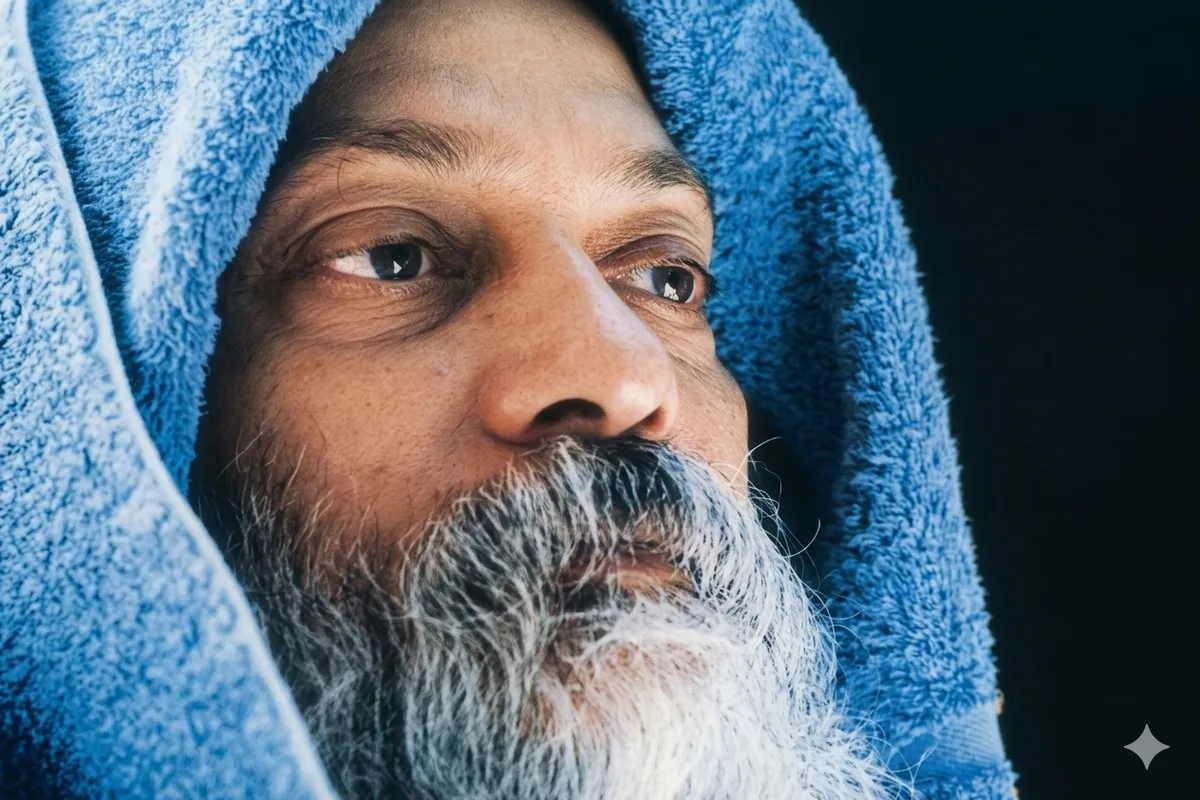
Being passive is just the mind doing “nothing” as a tactic; flowing means dropping the tactic, trusting life, and responding freely in the moment.
From the Discourses
Passages where Osho speaks to this question — each links to the complete discourse.
What is the difference between waiting for godot and waiting for god?
It is as if the sun has risen in the morning and you are sitting in your room with closed doors and windows, in darkness. Open the doors, you become available to the sun. The sun was already available -- just the meeting happens. You cannot wait for God. All waiting is for Godot. Godot means the one who never comes, who CANNOT come, whose arrival is impossible. And the only impossible thing is that which has already happened -- how can it happen again? You are alive, and you are waiting for life, Now, this is ridiculous. The real man of religion does not think in terms of God. He thinks in terms of life or, even better, of living -- because life can again become an abstract idea. Living, moment-to-moment living. In that very living, one knows what God is, because one knows who one is. Your idea…
Sometimes I feel in a state of non-doing, very passive, but may awareness of what is happening around me seems less. In fact, I feel detached from things around me. This somehow means false passivity, as I imagine on-doing should be synonymous with increased awareness. Can you please define this state?
Ordinarily we are in a feverish state -- active, but feverishly. If you become passive the fever will be lost. If you become passive, non-doing, if you relax within yourself, activity will be lost, fever will be lost, and the intensity that comes through fever will not be there. You will feel a little dull, you will feel as if your awareness is decreasing. It is not decreasing; only the feverish glow is decreasing. And it is good, so don't be afraid of it, and don't think that this passivity is not real. This is being said by your mind which needs and wants the feverish activity and the glow that comes through fever. Fever is not awareness, but in fever you can have a very unhealthy awareness, alertness. That is diseased; don't hanker for it. Allow it to go, fall into passivity. In the beginning it will look like…
Osho, have I to push the river?
Please, flow with the river. You are a part, you cannot impose yourself on the whole; the whole is infinite. It is as foolish as a small wave trying to direct the whole ocean, trying to dominate the whole ocean, trying to pull the ocean in a certain direction, to certain goals. It is not possible. How can a small wave be in control of the vast ocean? And we are not even waves, we are just ripples. For one moment we are there, another moment we are gone. With this momentary life the only thing that you can learn is to surrender, to be in a let-go, not to push. Pushing, you will be moving in a wrong direction, the direction of the ego. Surrender Fight, all fight, is out of the ego. Don't even swim, just float with the river wherever it takes you. Finally it takes you…
One more question—a friend has asked. That too is related to this. That too should be understood. Osho, what is the difference between doing meditation and being in meditation—to be in meditation and to do meditation?
It makes no difference. Keep the arithmetic of seven. Add it up in total. Don’t count one by one that four in the morning, three in the evening—or three in the morning, four in the evening. Seven! And I have given the seven bananas. If you get tangled in the counting, you might go away disappointed. So I have said this at the end: I have given the seven bananas. What I had to say, I have said. Now let us sit for the night meditation. Spread out a little. We will not talk. Quietly, those who need to go may go; those who wish to meditate may sit. Do not talk. Friends who need to leave should go quietly, and those who wish to sit should sit quietly. Those who want to lie down may lie down. Yes—those who are still standing, either sit or go; no one should…
Osho, you said last night that those who have become void, valley-like, do not react but they respond, and that the responses of these different enlightened ones will be different -- that the valley will reecho in its own unique and individual way. Now a question arises whether those who become absolutely void, nothingness, still have a personality and individuality. If so, then please explain how this becomes possible.
THIS is one of the paradoxes of spiritual life: the more one dissolves into the Divine, the more unique one becomes. The dissolution is not of the individuality but of the self. The dissolution is not of the uniqueness but of the ego. The more you are an ego, the more you are like others, because everyone is an egoist. The ego is the most ordinary thing in the world. Everyone is an egoist; even a newborn child is an egoist -- a perfect egoist. So it is not anyone's achievement; it is not extraordinary. Really, it can be said that to be just ordinary is the most extraordinary thing possible because no one feels just ordinary. So to feel oneself extraordinary is just the most ordinary thing. Everyone feels like that! So ego is not something unique. If you have an ego, it is not something unique. Really, egolessness…