
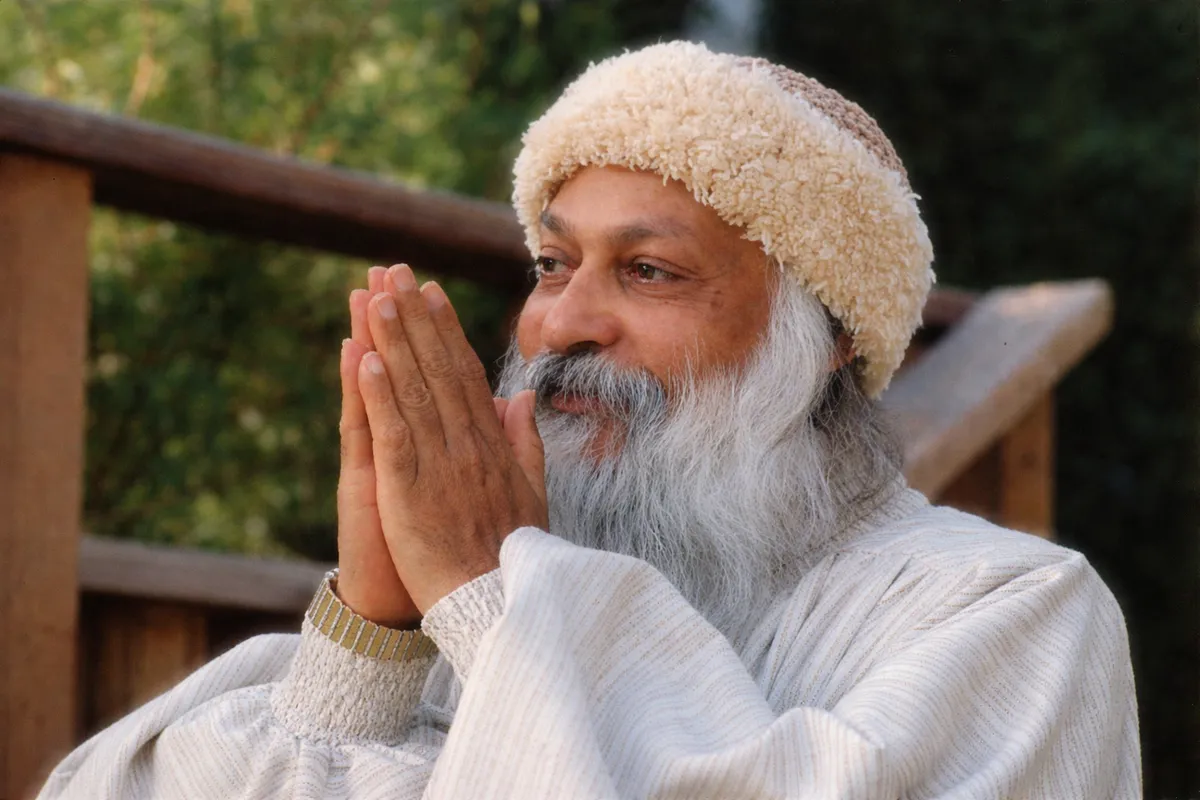
A poet dreams about truth and comforts us; a rishi has fully awakened to truth and jolts us awake.
From the Discourses
Passages where Osho speaks to this question — each links to the complete discourse.
Osho, what is the definition of God?
Words are very small. If you say God is light, then what of darkness? The scriptures have said that God is light. Suppose we accept this as a definition—then what about darkness? Where will darkness go? Darkness is too; in fact it is far more than light. Light sometimes is and sometimes is not; darkness is always, eternal. Where will you place darkness? If you say God is light, darkness is left out. If you say God is darkness, then light is left out. If you say God is both darkness and light, a contradiction arises: they cannot be together. Try to have both darkness and light in the same room. If you bring in light, darkness disappears; if you preserve darkness, you cannot have light. Then how can both be together? That becomes an impossibility. So you cannot say “both” either. Then the fourth device is to say: it…Read the full discourse →
Osho, yesterday you said that when anger is watched consciously, it dissolves. But why is it that when sexual desire arises, even in awareness its intensity persists? Why is it so?
There is no entanglement in the breath. If you try to practice on anger… Anger is not happening every moment; it happens sometimes. And when it happens, it happens with such intensity that you are already going deep into it; so much is at stake in those moments that you may think, “We will look into awareness later; first let’s settle this now.” Lust is very deep, because existence has made it so deep; life depends on it. If lust were so easy that you decided and were freed, perhaps you would not even have been born—because many before you would have become free, and the possibility of your being would have been almost nil. But your parents, and their parents, did not become free; therefore you are. You too will not get free so easily, because your children are also to be—they are waiting: “Do not run away midway.”…Read the full discourse →
Hear then the wisdom of the wise: "go placidly amid the noise and the haste, and remember what peace there may be in silence. "as far as possible, without surrender, be on good terms with all persons. Speak your truth quietly and clearly; and listen to others, even to the dull and the ignorant; they too have their story."
Be exactly in the middle. Without compromising, avoid unnecessary quarrels. BE ON GOOD TERMS WITH ALL PERSONS, AS FAR AS POSSIBLE without selling your soul, without compromising on any ground, without surrendering at all. But there are many things which can be avoided. In fact, ninety-nine percent of the problems which create fighting, argument, can be avoided. The child asks you, "Daddy, can I go out and play?" and the immediate response of almost all daddies is "No!" Now the quarrel starts. And all children know how great your patience is. They will tramp their feet in front of you, they will go into a tantrum, they will cry, they will start throwing their toys, tearing their books. And then finally you will say, "Go OUT and play!" This you could have done before, you could have said yes, because there was nothing wrong. But somehow our whole upbringing is…Read the full discourse →
Osho! You say the poet is close to the seer. Yet it is surprising that even poets and artists with such sensitive hearts—who have set out in life seeking satyam, shivam, sundaram—hesitate to come here. You say meditation deepens sensitivity. Then what are these poets and artists afraid of? Are meditation and creation not possible together?
Arun Satyarthi! The poet is certainly close to the rishi. Poet means: one who has begun to receive glimpses of the Divine. Rishi means: one who has become one with it. Poet means: one who has seen, from afar, the snow-white peaks of the Himalayas. Rishi means: one who has made his home upon those peaks. Between the poet and Truth there is a slight distance; the rishi is one with Truth. But without being a poet no one becomes a rishi. Though not all poets become seers, all seers are bound to be poets. One can choose to cling to the glimpses, to revel in them. The poet is showered by a drizzle; the rishi is drenched in a cloudburst. The poet, you can say, lives by ponds and pools; the rishi is merged into the ocean—he becomes the ocean. Yet a poet may mistake his pond for the…Read the full discourse →
Hear then the wisdom of the wise: "go placidly amid the noise and the haste, and remember what peace there may be in silence. "as far as possible, without surrender, be on good terms with all persons. Speak your truth quietly and clearly; and listen to others, even to the dull and the ignorant; they too have their story."
WE ENTER TODAY into one of the most beautiful worlds, that of a small document called the DESIDERATA. It is strange because it has appeared many times and disappeared many times; hence nobody exactly knows who wrote it. Truth has the capacity to appear again and again; because of human stupidity it is lost again and again too. The Desiderata seems to be one of the most ancient documents available today, but it is copyrighted by a poet, Max Ehrmann. In his book of poems it is also given as a poem authored by him, copyrighted in 1927 in America, although in the first edition he talks about the legend that this small document was discovered on a plaque installed in St. Paul's Church in Baltimore when built in 1692, but it was lost. There is no proof any more whether it was installed as a plaque in St. Paul's…Read the full discourse →