
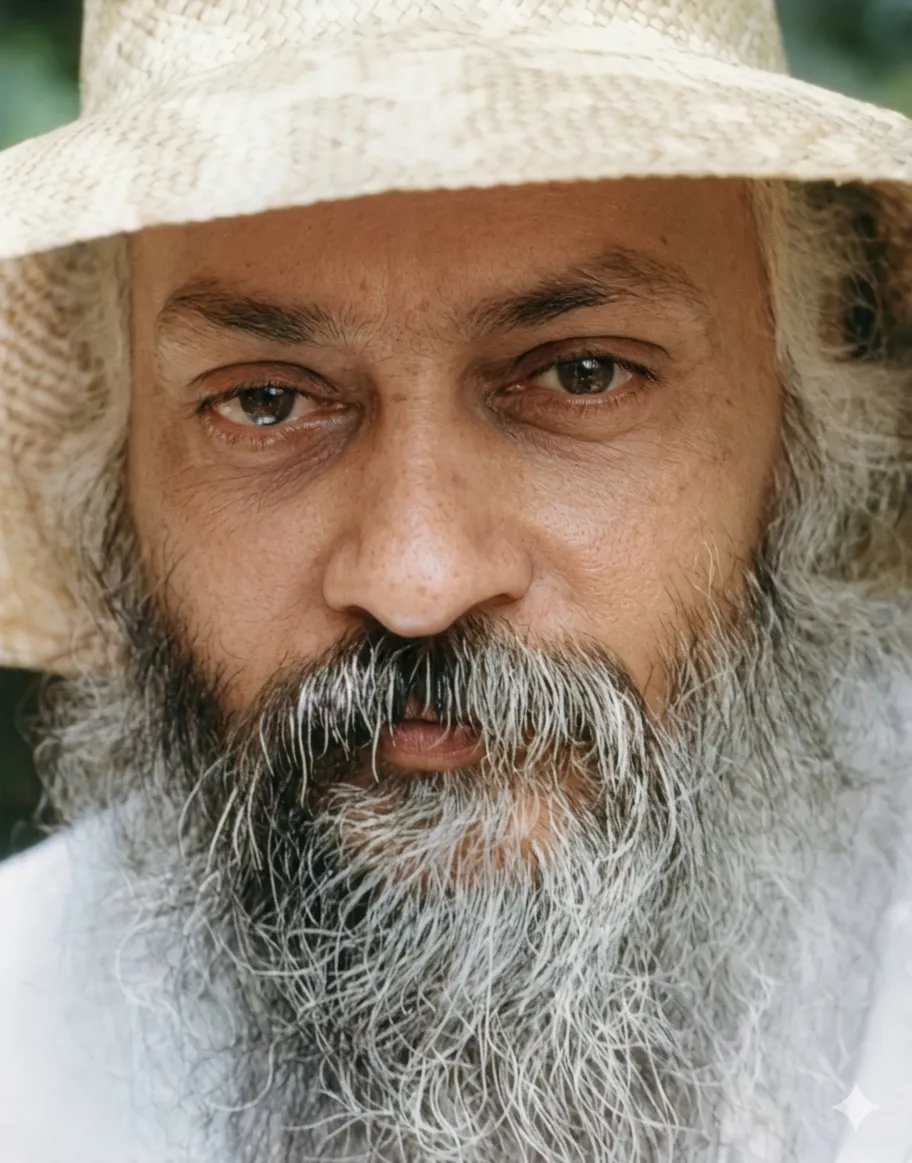
Don’t follow the noisy thoughts you learned; get very quiet inside until a gentle, wordless pull appears, and let that guide you.
From the Discourses
Passages where Osho speaks to this question — each links to the complete discourse.
What do you mean by saying to us, "listen to your inner voice and act accordingly," knowing well that we have only the voice of the mind? Does emptiness have any voice?
Yes. Emptiness has its own voice. Literally, it is not a voice; it is an urge. It is not a sound, it is silence. Nobody says something to do; you simply feel like doing. Listening to the inner voice means leaving everything to the inner emptiness. Then it guides you. You always move right if you move empty. If you have the inner emptiness nothing will be wrong, nothing can go wrong. In emptiness nothing ever goes wrong -- that is the very criterion of being right, always right. Yes, emptiness has its own voice, silence has its own music, no-movements has its own dance; but you will have to reach to it. I'm not saying listen to the mind. In fact mind is not yours. When I say, "Listen to your voice," I mean drop all that society has given to you -- your mind is given by the…
Beloved Osho, how can I find out which of the many voices inside me is the one which comes from the real self to guide me? How can I be sure it doesn't come from the unconscious?
It is very simple: none of the voices come from the inner self. All voices come from the mind. When all voices are absent, the inner self inspires you in silence towards a certain action, direction. It does not come in words -- it is just a silent indication. Otherwise it would have been absolutely impossible to find out which one is the voice of the inner self. It is easy because no voice is of the inner self. So when all voices have died down and there is utter silence, the inner self is capable of taking your hand and moving you. That is the moment to be in a let-go, and allow it to take you wherever it takes you. In language we have to use words which do not apply to the inner reality -- for example, the "inner voice." There is no voice -- it is…
Beloved Osho, how far can one rely on one's 'inner voice'?
The thief said, "But one thing let me say first: don't tell me to stop stealing. Because whenever I go -- and I go to mystics and saints and I am a famous thief around here, so they all know -- they immediately say, 'First you stop stealing,' and that I cannot do. I have tried but that I cannot do, so please don't make that condition. Whatsoever else you say I will do." Nagarjuna said, "Then you could not have yet met a mystic or a saint. You must have been meeting ex-thieves; otherwise, why should one bother about your being a thief? Be a thief! -- that is your business, that is not my worry. Just one thing I would like to tell you, and that is: Go, do whatsoever you feel, but be aware, alert. Don't do anything unconsciously, mechanically, robot-like." The thief said, "This is perfectly…
I am always listening to inner voices. But one voice says one thing and another says just the opposite. What should I do?
There are many people here who go on listening to inner voices. These inner voices are just crap. These are just fragments of your mind; they have no value at all. And sometimes you may think that you are listening to some inner guide or you are listening to some master from the beyond -- Master K H, or some spirit, some Tibetan spirit -- and you can go on imagining these things. And you will be simply be fooling yourself. These are all your fragments. And if you go on following them you will go crazy -- because one part will pull you to the north, another part to the south. You will start falling apart. Remember, this is neurosis -- you have to learn to watch all these voices. Don't trust any. Only trust silence. Don't trust any voice, because all voices are from the mind. And you…
Osho, which is the voice of the mind and which is the voice of the heart? What is the criterion to know? Please explain.
All voices are of the mind; the heart has no voice. Where voices disappear, there is the heart. Silence is the heart’s voice. Emptiness is the heart’s tone. So there is no complication at all. You think one voice is of the heart and another of the mind; you are falling into a great mistake. All voices are of the mind. It is the mind. It is the mind that wants to grasp wealth, and the mind that wants to renounce wealth. The mind is very complex. On one side it says, “Grab it, plunder it, enjoy!” On the other it says, “What’s the point? It’s all insubstantial.” But both are the mind. On one side it says, “Run! Life is only for a few days—win some position.” From the other side it says, “What’s in positions? Look at those who have arrived.” The mind keeps talking to itself, keeps…
पांचवां प्रश्न: ओशो, मन की आवाज कौन-सी है और हृदय की आवाज कौन-सी है? जानने की कसौटी क्या है? कृपया समझाएं।
… तुम सोचते हो, कोई आवाज हृदय की और कोई मन की; तो तुम बड़ी गलती में पड़े जा रहे हो। सब आवाजें मन की हैं। यह मन ही है। धन को भी मन ही पकड़ना चाहता है और धन को मन ही त्यागना चाहता है। मन बड़ा जटिल है। एक तरफ कहता है, पकड़ लो, लूट लो मजे। दूसरी तरफ कहता है क्या रक्खा? सब असार है। पर दोनों मन हैं। एक तरफ कहता है दौड़ लो। चार दिन मिले जिंदगी के, कुछ पा लो पद। दूसरी तरफ से कहता है, क्या रखा है पदों में? जो पहुंच गए उनको तो देखो। …