
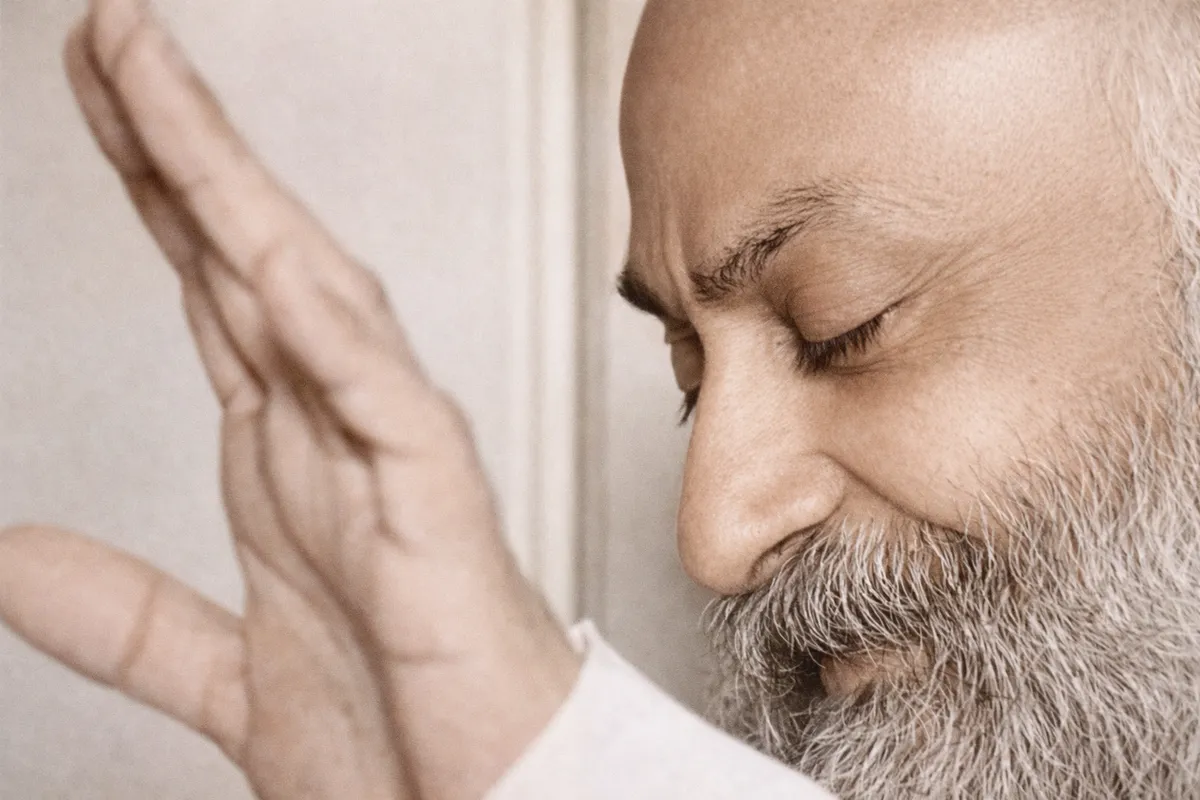
Stop judging or pretending; treat body and spirit as one, and turn everyday life into your practice.
From the Discourses
Passages where Osho speaks to this question — each links to the complete discourse.
Osho, a few months ago in the west I read a book by lama trungpa, entitled "cutting through spiritual materialism", and I got the impression that everything that could be done wrong, I was doing. Then I tried to be more alert, but by voiding one pitfall I was constantly stepping into another, and so on. Now my question is: would you be so kind as to speak about this subject of avoiding spiritual materialism?
Epicurus, Charvakas, Karl Marx, have a certain truth in what they are saying, but it is half-truth. The other half has been told by the so-called spiritualists. The other half is that matter is illusory, that it does not exist at all, it is maya. The real existence is of the soul; matter has to be avoided. What Lama Trungpa is saying is an ancient, very ancient and rotten ideology. He's a Tibetan, and Tibet is the most primitive country in the world, the most rotten -- even more rotten than India. If India is two thousand years rotten, Tibet is five thousand years rotten. It is stinking. He represents that stinking tradition. These so-called spiritualists have been saying the same thing as the materialists. The materialists say, "The soul does not exist, only matter exists." The spiritualists say, "The matter does not exist, only the soul exists." And my…
Where does educating the subconsciousness conflict or harmonise with tao, as it implies discipline with self-effort from an external expression?
Once upon a time, the Duke of Lu went forward to meet a sea bird that had made its appearance in the confines of that country, and escorted it to his ancestral hall. This is a Taoist parable. There, an ox, a sheep and a pig were slaughtered, and a feast was spread before the sea bird, while the band was playing the celebrated music composed under the supervision of the Emperor Shuen. The bird, however, merely looked on, sad and doleful, refusing to relish a morsel of meat or drink a single cup. Thus it died of hunger after three days. The duke fed the bird as he would feed himself, and he failed to see that it should have been treated as a bird and not as a king. The music is meaningless to the bird, and the ox and the sheep and the pig are not his…
You can discover it only, you cannot create it. And that discovery can be helped by Gurdjieff's statement. If you are shaken, and you cannot sleep anymore, knowing that you may not have the soul at all -- because you have not encountered. One thing is certain. You are not aware, so you cannot deny him. You know your mind. You know your body, but you don't know the knower, who knows the mind, who knows the body -- but he is there. Knowing the mind, knowing the body is enough proof that there is a third entity in you, which knows these both. And it is from the very birth. In fact, if you listen to children, in the beginning all the children of all the races use third person for themselves. They don't say, "I am thirsty." They say, "The baby is thirsty.
Beloved Osho, I have just passed a time of deep spirituality, and my life is changed. I understand your work more and more, and with my commune I want to be in more communion with you. I want to know how this is possible.
The revolution that spirituality brings is in a way very simple, but in another way it is very complex too. And you have to understand both sides, the simplicity of it and the complexity of it. A man of spirituality becomes innocent. He is just like a child. He is not childish, but he is as if just born in the world, as if for the first time he has opened his eyes. The colors are more colorful, everything has more a dream quality to it -- even stones are not so hard, they are also alive and with heart. This childlike innocence makes the spiritual person in a deep sense unburdened of all knowledge. He knows nothing. This knowing nothing is not ordinary ignorance. The ordinary ignorance knows something; however ignorant, it always knows something. The ordinary ignorant person knows very little but believes he knows much; he magnifies…
Osho, with reference to the East—and especially India—a question has been pursuing me for a long time: those who once scaled the Gaurishankar of philosophy and reflection, of religion and meditation, how did they, in the course of time, become so broken, degenerate, and impoverished? Osho, please be gracious and shed some light on this question.
The question is meaningful. The East reached great heights—but crippled heights, like a bird that has flown very high with only one wing. How high can it truly go, and how far? Maybe it flutters a bit, rides the winds a little, drags itself some distance—but not for long. Seeing just one wing, you can already say: this bird will fall; its fall is inevitable. Flight happens with two wings. A lame man can walk, but how different that walk is from walking on two sound legs. The lame walk is painful, compelled. One with two healthy legs sometimes runs for no reason, even dances, strolls with nowhere to go. The joy in the meeting of those two legs is complete in itself. Therefore I do not tell my sannyasin to renounce the world. The world has been renounced and the result is clear—those who left it fell badly, flat…
पहला प्रश्न: ओशो, पूरब के और खासकर भारत के संदर्भ में एक प्रश्न बहुत समय से मेरा पीछा कर रहा है। वह यह कि जिन लोगों ने कभी दर्शन और चिंतन के, धर्म और ध्यान के गौरीशंकर को लांघा था, वे ही कालांतर में इतने ध्वस्त, और पतित, और विपन्न कैसे हो गए? ओशो, इस प्रश्न पर कुछ प्रकाश डालने की अनुकंपा करें।
प्रश्न सार्थक है। पूरब ने बड़ी ऊंचाइयां पायीं, लेकिन ऊंचाइयां अपंग थीं। जैसे कोई पक्षी एक ही पंख से आकाश में बहुत ऊपर उड़ गया। कितने ऊपर जा सकेगा? और कितनी दूर जा सकेगा एक ही पंख से? शायद थोड़ा तड़फ ले। थोड़ा हवाओं के रुख पर चढ़ जाए। शायद थोड़ी दूर तक अपने को खींच ले। लेकिन यह ज्यादा देर नहीं होने वाला है। तुम एक पंख देखकर ही कह सकते हो कि यह पक्षी गिरेगा। इसका गिरना अनिवार्य है। उड़ान होती है दो पंखों पर। …