
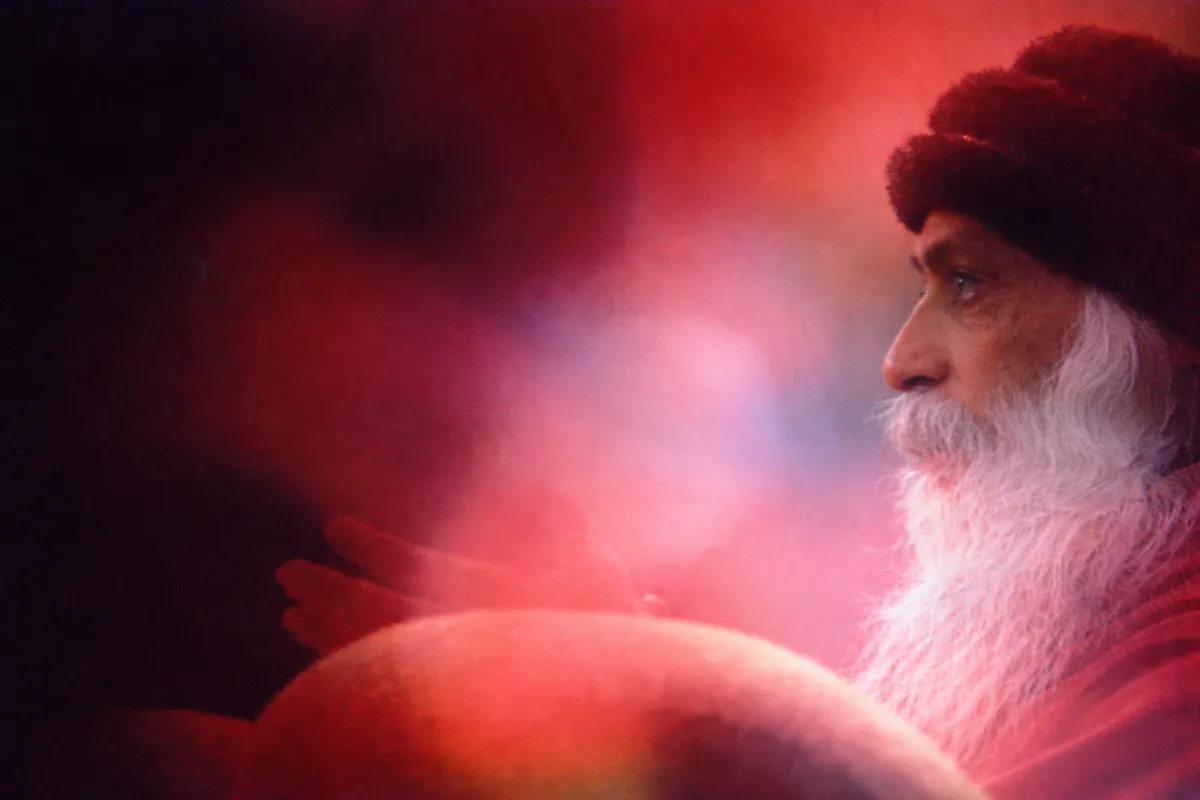
According to Osho, when a deep desire for sannyas arises, it is the heart’s irrational longing—pure joy, a love affair—calling you beyond the mind. It is not a goal or reasoned ambition but a source-oriented pull; mind cannot choose it because sannyas means dropping the mind. Trust the longing itself, without motives, and let sannyas happen from the heart.
That strong wish is your happy heart calling you—don’t overthink it; just follow it without a reason.
From the Discourses
Passages where Osho speaks to this question — each links to the complete discourse.
Sannyas is a quantum leap, a jump into the unknown, a great courage to become discontinuous with your own past. It is a rebirth. It is a change so great... as if the old dies, and dies utterly and totally and the new comes into being from nowhere, from nothingness, out of nothing. If the new comes from the old it remains the old. If the new is continuous with the old then it is only a modification of the old -- maybe a little bit colored and decorated and changed, with a new dress, with a new mask, but it is not a revolution, it is not a conversion. And sannyas to be true has to be a revolution so total that the old identity is simply dropped -- just as the snake slips out of the old skin and never looks back.
Osho, how can I take sannyas? I cannot get jealousy, ego, anger—anything at all—out of my mind. And you keep appearing before me day and night in dreams! What should I do?
Why does jealousy arise? Because someone seems to be getting ahead of you. Someone has bought a better sari, more beautiful jewelry, built a new house, gathered more money in a safe. Jealousy is born because your ego is bruised. A fire flares up inside, smoke begins to rise. You climb onto your own funeral pyre. Anxiety is born inside you. Anger means someone blocks your ego. You set out on a journey of conquest and someone stands in your way, a stone falls in your path because of someone, someone shoves you aside—someone becomes an obstacle. Anger erupts. Anger and jealousy are not very different—two sides of the same coin. Anger is a bit crude; jealousy a bit more civilized. I have heard a Rajasthani tale. A proud Rajput, full of swagger, would twirl his moustache all day long. His arrogance was such that he never allowed anyone else…
Question: First question: Osho, I want to take sannyas; when should I take it? And you ask, “I want to take sannyas; when should I take it?” Don’t ask “when” at all. Let me tell you a small story. In South India there was an extraordinary sannyasin named Sadasiva Swami. He was living in his master’s ashram, young then, not yet a renunciate. He had gone to learn wisdom. Often it happens that you go to learn knowledge and you return having learned sannyas. That is what a master is: you go for one thing, and he hands you something else. People go to get their questions answered, and the master solves them instead. People go to become a little more informed, a little more scholarly, and passing through the alchemy of the master they do not remain what they were; they return new.
Osho, the feeling for sannyas arises, and then the mind runs away. I can’t decide whether to take sannyas or not! Because it feels as if I’d be deceiving myself. It seems to me that I am not worthy of taking sannyas.
Three years passed. He thought and thought, listing hundreds of reasons pro and con: If I marry, these gains, these losses; if I don’t, these gains, these losses. In the end he found one extra gain in marrying—experience. And one loss in not marrying—no experience. The pan tilted. After three years he knocked on her door. Her father opened it. Kant said, “I have finally decided—one reason more on this side; I will marry.” The father laughed. “Too late. My daughter is married—and already has a child. You came far too late. Think again. And if someone else proposes, have your decision ready beforehand; don’t take so long.” He never married—no one else proposed. If you live by thinking, you’ll end up trivial. The vast requires a leap, not thinking. It requires courage—the gambler’s heart, not a shopkeeper’s book-keeping. Jamuna Singh, if you want to take it, take it. If…
It is asked: “I haven’t met you personally yet, and still I am filled with strange feelings toward you. Sometimes I cry; sometimes I just keep gazing at you.”
The friend who has asked—this is a new, fresh contact. New experiences are rising in it. Before these experiences lose their meaning, before these waves become inert, before you slowly accept even these waves and they, too, grow old—take the leap. “Sometimes I cry; sometimes I just keep gazing at you.” Tears are a sign that the connection is being made through the heart. If it were made through the intellect, tears would never come. If the connection is through the head, at most one nods: “Right”; or if not, one shakes the head: “Wrong.” Only the skull nods a little. Tears have nothing to do with the head. Tears flow from the eyes—but they come from the heart, from the innermost core. Tears are more meaningful—than doctrines, ideas, sects. Tears are more meaningful. Tears bring the news that the heart has been struck, something within has trembled. Before the…