
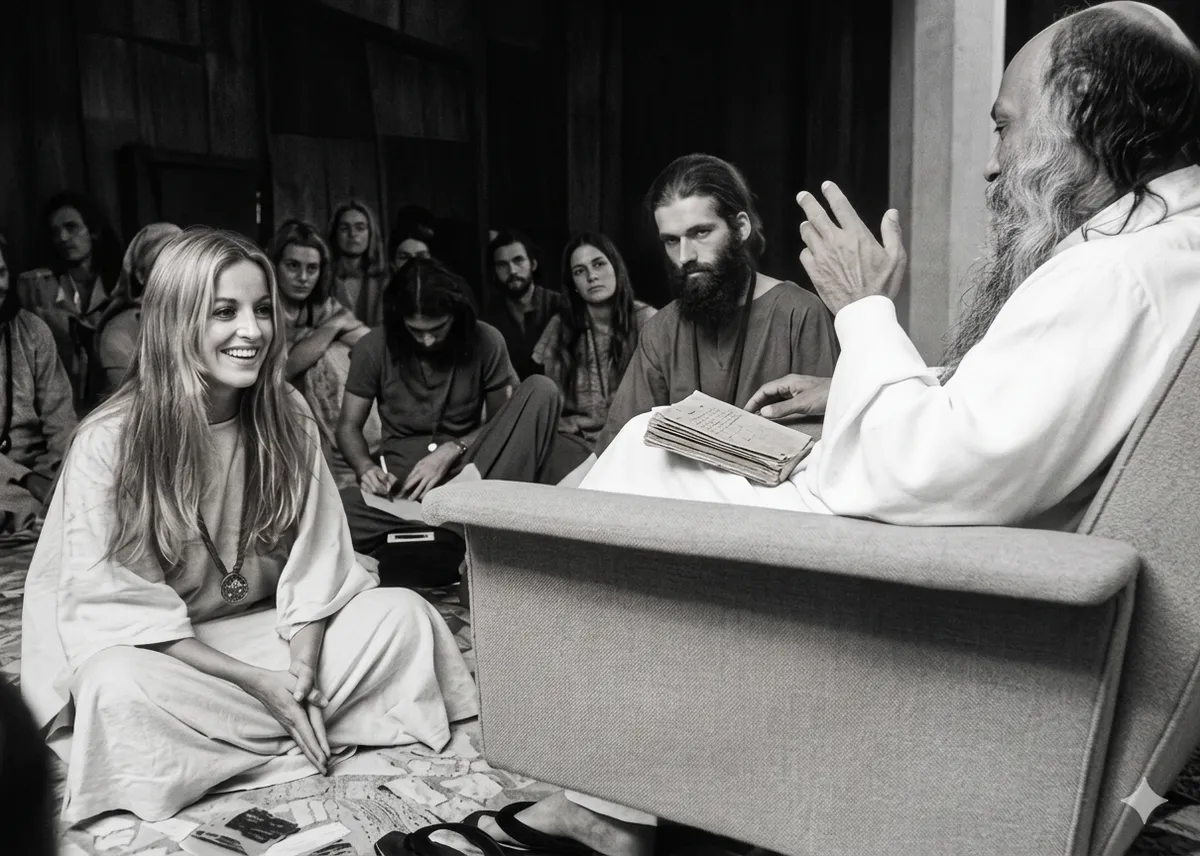
Saffron clothes act like a gentle color-filter that cools restless, sexual energy to support calmness, but the real peace must come from within.
From the Discourses
Passages where Osho speaks to this question — each links to the complete discourse.
Osho, what does it mean to wear saffron clothes?
Clothes do not make one a sannyasin—but a sannyasin too has his own kind of clothes. Clothes do not make one a sannyasin, yet a sannyasin may have his own robes. Clothes are a very ordinary thing, but not utterly meaningless. What you wear has many meanings. Why you wear it also has many meanings. One man wears loose clothes. Wearing loose clothes in itself makes no difference, but why does a person choose loose clothes? And why does another choose tight clothes? These are indicators of the person. If a man is very calm, he will not like tight clothes. A taste for tight clothes hints that the person may be quarrelsome, restless, aggressive, sensual. Loose clothes are not suitable for fighting. That is why you cannot dress a soldier in loose clothes; you can dress only a monk in them. A soldier should wear tight clothes—the work is…
ओशो, भगवे कपड़े पहनने का क्या मतलब होता है?
कपड़े पहनने से कोई संन्यासी नहीं होता, लेकिन संन्यासी भी अपने ढंग के कपड़े पहनता है। कपड़े पहनने से कोई संन्यासी नहीं होता, लेकिन संन्यासी के अपने कपड़े हो सकते हैं। कपड़े बड़ी साधारण चीज हैं, लेकिन एकदम व्यर्थ चीज नहीं हैं। आप क्या पहनते हैं, इसके बहुत से अर्थ हैं। आप क्यों पहनते हैं, इसके भी बहुत से अर्थ हैं। एक आदमी ढीले-ढाले कपड़े पहनता है। ढीले-ढाले कपड़े पहनने से कुछ फर्क नहीं पड़ता, लेकिन एक आदमी ढीले-ढाले कपड़े क्यों चुनता है? और एक आदमी चुस्त कपड़े क्यों चुनता है? ये उस आदमी के सूचक होते हैं। अगर आदमी बहुत शांत है तो चुस्त कपड़े पसंद नहीं करेगा। चुस्त कपड़े की पसंदगी इस बात की खबर देती है कि आदमी झगड़ालू हो सकता है, अशांत हो सकता है, उपद्रवी हो सकता है, कामुक हो सकता है। लड़ने के लिए ढीले कपड़े ठीक नहीं पड़ते। इसलिए सैनिक को हम ढीले कपड़े नहीं पहना सकते। सिर्फ साधु को पहना सकते हैं। सैनिक को चुस्त कपड़े ही पहनने चाहिए, काम चुस्त कपड़े का है। …
Questioner: what is the meaning of wearing orange clothes as a sannyasin?
It is not accidental that a book on sexology like the KAMASUTRA was not written in a country with a cold climate. It is the same with TALES OF THE ARABIAN NIGHTS; it is the product of a tropical climate. People living in tropical climates are more sexual because of the sun. Therefore people who were working on sannyas from many directions thought that sexuality could be calmed if the red color were kept away from sannyasins' bodies -- hence ochre was selected. You can ask why ochre was selected and not red. Pure red could well have been selected; it would have been more effective in calming sexuality. But there was a difficulty in choosing red, true out-and-out red; it would have totally prevented red from entering the body. But the body needs some amount of red rays to keep fit, so it would have been bad for the…
Question: at first sight, sannyas appears to be something that limits one's activities. Why does one have to change one's clothes to red? Why should one have to change his appearance, since sannyas is something that is within rather than without?
Gurdjieff used to say a very meaningful thing: that as you are now, you have no soul. He was both right and wrong. You have a soul, but you do not know about it. You are the outside, and so clothes are very meaningful. Because of clothes a person becomes beautiful and because of clothes a person becomes ugly. Because of clothes he becomes respected; because of clothes he is not respected. A judge has to wear certain clothes -- a supreme court justice has to use a particular robe -- and no one asks why. With that robe he is a supreme court justice; without that robe he is no one. This is how man is. When I look at a man he is more his clothes than his mind. And this is as it should be, because we belong to the body, we are identified with the body.…
I wonder about colors. No beginning, no end, but emptiness. What about orange, the color of the sun, and the sannyasins?
SANNYAS is the ultimate game -- the last, the final. Beyond it there is no game. It had to be very colorful. The householder, the grihasth, plays a game but it is in black and white. Poor. A sannyasin is playing a game but not in black and white. It is colorful. A sannyasin has to become a rainbow because the moment you know that everything is empty everything becomes possible; because that emptiness has in it all. To me, sannyas is not renunciation against indulgence. No. It is renunciation in indulgence. sannyas is not leaving the world; it is living in the world as if you are out of it -- it is an 'as if' phenomenon. You live in the world but you are not in it; you move in the world, but never, never, do you take a single step in it; you remain in the world…
Osho, your thoughts against rigid traditions seem very good and inspiring. But in your effort to bind people with the mala and saffron clothes, we sense the smell of tradition. It seems to us that behind accepting the address “Bhagwan” and giving the mala and saffron-colored clothes, there is a desire in you to be a pir-prophet or an avataric being. This may be entirely my delusion. Kindly dispel it!
And the question is not whether something is traditional. Life does not manifest all at once. Everything is connected, linked in a chain. The Ganga you encounter at Prayag has been flowing from Gangotri. It is not the same Ganga—and yet it is the same. Keep both facts in mind. Much that is new has entered it, yet the beginning, the source, is old. So my sannyas is ancient of the ancient, and newest of the new. Therefore I have chosen the oldest color for it, and the newest way for it. This is my choice. If it pleases you, fine; if it doesn’t, you are free to leave it. You ask about “accepting the address ‘Bhagwan’...” I have not accepted anyone’s address; this is my declaration. It is not anyone’s title. It is my declaration that every person is a Bhagwan, a God. So do you think I should…
पहला प्रश्न: ओशो, बंधी परंपराओं के विरुद्ध आपके विचार बहुत अच्छे व प्रेरणादायी लगते हैं। किंतु माला और भगवे कपड़े में बांधने के आपके प्रयास में हमें परंपरा की बू मालूम पड़ती है। हमें लगता है कि भगवान का संबोधन स्वीकार करने और माला तथा भगवे रंग के कपड़ों को देने के पीछे आपकी एक पीर-पैगंबर या अवतारी पुरुष होने की वासना छिपी हुई है। यह मेरा नितांत भ्रम भी हो सकता है। कृपा करके इसका निवारण करें!
और सवाल इसका नहीं है कि क्या परंपरागत है। क्योंकि जीवन कोई एकदम से थोड़े ही आविर्भूत होता है। सारी चीजें संबद्ध हैं, श्र्ृंखलाबद्ध हैं। जो गंगा तुम प्रयाग में पाते हो, वह गंगोत्री से चल रही है। वही गंगा नहीं है, लेकिन फिर भी वही है। दोनों बातें ध्यान में रखना। बहुत कुछ नया आ गया है उसमें, लेकिन शुरुआत, प्रारंभ, स्रोत तो पुराना ही है। तो मेरा संन्यास प्राचीन से प्राचीन है और नवीन से नवीन। इसलिए मैंने पुराने से पुराना रंग चुना है उसके लिए और नये से नया ढंग चुना है उसके लिए। यह मेरा चुनाव है। तुम्हें प्रीतिकर लगे, ठीक; तुम्हें प्रीतिकर न लगे, तुम छोड़ने को मुक्त। तुम पूछते हो कि ‘भगवान का संबोधन स्वीकार करने...’ मैंने किसी का संबोधन स्वीकार नहीं किया; यह मेरी घोषणा है। यह किसी का संबोधन नहीं है। यह मेरी घोषणा है कि प्रत्येक व्यक्ति भगवान है। तो क्या तुम सोचते हो, सिर्फ मैं अपने को अपवाद मान लूं कि मुझे छोड़ कर सब व्यक्ति भगवान हैं? भगवत्ता प्रत्येक व्यक्ति के भीतर छिपी है, यह मेरी उदघोषणा है। …