
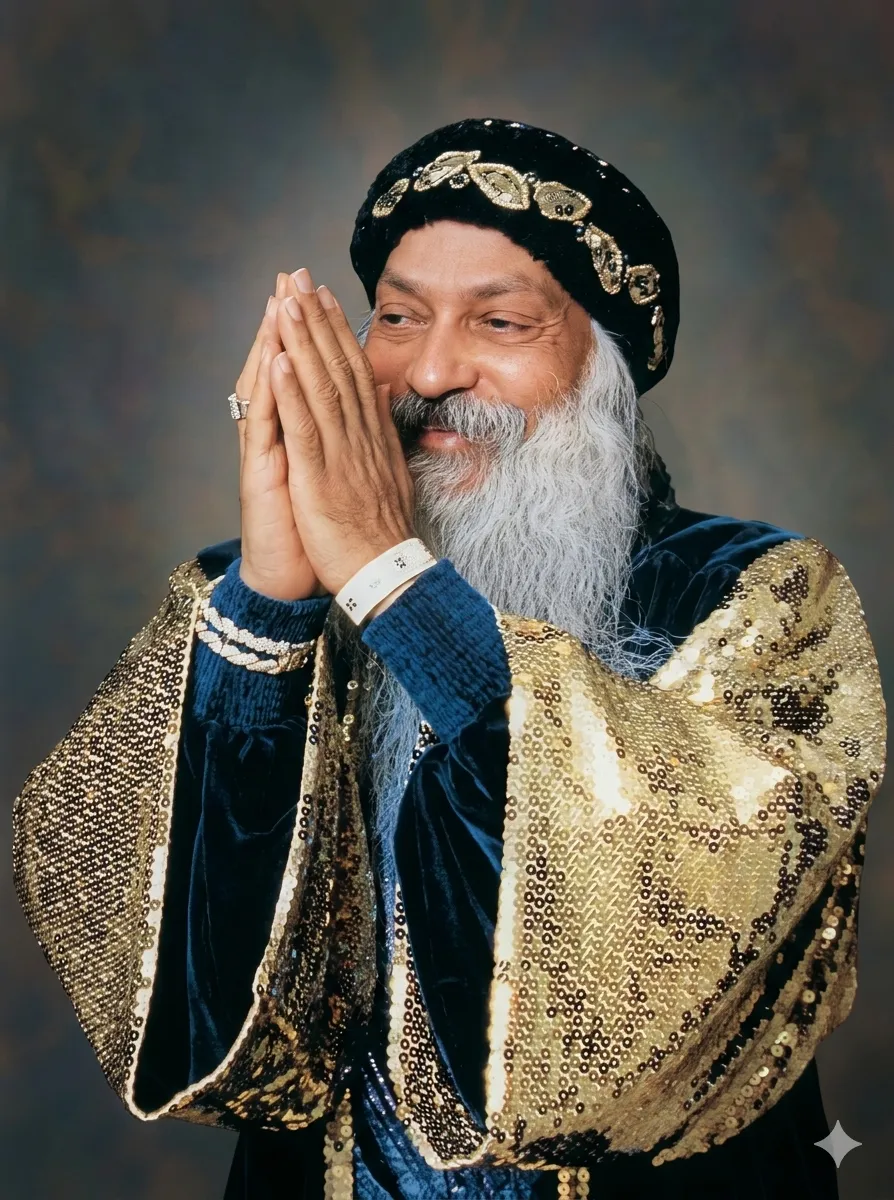
You can’t see it from outside; when it happens you just know—your old self falls away, you feel newly born, and the sound is everywhere, not coming from you.
From the Discourses
Passages where Osho speaks to this question — each links to the complete discourse.
Osho, what are the characteristics and indications that show whether one has reached the authentic and real cosmic sound aum?
It is a difficult question -- difficult because the happening is always inside, in a way private. And you cannot know of it or about it from the outside. You can never decide from the outside whether someone has achieved the cosmic sound AUM. The deeper you go, the more private is the happening. The public world from where you can decide is just outside. So how to decide whether one has achieved the cosmic sound, whether one has gone to the deepest ground, has known? You cannot decide it from the outside; that is one thing. Of course, many things which can be known from the outside will begin to happen through the person who has reached. But still. the feeling that he has reached the cosmic ground will just be an inference -- an inference from his behaviour. And behaviour can be false; behaviour can be imitated. Buddha…
Question: MANDUKYOPANISHAD SANTI-PATHAH OM BHADRAM KARNEBHIH SRNUYAMA DEVAH STHIRAIR ANGAIS TUSTUVAMSAS TANUBHIR VYASEMA DEVA-HITAM YAD AYUH SVASTI NA INDRO VRIDDHASRAVAH SVASTI NAH PUSA VISVAVEDAH SVASTI NASTAKRSYO ARISTANEMIH SVASTI NO VRHASPATIRDADHATU OM SANTIH SANTIH SANTIH OM ITYETAD AKSARAM, IDAM SARVAM TASYOPAVYAKHYANAM, BHUTAM BHAVAD BHAVISYAD ITI, SARVAM ONKARA EVA. YAC CANYAT TRIKALATITAM TAD APYOMKARA EVA. SARVAM HYETAD BRAHMA, AYAM ATMA BRAHMA AUM, THE IMPERISHABLE SOUND, IS THE SEED OF ALL THAT EXISTS. THE PAST, THE PRESENT, THE FUTURE, -- ALL ARE BUT THE UNFOLDING OF AUM. AND WHATEVER TRANSCENDS THE THREE REALMS OF TIME, THAT INDEED IS THE FLOWING OF AUM. THIS WHOLE CREATION IS ULTIMATELY BRAHMAN. AND THE SELF, THIS ALSO IS BRAHMAN. AUM PURNAMADAH PURNAMIDAM PURNAT PURNAMUDACHYATE PURNASYA PURNAMADAYA PURNAMEVA VASHISYATE. ... All the Upanishads begin with AUM; AUM means the primordial sound.
In doing sadhana on aum, is it better to repeat it like a mantra or to try to hear it as an inner sound?
And the third step is when the mind feels saturated. And you will come to know it when this happens; there is no need to ask how one will feel it. It is just like eating: you feel, "Now, enough" The mind will feel when it is enough. Then you start the third step. The third is: neither body has to be used nor mind has to be used. As you lock the body, now you lock the mind. And it is easy. When you have been doing the chanting for three, four months, it is very easy: you simply lock the body, you simply lock the mind. Just listen, and you will hear a sound coming to you from your own heart of hearts. The Aum will be there as if somebody else is chanting; you are just the listener. This is the third step, and this third step…
Aum tasya nishchintanam dhyanam aum meditation is the constant contemplation of that.
First, the Upanishads know that human consciousness has five steps. We know the three gross ones -- the waking, the dreaming and the sleep. These are three gross -- A-U-M. The Upanishads call the fourth turiya. They have not named it because it is not gross. The fourth is that in which one becomes aware of deep sleep also. If you have been deep in sleep, in a deep dreamless sleep, if in the morning you can say, "I have been in a deep, deep sleep," then someone in you has been aware and remembers somehow that there has been a very deep, dreamless sleep -- but a witness was there. That witness is known as the fourth. But the Upanishads say that even the fourth is not the ultimate, because to be a witness is still to be separate. So when the witness also dissolves, if only the Existence…
Om is the fundamental sound of Sanskrit. In Om, all the sounds of Sanskrit are included. Om is made of A, U, and M—the joining of three sounds: A, U, M. These are the three primal vowels; the rest of language is born from them. All words are then constructed of these. Om is the root; A, U, M are its three branches; and from these three branches the whole web of sound and the birth of all words happens. The Jews would call Om the Logos; Christians would call it the Word. This sutra concerns this Om. Understand this sutra well. For those who would enter within can very easily do so with the support of this sound—because it is resonating within. Every moment this sound is echoing inside. This sound is your very life-breath. If this sound disappears within, you disappear.
… ओम बना है अ, उ और म--तीन ध्वनियों के जोड़ से। ए, यू, एम। ये तीन मूल स्वर हैं। बाकी सारी भाषा इन्हीं से पैदा होती है। सारे शब्द फिर इनसे ही निर्मित होते हैं। ओम मूल है, अ, उ, म उसकी तीन शाखाएं हैं। और फिर इन तीन शाखाओं से सारी ध्वनि का जाल और सारे शब्दों का जन्म होता है। ओम को लोगोस कहेंगे यहूदियों की भाषा में; शब्द कहेंगे ईसाइयों की भाषा में। इस ओम के संबंध में यह सूत्र है। और इस सूत्र को बहुत ठीक से समझ लेना। क्योंकि भीतर जिन्हें प्रवेश करना है, वे इस ध्वनि के सहारे बड़े आसानी से भीतर प्रवेश कर सकते हैं। क्योंकि यह ध्वनि भीतर निनादित हो रही है। प्रतिक्षण यह ध्वनि भीतर गूंज रही है। यह ध्वनि ही आपका प्राण है। …