
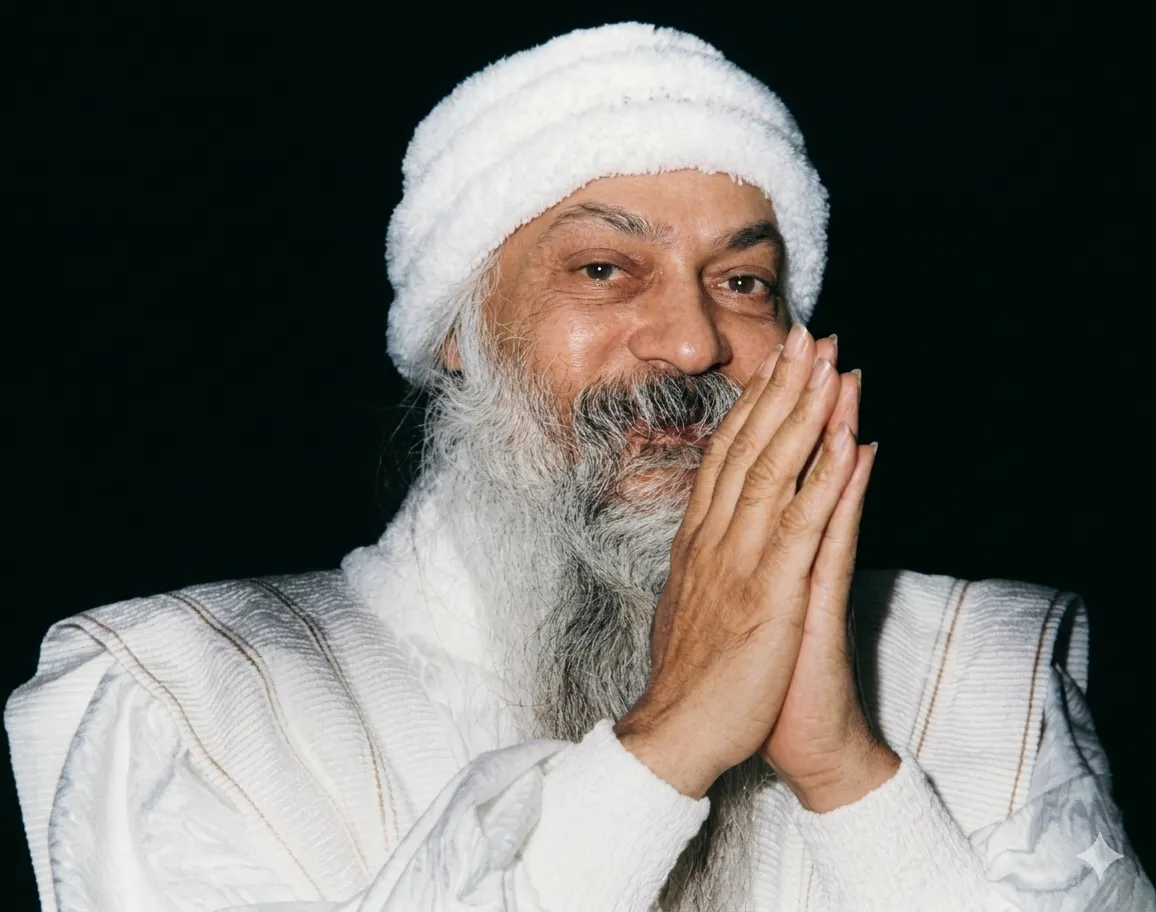
According to Osho, be a Taoist psychotherapist by remaining natural, silent, and at ease, even amid a Confucian, rule-bound institution. Expect friction—it's birth-pain, not failure. Taoism needs no outer conditions: carry a non-tense, respectful presence. Drop labels like 'mad'; see people as simply different. Your unhurried, nonjudgmental being becomes the therapy, inviting patients toward alertness, while you refuse to be colonized by institutional tension.
Stay calm and kind no matter the rules, see patients as different not broken, and let your quiet presence help them heal.
From the Discourses
Passages where Osho speaks to this question — each links to the complete discourse.
How to be a taoist psychotherapist within a very confucius-oriented mental institution? In other words, how to be a nut-healer instead of a nut-cracker?
Now this has to be understood: when a person goes mad it simply shows that he was the weakest link in the group in which he used to live -- for example, in a family. If the family is neurotic -- as families are -- then the person who is the weakest in the family will become neurotic. And through that person the whole neurosis of the family will start flowing. He will become the scapegoat. He may be weaker, he may be more fragile, he may be more sensitive than the others. He may be of a softer heart and a softer build. So the whole neurosis of the family will start flowing through him and the whole family will start calling him mad. And they will start thinking about taking him to the psychiatrist, to the institution. And he was helpful, he was a safety valve for the…
Can one believe in tao, not interfering with other people's lives, accepting what is now, and by profession be a psychotherapist? What, or how, is a tao way of doing therapy?
It is from Poonam. It is of tremendous significance. The first thing: 'Can one believe in Tao...?' Tao does not depend on belief. You cannot believe in it. Tao knows no belief system. It does not say 'Believe.' That's what other religions do. Tao is the dropping of all belief systems. Then arises a totally new kind of trust -- trust in life. Belief means believing in concepts. Concepts are ABOUT life. Trust is not concerned with concepts. Trust is immediate, direct, in life; it is not about life. Belief is far away from life. The stronger the belief, the greater the barrier. Tao is neither a belief nor a disbelief but the dropping of all beliefs and disbeliefs. When you drop all beliefs and disbeliefs and you are immediate, in contact with life, a trust arises, a great 'yes' arises in your being. That 'yes' transforms, transforms totally. So…
Whenever we are pushing, trying to prove something, trying to get something, trying to fight for something, trying to struggle, whenever there is some kind of will, we are against tao. Tao is will-lessness: just going with the current wherever it is going, moving with the river.... [Osho suggests some groups to the new sannyasin who assisted therapy groups in the west. She says: I have this idea about therapy -- I don't want therapy... but I'll do them.] Mm mm, it is not therapy, because you are not a patient and it is not therapy. The word is ugly... but this is a necessary evil with language: whatsoever word we use it is never true to the fact. Now, therapy is ugly. It presupposes that somebody is abnormal, ill, diseased, that somebody is not in the right shape, that somebody is a case, somebody is mental or something.
The venerable master said:
THE UNFOLDMENT OF MAN'S MIND LEADS HIM TO THIS UNCHANGING TRUTH. IN UNCHANGING STILLNESS, UNCHANGING PURITY AND REST ARE FOUND. HE WHO ATTAINS PURITY AND STILLNESS ENTERS INTO THE IMMUTABLE TAO. HAVING ENTERED INTO THE IMMUTABLE TAO HE IS NAMED THE POSSESSOR OF TAO. ALTHOUGH HE IS NAMED THE POSSESSOR OF TAO HE KNOWS THAT HE DOES NOT POSSESS IT. ONLY WHEN HE CAN TRANSMUTE ALL LIVING THINGS CAN HE BE TRULY NAMED THE POSSESSOR OF TAO. HE WHO IS ABLE TO UNDERSTAND THIS CAN LEAD OTHERS TO SACRED TAO. ... After a while he heads for the roulette table where he resumes his winning streak. Soon a crowd gathers to watch him rake it in while knocking back double bourbons. Eventually he wins so much money that he and the crowd move off to a penthouse suite to continue the party. The next day he wakes up with a splitting
And one has to be very alert about what one is saying. Sometimes say 'no' -- I'm not saying to always say 'yes'. If you always say 'yes', you will be dead. Then you don't have any stamina in you, you won't have spine. Many times say 'no', but don't get addicted to 'no'. Sometimes say 'yes' too. And make a balance. Then your parents will also uriderstand. This was my situation with my parents. They knew well that if I say 'yes', I mean 'yes'; if I say 'no', I mean 'no'. Once my father said to me, 'Do you say "yes" and "no" in a very mathematical way? Because sometimes you suddenly say "yes", and we were not expecting it. And sometimes you say "no", and we were not expecting it. How do you manage when to say "no" and when to say "yes" ?