
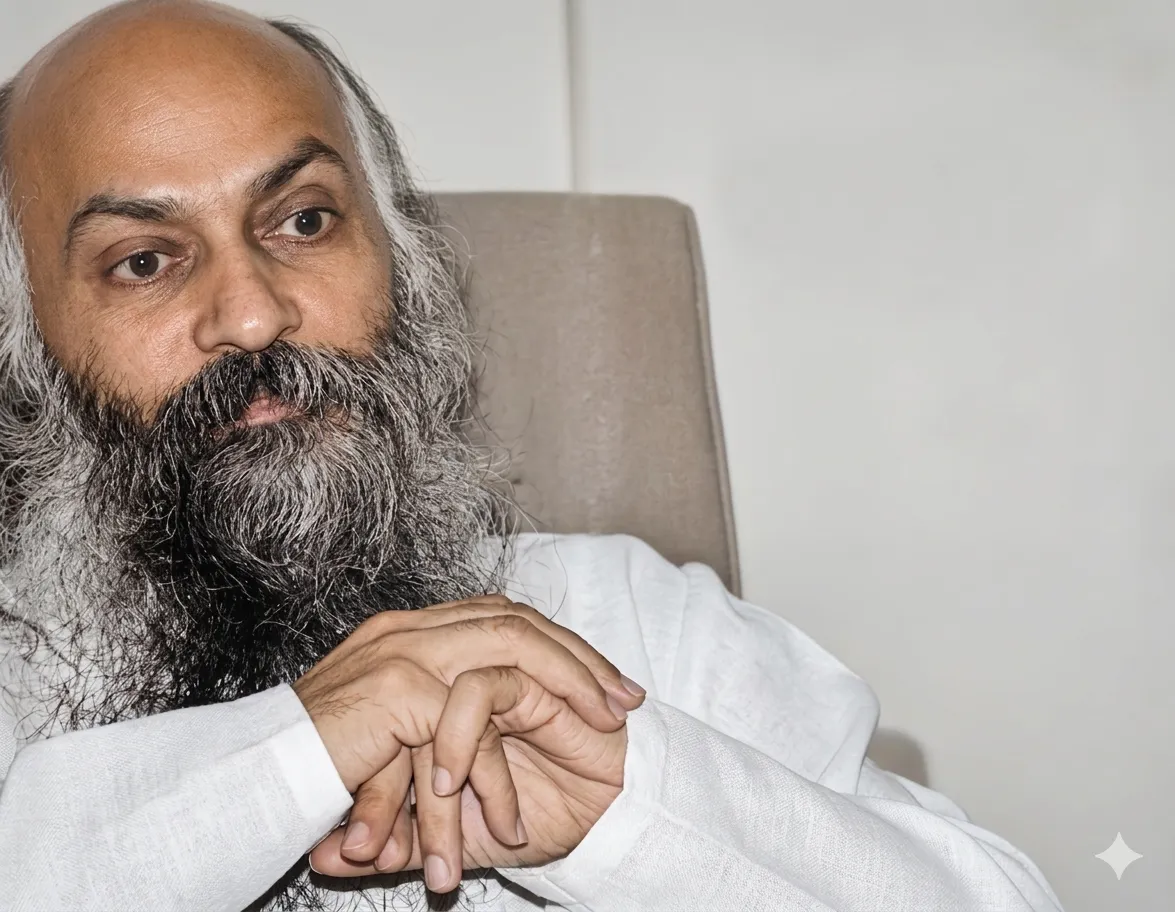
Quietly watch your thoughts; small silent pauses appear and, with patience, they join together until only silence remains.
From the Discourses
Passages where Osho speaks to this question — each links to the complete discourse.
Beloved Osho, how does watching lead to no-mind? I am more and more able to watch my body, my thoughts and feelings and this feels beautiful. But moments of no thoughts are few and far between. When I hear you saying "meditation is witnessing," I feel I understand. But when you talk about no-mind, it doesn't sound easy at all. Would you please comment?
The small child rides on the horse with a servant riding on another horse. A tremendous desire arises in him when the road turns, just to have a look again back to the family house, its garden. The father must be standing there, the mother must be crying... but he remembers that the father has said, "Don't look back." And he does not look back. With tears in his eyes, he turns with the road. Now he cannot see his house anymore and one never knows how long it will take -- perhaps years and years -- until he will be able to see his father and mother and his family again. He reaches the monastery. At the gate of the monastery the abbot meets him, receives him gracefully, as if he is a grownup, bows down to him as he bows down to the abbot. And the abbot says,…
Osho said that there was no need to try to still the mind, to stop the thoughts. He said that just as the traffic goes by and one remains on the sidewalk, unaffected, just a watcher, so one should simply witness the thoughts as they went by. We are not our thoughts, and recognising that we are the witness is enough. The very acceptance of the thoughts makes one more relaxed. The relaxation helps to create a distance, to separate oneself. To evaluate a thought as good or bad means that you are attached to your thoughts -- so one should not put labels on them.] ... put yourself aside, sit under a tree, and just watch the traffic. Soon, one day, the traffic disappears and the road is empty. Suddenly there is an interval and in that interval is meditation. But that interval cannot be created or cultivated.
Osho, last night you said that the mind cannot do two things together -- that is, thinking and witnessing. It seems then that witnessing is a mental faculty and an act of the mind. Is it so? Please explain. Is there anything like partial witnessing and total witnessing?
WITNESSING is not a mental activity; thinking is a mental activity. Rather, it would be better to say that thinking is mind. When the mind is not, when the mind is absent, when the mind has disappeared, only then do you have witnessing. It is something behind the mind. Zen Buddhism uses mind in two ways: the ordinary mind means thinking; then Mind with a capital "M" means the Mind behind thinking. Consciousness is behind the mind; consciousness comes through the mind. If mind is in a state of thinking, it becomes opaque, non-transparent, just like a clouded sky -- you cannot see the sky. When the clouds are not, you can see the sky. When thinking is not there, then you can feel the witnessing. It is the pure sky behind. So when I said that you cannot do two things, I meant either you can think or you…
Osho, can the ultimate state not be attained through continuous witnessing and without meditation? And when only witnessing remains, how does one become free of that too?
Begin with action—and go to non-action. Begin with meditation—and go to samadhi. Start in shallow waters, then slowly go deeper… then into the bottomless depths. Do not hurry. Gently, step by step… But you seem to be in a hurry. The question is quite extraordinary: “Can the ultimate state be attained through continuous witnessing and without meditation?” And then: “And when only witnessing remains, how to be free of that too?” You are in a great rush! Witnessing has not happened yet. Meditation has not happened yet. Meditation hasn’t even begun; theoretically you have adopted the notion: it would be good if witnessing were accomplished—without meditation. If it had happened, you would not be asking. It has not happened. Yet you go further: “If witnessing is accomplished—without meditation—then how to be free of that?” Not such haste. If you leap like this, you will break your hands and feet. The…
दूसरा प्रश्न: ओशो, क्या सतत साक्षीभाव के द्वारा और बिना ध्यान के परम स्थिति को उपलब्ध नहीं हुआ जा सकता है? औैर जब सिर्फ साक्षीभाव रह जाए, तो उससे भी कैसे मुक्त हुआ जाए?
प्रश्न बड़ा अदभुत है: ‘क्या सतत साक्षीभाव के द्वारा और बिना ध्यान के परम स्थिति को उपलब्ध नहीं हुआ जा सकता है?’ और उसके बाद पूछा है कि ‘और जब सिर्फ साक्षीभाव रह जाए, तो उससे भी कैसे मुक्त हुआ जाए?’ बड़ी जल्दी है! अभी साक्षीभाव हुआ भी नहीं। अभी हुआ ध्यान भी नहीं है। अभी ध्यान हुआ नहीं है, सैद्धांतिक रूप से मन में यह खयाल बैठ गया है कि साक्षीभाव सध जाए--बिना ही ध्यान के, तो अच्छा। सध जाता, तो तुम प्रश्न पूछे नहीं होते। सधा नहीं है। मगर आगे जा रही है बात और।
Osho, please explain how I can meditate over something without using my mind.
Meditation has nothing to do with mind; meditation simply means a state of no-mind. The functioning of the mind is the only disturbance in meditation. If you are trying to achieve meditation THROUGH mind you are bound to fail, doomed to fail. You are trying to achieve the impossible. A Zen initiate was meditating for years and whenever he would come to his Master, whatsoever experience he would bring to the Master, the Master would simply reject: "It is all nonsense. You go back and meditate again." One day the Master came to the but of the disciple -- he was sitting in a Buddha posture. The Master shook him and told him, "What are you doing here? If we needed stone Buddhas we have many in the temple! Just by sitting like a stone Buddha you will not attain to meditation. Do what I have been telling you to…