
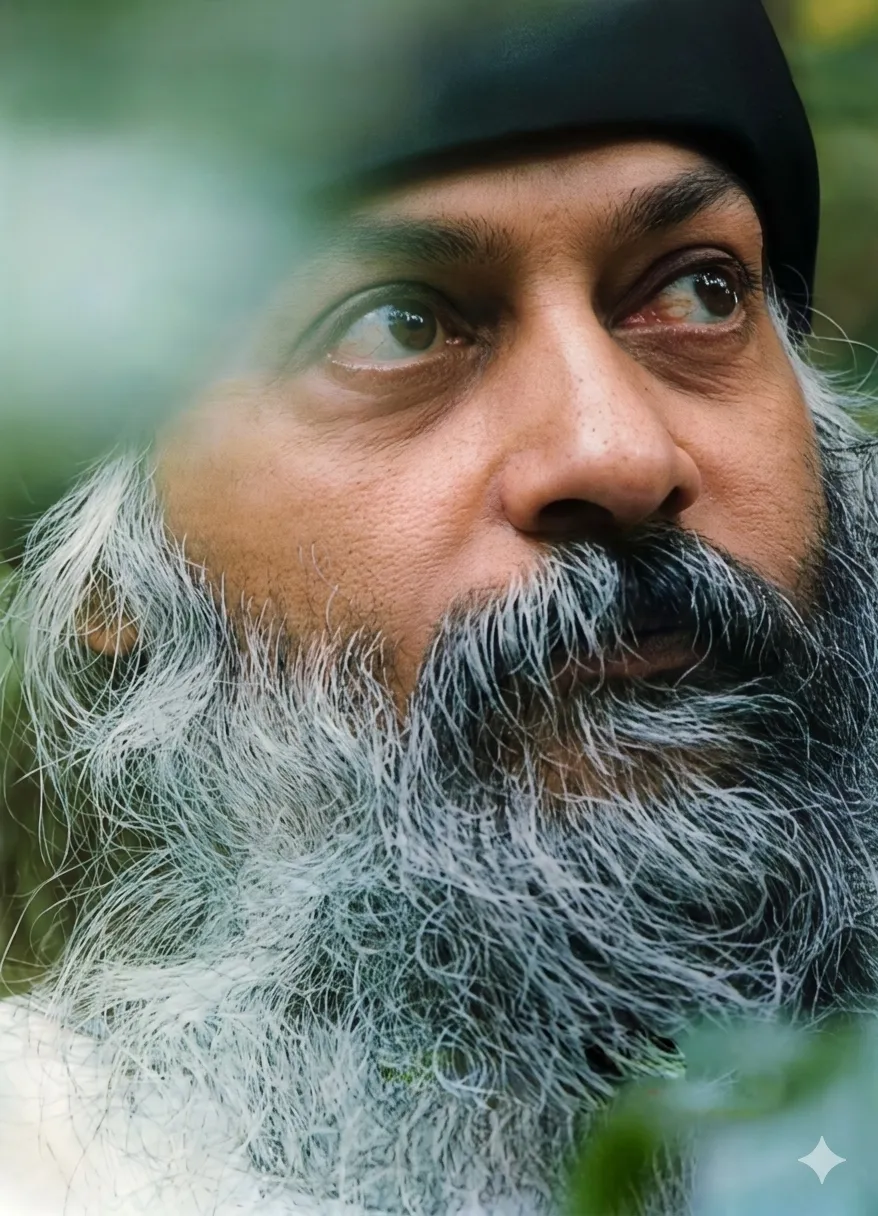
Say the gachchhamis with love and childlike wonder as your own choice to wake up, not as a boring rule.
From the Discourses
Passages where Osho speaks to this question — each links to the complete discourse.
Beloved Osho, would you speak about the significance of the gachchhamis? How can we keep them fresh and alive and prevent them from becoming like the meaningless, stereotyped rituals practiced in other religions?
The first is, buddham sharanam gachchhami: I go to the feet of the awakened one. It does not say, "I go to the feet of Jesus, Mohammed, Mahavira, Gautam Buddha" -- no. Buddham is not Gautam Buddha. Gautam Buddha's original name was Gautam Siddharth. When he became awakened, then Siddharth was dropped and the world has know him since then as Gautam Buddha. "Buddha" is nobody's property. It simply means the sleep is over, you are no longer dreaming, no longer hallucinating; you are simply awake. Reminding yourself, "I go to the feet of the awakened one," is not worshipping, because the awakened one is not any person in particular. There are no feet of the awakened one. It simply says, and reminds you, that you are surrendered to the fact of awakening, that this is your decision, this is your commitment. The second line of the gachchhamis is, sangham…
Beloved master, please speak about the significance of the gachchhamis now that we have dropped rajneeshism.
Gachchhamis have nothing to do with religion. Gachchhamis have something to do with your determination. These are the gachchhamis. It is not a prayer.... "I go to the feet of the awakened one, to his commune, to his truth." This is simply a declaration on your part. The awakened one does not indicate any individual; it simply means all the awakened ones of the past, of the present, of the future. It simply means the quality of being awakened. And you are making yourself remember, "I am dedicated to only one thing: I have to become awakened." ..."To his commune... to his truth." No particular name is mentioned. All the communes of all the awakened ones are implied in it. Of course the truth is the same; whoever has awakened has found the same truth. The gachchhamis are simply a remembrance of your own decision. They are going to remain.…
Beloved Osho, when we are scattered throughout the world, most of us far from you and living in small groups. Then what is the meaning of the second gachchhami: sangham sharanam gachchhami?
Now it has more meaning than it had before. Let me tell you about all the gachchhamis. The first is: Buddham sharanam gachchhami: "I go to the feet of the awakened one." It is an approach of humbleness, openness, non-resistance. Without such an approach no master can function. The disciple has to give way for the master to enter the innermost core of his being. And that's what he is saying: Buddham sharanam gachchhami -- "I go to the feet of the awakened one." He is saying, "I am no more." He is saying, "Now you can do anything you want to do with me. I am absent and I want your presence in me." The second gachchhami is Sangham sharanam gachchhami -- "I go to the feet of the commune of the awakened one." The question has arisen about the second because now the commune in America is no…
Osho, when a seeker receives a ray of light, what should be done to keep it continuous?
So if this morning you felt good in meditation, then remembering it five or ten times during the day will be very important. In this way, that memory will deepen; and by remembering it again and again, it will begin to become part of the mind’s enduring nature. If this question is approached experimentally in this way, there will be benefit—and it should be done. Often man’s mistake is that he remembers what is wrong and does not remember what is auspicious. One of man’s basic errors is to remember what is negative and to forget what is constructive. Rarely do you recall the moments when you were filled with love; rarely the moments when you felt some wondrous sense of well‑being; rarely the moments when you became very quiet. But what you recall daily are the times you were angry, you were restless; when someone insulted you, or when…
ओशो, साधक को प्रकाश की किरण मिले, उसको सतत बनाए रखने के लिए क्या किया जाए?
तो अगर आज सुबह आपको ध्यान में अच्छा लगा हो, तो दिन में दस-पांच बार उसका पुनर्स्मरण बहुत महत्वपूर्ण होगा। उस भांति वह स्मृति गहरी होगी। और बार-बार स्मरण आ जाने से वह चित्त के स्थायी स्वभाव का हिस्सा बनने लगेगी। इसे, यह जो प्रश्न पूछा है, इस भांति अगर इस पर प्रयोग हुआ, तो लाभ होगा। और यह करना चाहिए। अक्सर मनुष्य की भूल यह है कि जो भी गलत है, उसका तो वह स्मरण करता है; और जो भी शुभ है, उसका स्मरण नहीं करता। मनुष्य की बुनियादी भूलों में से एक यह है कि जो भी नकारात्मक है, निगेटिव है, उसका वह स्मरण करता है; और जो भी विधायक है, उसका स्मरण नहीं करता। आपको शायद ही वे क्षण याद आते हों, जब आप प्रेम से भरे हुए थे; शायद ही वे क्षण याद आते हों, जब आपने स्वास्थ्य की कोई बहुत अदभुत अनुभूति की थी; शायद ही वे क्षण याद आते हों, जब आप बहुत शांत हो गए थे। लेकिन आपको वे स्मरण रोज आते हैं, जब आप क्रोधित हुए थे, जब आप अशांत हुए थे; जब किसी ने आपका अपमान किया था, या आपने किसी से बदला लिया था। …
Even Joseph didn't listen to Jesus. The parental ego is strong. They think they know. They have lived, experienced life. What do you know? You are just young; you have to see many things... that idea. So no need to argue with him, no need to be aggressive. Just say very humbly that something has happened to you. Just try to explain what has happened with no arrogance, with no effort to convince him and no effort to convert him. There is no need... there is no need to disturb him. But let him feel your joy... not your philosophy but your joy, which will be of great help. Let him feel your silence. Let him feel that you have changed, that something has started growing in you which was not there before. Let him watch and see and feel.