
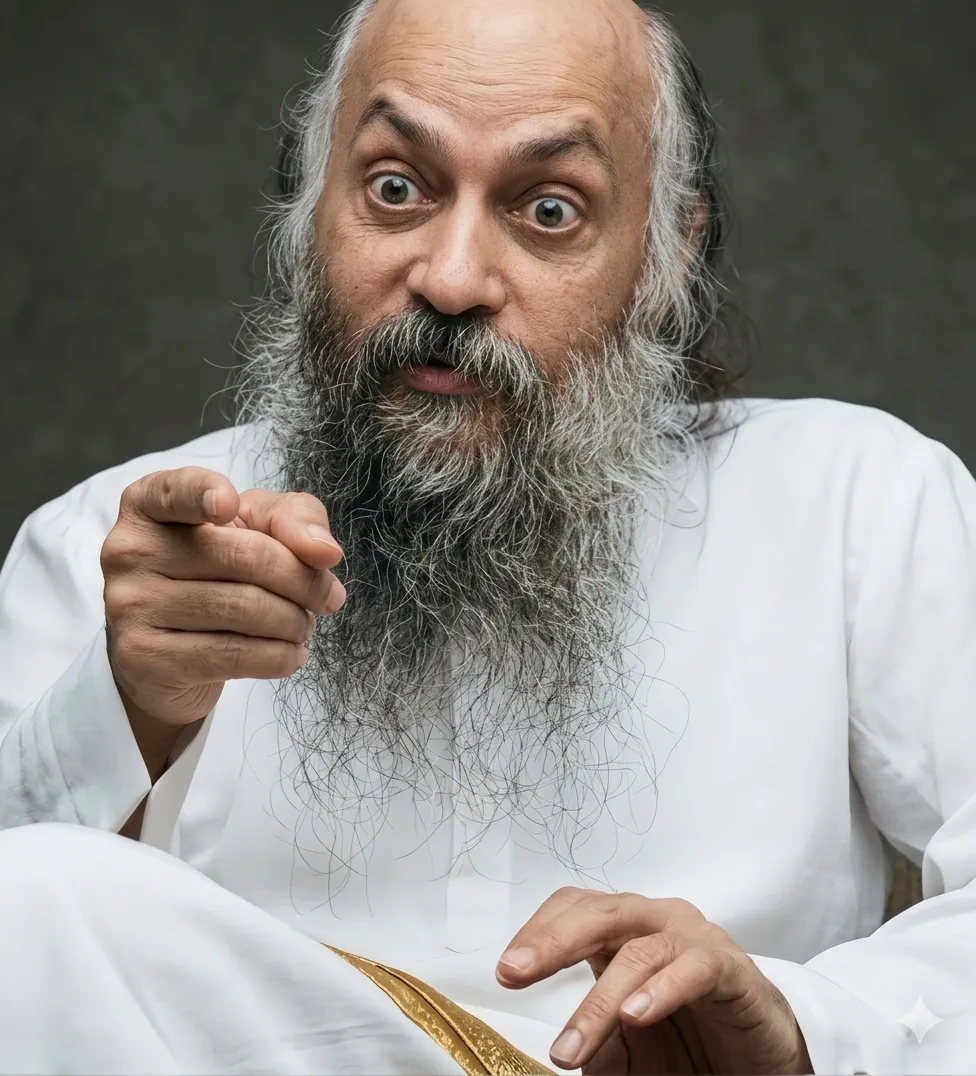
If you feel heavy and sleepy it’s laziness; if you feel bright and full of energy with no rush, it’s nondoing—stay awake and let the next step show itself.
From the Discourses
Passages where Osho speaks to this question — each links to the complete discourse.
How can I tell the difference between 'nondoing' and being lazy... And if 'floating' -- how to make decisions?
IT IS not difficult. Both have different tastes, and very clear-cut, very distinct. When you are lazy, it is a negative taste -- you simply feel you have no energy, you simply feel dull; you simply feel sleepy, you simply feel dead. When you are in a state of nondoing then you are full of energy -- it is a very positive taste. You have full energy, overflowing. You are radiant, bubbling, vibrating. You are not sleepy, you are perfectly aware. You are not dead -- you are tremendously alive. So there is not a problem. You can just check in, and always continue to check. There is a possibility the mind can deceive you: it can rationalize laziness as non-doing. It can say "I have become a Zen master" or "I believe in Tao" -- but you arc not deceiving anybody else. You will be deceiving only yourself. So…
What is the difference between waiting for godot and waiting for god?
It is as if the sun has risen in the morning and you are sitting in your room with closed doors and windows, in darkness. Open the doors, you become available to the sun. The sun was already available -- just the meeting happens. You cannot wait for God. All waiting is for Godot. Godot means the one who never comes, who CANNOT come, whose arrival is impossible. And the only impossible thing is that which has already happened -- how can it happen again? You are alive, and you are waiting for life, Now, this is ridiculous. The real man of religion does not think in terms of God. He thinks in terms of life or, even better, of living -- because life can again become an abstract idea. Living, moment-to-moment living. In that very living, one knows what God is, because one knows who one is. Your idea…
Your energy will awaken only when you become utterly non-doing in this world; when you do not waste even a grain here. There is nothing here worth spending for. There is nothing here worth gaining. What shopping are you busy with? You are only losing. Here is a desert that will drink your energy away. Seal all the leaks. Close all the pores, says Lao Tzu. Close all the doors, so that energy becomes organized. The organization of energy, and a growing accumulation, at a certain point turns into a qualitative change. Quantitative change, at a point, becomes qualitative. There is a limit of quantity where the quality itself changes. Like heating water—the water remains water up to ninety-nine degrees; at one hundred it becomes steam. What is happening? What revolution occurs by adding just one more degree? Only a difference of quantity: from ninety-nine to one hundred.
तुम्हारी ऊर्जा तभी जगेगी जब इस संसार में तुम पूरे निष्क्रिय हो जाओगे; यहां तुम रत्ती भर न गंवाओगे। यहां गंवाने योग्य है ही नहीं। यहां कुछ पाने योग्य नहीं है। तुम किस खरीददारी में लगे हो? तुम सिर्फ खो रहे हो। यहां सिर्फ मरुस्थल है जो तुम्हारी ऊर्जा को पी जाएगा। सब छिद्र रोक दो। बंद करो सब छिद्र, कहता लाओत्से। बंद करो सब द्वार, ताकि होती जाए संगठित ऊर्जा। ऊर्जा का संगठन और ऊर्जा की बढ़ती हुई मात्रा एक जगह जाकर गुणात्मक परिवर्तन हो जाती है। क्वांटिटेटिव चेंज एक जगह जाकर क्वालिटेटिव चेंज हो जाता है। मात्रा की एक सीमा है, जहां गुणात्मक रूप बदल जाता है। जैसे तुम पानी को गरम करते हो तो निन्यानबे डिग्री तक तो पानी ही रहता है; सौ डिग्री पर भाप हो जाता है। क्या हो रहा है? सिर्फ एक डिग्री गरमी और बढ़ने से कौन सी क्रांति घट जाती है? एक डिग्री का और गरम होना केवल मात्रा का भेद है, क्वांटिटी का भेद है। निन्यानबे डिग्री गरमी थी, अब सौ डिग्री गरमी है। लेकिन गुणात्मक रूपांतरण हो गया; क्वालिटी बदल गई। …
Osho, I am extremely lazy. I am frightened—how will liberation happen? Please guide me!
I saw his pictures in the newspapers. In every picture—now he is naked; no newspaper will agree to print that, and they themselves must feel shy, the devotees too must feel a little shame—so in all the photos he is sitting with a very large scripture on his knees to hide his nakedness. My dear fellow, a loincloth would have sufficed—what harm in that? A loincloth would be lighter than that huge book, simpler too! Tie a simple strap. Why sit with a massive volume—just to hide a small thing! But once we have a belief, we do not see the absurdity. In Jain homes, pictures of Mahavira hang. They paint them so that Mahavira stands in meditation and a tree branch serves as a loincloth. Why trouble the poor man! I was a guest in a house. The picture was beautiful, but that one branch spoils everything—dense leaves covering…
दूसरा प्रश्न: ओशो, मैं अत्यंत आलसी हूं। इससे भयभीत होता हूं कि मोक्ष-उपलब्धि कैसे होगी? मार्ग-दर्शन दें!
उनके मैंने अखबारों में चित्र देखे। जितने चित्र देखे सभी में वे...अब नंग-धड़ंग बैठे हैं, तो नंग-धड़ंग तो अखबार कोई छापने को राजी होगा नहीं, और खुद भी संकोच होता होगा, और भक्तों को भी थोड़ी लाज आती होगी...तो सब अखबारों में जो उनके फोटो छपे हैं, उसमें एक बहुत बड़ा ग्रंथ अपने घुटनों पर रखे हुए बैठे हैं, जिसमें कि उनका नंग-धड़ंगपन न दिखाई पड़े। तो भैया मेरे, एक लंगोट ही पहन लेते, उसमें क्या हर्जा था? इतना बड़ा ग्रंथ, इससे लंगोट हलका होता, ज्यादा सरल होता! एक तिग्गी बांध लेते। इतना बड़ा ग्रंथ लिए बैठे हो--जरा सी बात छिपाने को!
Osho, on the first day you explained that “non-ability” is a precious word in Taoist vision and carries great spiritual value. In that context it seems that tamasic and lazy people already possess the quality of non-ability, yet their spiritual growth is not visible. What is your view on this?
What Lao Tzu calls “non-ability” is the name of the deepest ability. It is not laziness; it is the ultimate state of rest. Nor is it tamas; it is a most incandescent state of energy. Understand the difference clearly. The confusion is natural, because if someone is sitting inactive it appears to us that he is lazy. But all who sit inactive are not lazy. The one we call lazy does not truly sit empty; the work of the mind goes on. Perhaps the lazy man does nothing with his body, but with the mind he is fully busy. Where those who are bodily active are running, he too runs with his desires and cravings. In the mind there is no difference. He seems lazy to us because he is not running as we are. But he too is running. If laziness becomes absolute—what Lao Tzu calls non-doing—then laziness itself…
पहला प्रश्न: ओशो, प्रथम दिन की चर्चा में आपने समझाया कि अयोग्यता ताओ चिंतना का कीमती शब्द है, तथा उसका बहुत आध्यात्मिक मूल्य है। इस संदर्भ में ऐसा लगता है कि तामसी व आलसी लोग तो अयोग्यता के गुण से संपन्न होते ही हैं, लेकिन फिर भी उनका आध्यात्मिक विकास होता दिखाई नहीं पड़ता। इस विषय में आपकी क्या दृष्टि है?
लाओत्से जिसे अयोग्यता कहता है वह गहनतम योग्यता का नाम है। वह आलस्य नहीं है, विश्राम की परम दशा है। वह तमस भी नहीं है, ऊर्जा की अत्यंत प्रज्वलित स्थिति है। फर्क को ठीक से समझ लें। भ्रांति स्वाभाविक है, क्योंकि जो व्यक्ति भी निष्क्रिय बैठा है, हमें लगेगा, आलसी है। सभी निष्क्रिय बैठे हुए व्यक्ति आलसी नहीं होते। जिसे हम आलसी कहते हैं, खाली तो वह भी नहीं बैठता; मन का काम जारी रहता है। शायद आलसी आदमी शरीर से कुछ न करता हो, मन से तो पूरी तरह करता है। और जहां शरीर की गति वाले लोग दौड़ रहे हैं वहां वह भी अपनी कामना और वासना से दौड़ता है। उसके मन के संबंध में कोई फर्क नहीं है। हमें आलसी दिखाई पड़ता है, क्योंकि हमारे जैसा नहीं दौड़ रहा है। दौड़ तो वह भी रहा है।