
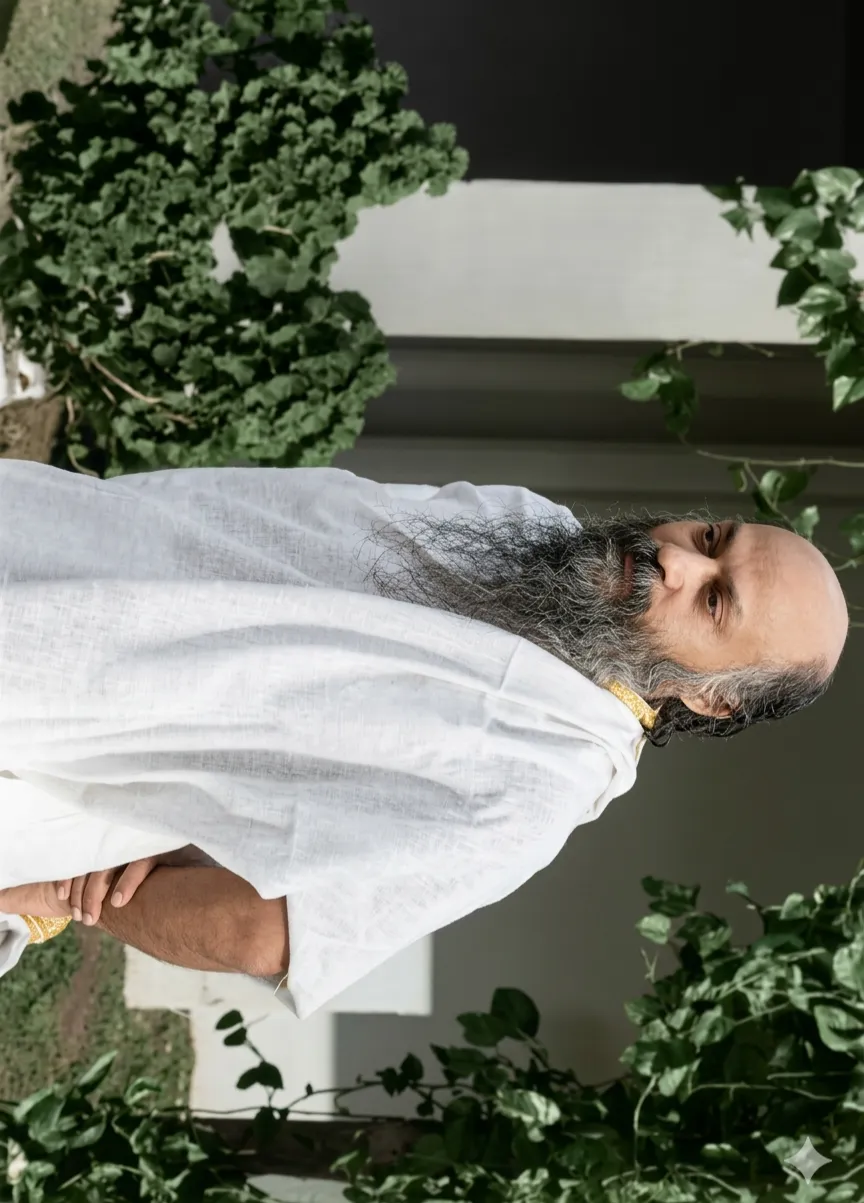
He says you’re just imagining it; the tough part is the same for everyone—letting go of ego and comparisons.
From the Discourses
Passages where Osho speaks to this question — each links to the complete discourse.
Osho, the Buddha wanted to avoid giving sannyas to women. Shankara too was not in favor of giving sannyas to women. What incompatibility is there between the life of sannyas and women? Is there no harmony between them, or only a little? Do women need sannyas less than men?
Man and woman have essentially different paths. The man’s path is meditation; the woman’s path is love. The man’s path is knowledge; the woman’s path is devotion. Their inner climates are very different, even opposite. To man, love seems a bondage; to woman, love seems a liberation. So even when a man loves, he does it while running, fearful that he may get bound. And when a woman loves, she wants to be bound wholly, because in bondage she has known freedom. Therefore the man’s language is: How to get free? How to be liberated from the world? And the woman’s search is: How to drown totally so that nothing remains behind? So sannyas is fundamentally masculine. That is why even Buddha hesitated. Women were moved—women are moved easily, for their hearts are more sensitive—and they began to ask: Give us sannyas too. Buddha was afraid. Mahavira even told them…
Osho, then will there also be a difference in the spiritual practice of women and men?
There will be a difference. Less in the method of practice, more in the state of consciousness. Even if the practice is the same, even if the method is one, a man will go at it aggressively, and a woman will go to it receptively; a man will attack it, a woman will surrender to it. The practice may be one, yet their ways, their attitude, will be different. When a man goes, he will seize the practice by the throat; when a woman goes, she will place her head at its feet—at the feet of the practice. There will be a difference in their manner, in their attitude. And that much difference is natural. Beyond that, there is no question of any further difference. Her essential mood will be surrender. And when the ultimate attainment comes to her, she will not feel, “God has come to me”; she will…
Beloved Osho, I hear you, your loving compassion for me as a woman, behind your words, which sometimes jar me. And I also feel that my very woman-ness is the main barrier to my ever experiencing the bliss of enlightenment, because all of the enlightened beings you ever talk about are men, and because your own experiences are as a male. Please share with me what you can about how enlightenment is for me as a woman.
History is recorded by men, and women are not interested in recording things. They are more interested in experiencing and living them: that is one thing. The second thing is that a woman finds it very easy to become a disciple, very easy to become a disciple, because she is receptive. For a man, it is difficult to become a disciple because he has to surrender, and that is the trouble. He can fight but he cannot surrender. So when it comes to disciplehood, women are perfect. But just the opposite happens when you have to become a Master. A male can easily become a Master. A woman finds it very difficult to become a Master, because to become a Master you have to be really aggressive. You have to go out and destroy others' structures. You have to be almost violent; you have to kill your disciples. You have…
Beloved Osho, is there a difference in the relationship of the master to his male disciples and his relationship to his female disciples?
All disciples are female. All masters are male. The very qualities of being a disciple are the qualities which are feminine -- receptivity, openness, trust, love, a deep surrender. It is not a coincidence that there have not been many women masters, and those that have been were almost as male in their approach as any male can be. For example, I will give you few names -- because there are only few women masters in the whole of history. They can be counted on the fingers of one hand. The most ancient is Gargi. She's reported in the VEDAS. One of the great kings -- five thousand years ago according to Christian scholars, and ninety thousand years ago according to Hindu scholars.... And I have not been able to find any fault with the Hindu scholars. Their arguments are immensely valid, and the Christian scholars have not been able…
Osho, the other day in darshan you were talking about women and transforming their energy. You said that in the past masters such as jesus mahavira, and even gautam the buddha were not able to understand and transform women's energy and allow it to come to a peak. You said that this time here with you it will be possible for women as well as for men to flower and come to a peak. Somehow I was touched by this very deeply. Can you say something more about this difference between man and woman and how you work with us in different ways?
If you allow your own inner woman freedom to meet with the man inside you, to have a deep togetherness, an orgasmic quality, so that as far as your consciousness is concerned it is no more split as man and woman... It is one, it is human, it is whole. It is no more a conflict; it is a concord. It has attained to the highest synthesis possible. When this happens one is whole; whether one is man or woman does not matter. But for centuries man has dominated, and the only way to dominate is to destroy the outer woman, to reduce her into a slave, to reduce her into a commodity, sellable, purchasable, something of the marketplace. This is the ugliest thing that has happened in the past. Because of this the whole past of humanity is rotten, unbalanced, insane. And if the man represses the woman on…