
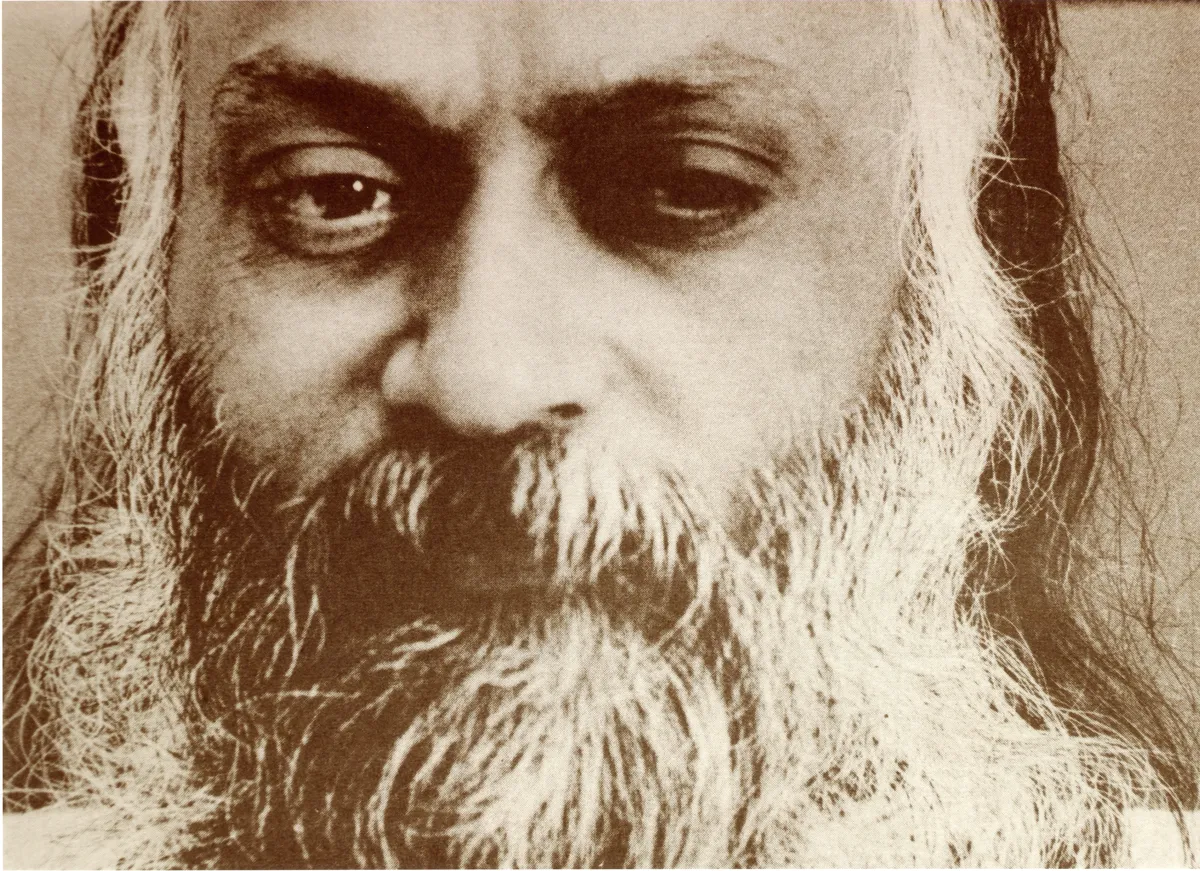
First babble to dump your busy thoughts, then be utterly still and let go—like pretending to die—and you can feel a quiet beyond the mind.
From the Discourses
Passages where Osho speaks to this question — each links to the complete discourse.
We are not the body and we are not the mind either. Mind is also part of the body. The visible part is called body, the invisible part is called mind. It is a psychosomatic mechanism and we are the witness of it. We are in it but we are not it. This is the greatest experience. Once it has happened your life goes through a radical change. Then you are never the same again. It is a breakthrough. The whole effort here is to bring this breakthrough closer and closer. Every support, every technique and device is provided for this breakthrough so that you can see yourself as a witness of it all, as pure consciousness. To know oneself as pure consciousness is to be free of all bondage. It is to be free of birth and death, it is to be free of time.
As you move into meditation this feeling starts becoming stronger every day. That does not mean that you start neglecting the body, on the contrary, you start caring about the body more carefully because it is a beautiful house, a gift of god. You have to keep it clean and beautiful and young and vital, energetic, alive, because you have to live in it for many many years. There is no need to make it ugly, poor, starved. Make it a palace, make it a marble palace, make it a temple, but remember "I am not it," so when it dies you are not dying. The body is born, the body dies; you are never born and you never die. And the method of meditation is very simple: just watching. Three things have to be watched. The first is the body and its actions.
Question: OSHO, CAN SILENCE BE HEARD AND UNDERSTOOD? My own feeling is Socrates knows perfectly well that he's not going to die. It is impossible that he should not have known -- such a tremendous intelligence, such an individuality, such purity, such penetrating insight -- it is not possible that he would not have known the non-temporal, the timeless. The moment you understand that you are eternal, all fear disappears. And the society exists through exploiting your fear; hence, it teaches you from the school to the university, it devotes almost one-third of your life in learning words, language, logic. It is not concerned at all that you should understand, Pradeep, silence. That's the function of a Master: to undo all that the society has done to you, to help you to go beyond words. And you can experience it happening here -- you can hear the silence.
Osho, when you sit silently, that silence doesn’t come within our grasp. But when you begin to speak, a glimpse of silence appears between two sentences, between two words. Yet in becoming so absorbed in understanding the meaning of your speech, that silence keeps slipping away. So please explain: when we listen, how should we listen to you?
It will be so—naturally. When I sit utterly silent, you are not able to sit silent; inside you the stream of thoughts flows, an undercurrent keeps moving—you start talking to yourself. The habit of inner talking has become so deep, so carved in stone, that not even for a moment do you find rest within. If I sit completely silent, you will simply forget me. Your inner stream becomes active, your old habit seizes you, you get absorbed in inner conversation. It’s a monologue—you speak alone, yet you do speak. Then even my silence is hard for you to see, because we can only see that which has its opposite as a background. A psychologist once did an experiment at a university. On a large black blackboard he drew a tiny white dot and asked the students, “What do you see?” Not one of them saw the big blackboard; all…
Emptiness here, emptiness there, but the infinite universe stands always before your eyes. Infinitely large and infinitely small; no difference, for definitions have vanished and no boundaries are seen. So too with being and non-being. Don't waste time in doubts and arguments that have nothing to do with this.
ONE THING, ALL THINGS: MOVE AMONG AND INTERMINGLE, WITHOUT DISTINCTION. TO LIVE IN THIS REALIZATION IS TO BE WITHOUT ANXIETY ABOUT NON-PERFECTION. TO LIVE IN THIS FAITH IS THE ROAD TO NON-DUALITY, BECAUSE THE NON-DUAL IS ONE WITH THE TRUSTING MIND. WORDS! THE WAY IS BEYOND LANGUAGE, FOR IN IT THERE IS That's why in the world of religion you see the most egoistic people possible, because they are trying to be perfect about everything. They insist on perfection. They cannot be relaxed, they will always be tense. And always something will be wrong and they have to put it right -- and they will always remain in anxiety. Go to the madhouses, and you will find there ninety percent perfectionists. A man of understanding remains relaxed. That doesn't mean that he doesn't care. No, he cares but he knows the limitations. He cares, but he knows that he is…