
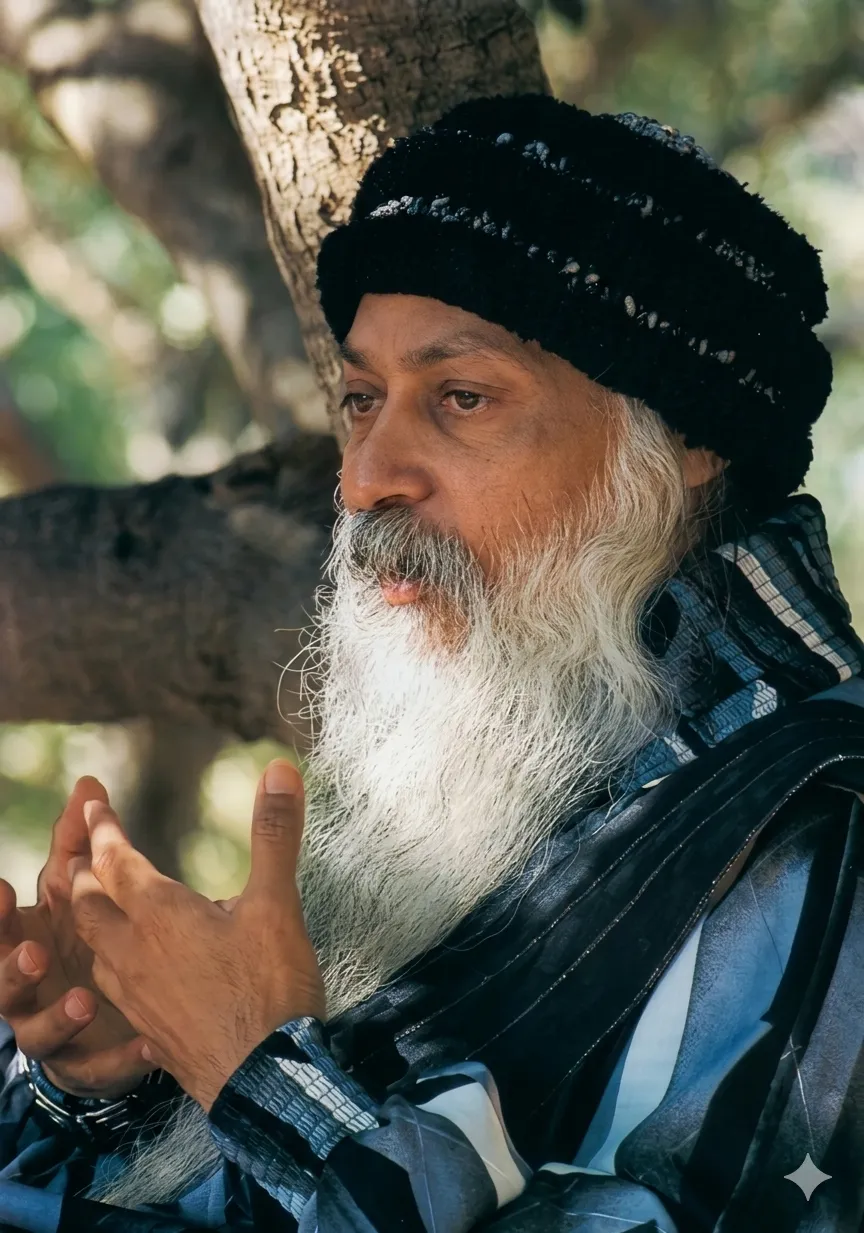
Osho's original Hindi beside Osho Live's English translation, matched passage by passage.
अंग्रेज विचारक ब्रैडले की एक प्रसिद्ध कृति है: एपियरेंस एंड रिएलिटी--आभास और सत्य, या कहें माया और ब्रह्म। जो दिखाई पड़ता है, वह केवल आभास है। जो दिखाई पड़ने के भीतर छिपा है और दिखाई नहीं पड़ता, वही सत्य है। तो यथार्थ के दो रूप हैं। एक तो जैसा दिखाई पड़ता है--ऊपर-ऊपर; और एक, जैसा है--भीतर।
The English thinker Bradley has a famous work: Appearance and Reality—appearance and truth, or say Maya and Brahman. That which appears to the eye is only appearance. That which is hidden within the appearance and does not appear—that alone is truth. Reality has two aspects: one as it appears—on the surface; and one as it is—within.
मैं आपको देखता हूं, तो रूप दिखाई पड़ता है, आकार दिखाई पड़ता है, शरीर दिखाई पड़ता है, लेकिन आप दिखाई नहीं पड़ते। इस सबके भीतर छिपे हैं आप। यह सब जो रूप है, यह सब जो दृश्य हो रहा है, यह सिर्फ बाहर की परिधि है, यह भीतर का केंद्र नहीं है। इसलिए अगर कोई मान ले कि आपको देखकर उसने आपको जान लिया, तो भूल हो जाएगी। जो उसने देखा, वह केवल परिधि थी।
I look at you: form appears, shape appears, body appears—but you do not appear. You are hidden within all this. All this that is form, all that is seen, is only the outer circumference; it is not the inner center. So if someone assumes that by seeing you he has known you, a mistake will be made. What he has seen is only the circumference.
जैसे कोई किसी के घर के बाहर की दीवालों को देखकर लौट आए। ऐसे ही आपके शरीर को, आप में जो दृश्य है उसे देखकर जो समझ ले कि आपसे परिचित हो गया, वह भ्रांति में पड़ गया। आप तो भीतर गहरे में छिपे हैं, जो आंख की पकड़ में नहीं आता, हाथ के स्पर्श में नहीं आता, कान जिसे सुन नहीं सकते। इसलिए गहन प्रेम के क्षण में ही आपको जाना जा सकता है। क्योंकि प्रेम ही वहां तक पहुंच पाएगा, जहां तक इंद्रियां नहीं पहुंच पातीं।
It is as if someone looked at the outer walls of a house and went back. In just the same way, if someone sees your body, whatever is visible in you, and thinks he has become acquainted with you, he falls into illusion. You are hidden deep within—beyond the grasp of the eye, beyond the touch of the hand, beyond the hearing of the ear. Therefore only in moments of deep love can you be known—because love alone can reach where the senses cannot.
यह पूरा जगत ही ऐसा है। और स्वाभाविक है कि ऐसा हो, क्योंकि किसी भी वस्तु की परिधि होगी और केंद्र होगा, सरकमफ्रेंस होगी और सेंटर होगा। जो बाहर से देखा जा सकता है, वह एक। और जो भीतर से ही गहन हृदय में प्रवेश करके जाना जा सकेगा, वह दो। वही सत्य है, जो केंद्र पर है। परिधि तो रोज बदलती रहती है।
This whole world is such. And it is natural that it be so, because every thing has a circumference and a center. What can be seen from the outside is one thing; and what can be known only by entering inward through the deep heart—that is another. That alone is truth which abides at the center. The circumference keeps changing day by day.
आप मां के पेट में थे तो एक छोटे से अणु थे। अगर वह अणु आज आपके सामने रख दिया जाए तो आप पहचान भी न सकेंगे कि कभी मैं यह था। लेकिन भीतर के केंद्र पर उस क्षण भी आप यही थे जो आज हैं। परिधि बदल गई। आप बच्चे थे कभी, कभी जवान थे, कभी बूढ़े हुए--परिधि बदलती चली गई। अगर आप अपने ही चित्रों को बचपन से लेकर बुढ़ापे तक देखें, तो आप पहचान न पाएंगे कि ये एक ही आदमी के चित्र हैं। सब बदलता चला गया है।
You were in your mother’s womb—you were a tiny atom. If that atom were placed before you today, you would not even recognize that once you were that. But at the inner center you were then the same as you are today—the circumference has changed. Once you were a child, once a youth, once you became old—the circumference went on changing. If you look at your own photographs from childhood to old age, you will not be able to recognize that these are pictures of one and the same person. Everything goes on changing.
शरीरशास्त्री कहते हैं, शरीर प्रतिपल बदल रहा है और सात वर्ष में पूरा शरीर बदल जाता है। अगर आप सत्तर साल जीएंगे, तो दस बार आपको नया शरीर मिल चुका होगा।
Physiologists say the body changes every moment, and in seven years the whole body is renewed. If you live seventy years, ten times you will have received a new body.
प्रतिपल शरीर में कुछ मर रहा है। भोजन से आप नया शरीर अपने में निर्मित करते जा रहे हैं। मल से, मूत्र से, पसीने से, बाल से, नाखून से, मरे हुए हिस्से बाहर निकलते जा रहे हैं। इसलिए तो बाल काटने से पीड़ा नहीं होती, वह शरीर का मरा हुआ हिस्सा है। शरीर उसे बाहर फेंक रहा है। नाखून काटने से पीड़ा नहीं होती, वह मरा हुआ हिस्सा है।
In every instant something in the body dies. Through food you are continuously building new body. Through excrement, urine, sweat, hair, nails, dead parts are being expelled. That is why cutting hair does not hurt—it is a dead part of the body which the body is throwing out. Cutting nails does not hurt—they are dead parts.
आप जानकर चकित होंगे कि मुर्दे के भी बाल और नाखून बढ़ते हैं। मुर्दा भी रखा रहे, तो उसके बाल और नाखून बढ़ते रहते हैं, क्योंकि बाल और नाखून से जीवन का कोई संबंध नहीं है। वह शरीर का मरा हुआ हिस्सा है। मुर्दे का शरीर भी उस मरे हुए हिस्से को फेंकता रहता है।
You will be amazed to know that even a corpse’s hair and nails continue to grow. Even when the body is dead and kept, its hair and nails keep growing, because hair and nails have no relation to life—they are dead parts of the body. A corpse’s body keeps expelling those dead parts.
सात वर्ष में आपके शरीर के सारे कोष्ठ बदल जाते हैं, नए हो जाते हैं। यह परिधि है आपकी। जो नदी की धार की तरह बहती चली जाती है। किसी दिन यह जन्मी थी और किसी दिन यह समाप्त भी हो जाएगी।
In seven years all your body-cells are replaced, new. This is your circumference—flowing like a river’s current. One day it began, and one day it will end as well.
लेकिन भीतर जो केंद्र है, वह जब आप एक छोटे से अणु थे, जो खाली आंख से देखा भी नहीं जा सकता, जिसे देखने के लिए खुर्दबीन चाहिए...। फिर कभी आप बच्चे थे, फिर जवान थे, कभी बूढ़े थे और कभी फिर मिट्टी में गिर गए। वह सब शरीर के तल पर हो रहा है; केंद्र अछूता है। वह केंद्र ही सत्य है, यह परिधि आभास है। आभास इसे इसलिए कहते हैं कि इसको ही बहुत-से लोग सत्य मान लेते हैं। सत्य होने का भ्रम इससे पैदा होता है।
But the inner center—when you were a tiny particle, not even visible to the naked eye, needing a microscope to be seen; then a child, later a youth, later old, and one day falling back into dust—this all occurs on the plane of body; the center remains untouched. Only that center is truth; the circumference is appearance. It is called appearance because many take it to be truth; from it arises the illusion of being true.
और ऐसा व्यक्ति के संबंध में ही नहीं, जीवन के समस्त रूपों के संबंध में सत्य है। ये जो वृक्ष खड़े हैं, इनको आप देखते हैं। इनके पत्ते हैं, इनकी शाखाएं हैं--ये वृक्ष का मूल नहीं हैं और न इस वृक्ष का केंद्र हैं, न ये इसकी आत्मा हैं। ये भी इसकी देह हैं। इस देह के भीतर छिपी है वैसी ही आत्मा, जैसी आपके भीतर छिपी है।
And this is not only in relation to the person; it is true regarding all forms of life. You see these trees standing. They have leaves, they have branches—these are not the root of the tree, nor its center, nor its soul. These too are its body. Within this body is hidden a soul just like the one hidden in you.
और भारत के मनीषी कहते रहे हैं कि कभी आप भी वृक्ष थे। आज आप मनुष्य हैं, वह परिधि का परिवर्तन है। आज जो वृक्ष है, कभी वह भी मनुष्य हो जाएगा। और यहां इतने वृक्ष खड़े हैं, ये भी सब एक जैसे नहीं हैं। इनके भी व्यक्तित्वों में भेद है। इनमें भी मूढ़ वृक्ष हैं, इनमें भी बुद्धिमान वृक्ष हैं। इनमें जो बुद्धिमान वृक्ष हैं, वे तीव्रता से गति कर रहे हैं, वृक्ष की परिधि को पार करके जीवन के और ऊंचे आयाम में प्रवेश करने के लिए। मनुष्यों में भी सभी मनुष्य एक जैसे नहीं हैं। मूढ़ हैं, जो जहां हैं वहीं ठहरे हुए हैं। जिन्होंने परिधि को पकड़ लिया है और उसी को सत्य मान लिया है। उनमें ज्ञानीजन हैं, जो उस परिधि को छोड़कर और श्रेष्ठतर जीवन के आयाम में प्रवेश का प्रयत्न कर रहे हैं।
And the seers of India have said that once you too were a tree. Today you are human—that is the change of circumference. Today a tree is—someday it too will become a human being. And these many trees standing here—even they are not all alike. There are differences in their personalities too. Among them are dull trees and wise trees. Those trees that are wise are moving swiftly, seeking to cross the tree’s circumference and enter a higher dimension of life. Among humans too all are not alike. There are the dull, who remain where they are—they have grasped the circumference and taken it to be truth. And there are the wise, who try to leave the circumference and enter a superior dimension of life.
रूपों के संबंध में ही नहीं, पूरे अस्तित्व को इकट्ठा भी लें, तो परमात्मा की जो परिधि है, उसका नाम माया है--आभास, एपियरेंस। संसार उसी परिधि का नाम है। और इस संसार के गहन गुह्य में छिपा हुआ जो केंद्र है, वही ब्रह्म है।
Not only regarding forms—take the whole Existence together. The circumference of the Divine is called Maya—appearance. The world is the name of that circumference. And hidden in the deep mystery within this world is the center—that alone is Brahman.
हम सभी रूप से, आकार से मोहित, सम्मोहित दौड़ते चले जाते हैं। जो व्यक्ति भी इस आकार के भीतर छिपे हुए निराकार की खोज में लग जाता है, उसे ही उपनिषद ब्राह्मण कहते हैं। ब्राह्मण कोई जन्म से नहीं होता। जन्म से कोई ब्राह्मण होकर समझ ले कि ब्राह्मण हो गया तो पागल है।
We all run enamored, hypnotized by form, by shape. The one who begins to search for the formless hidden within form—the Upanishads call him a Brahmin. No one is a Brahmin by birth. If someone assumes he is a Brahmin by birth, he is deluded.
ब्राह्मण होना तो सतत साधना की उपलब्धि है। जन्म से तो सभी शूद्र पैदा होते हैं, सभी। इन शूद्रों में से कुछ ब्राह्मण हो जाते हैं, शेष शूद्र ही रह जाते हैं।
To be a Brahmin is an attainment of continuous sadhana. By birth all are Shudras—all. Among these Shudras some become Brahmins; the rest remain Shudras.
ब्राह्मण वही हो जाता है, जो परिधि को छोड़कर केंद्र की तलाश में लग जाता है, जो माया के आवृत को तोड़कर और ब्रह्म की खोज में लग जाता है। आंखें जिसे देख पाती हैं, उसमें उसकी उत्सुकता नहीं। जो अदृश्य है, जिसे आंखें नहीं देख पातीं, जिसे केवल विवेक की आंख देख पाती है, जिसे केवल अंतःप्रज्ञा देख पाती है, उसकी खोज में जो लग जाता है, वह ब्राह्मण है।
A Brahmin is one who leaves the circumference and sets out in search of the center; who breaks the cover of Maya and begins the search for Brahman. What the eyes can see no longer interests him. That which is invisible, which the eyes cannot see, which only the eye of discrimination can see, which only inner prajna can see—whoever sets out in search of that, he is a Brahmin.
ये सूत्र कई अर्थों में कीमती हैं। इनमें हम प्रवेश करें।
These sutras are precious in many senses. Let us enter them.
यह सबका आत्मरूप परमपुरुष समस्त प्राणियों में रहता हुआ भी माया के परदे में छिपा रहने के कारण सबके प्रत्यक्ष नहीं होता। केवल सूक्ष्मतत्वों को समझने वाले पुरुषों द्वारा ही अति सूक्ष्म तीक्ष्ण बुद्धि से देखा जा सकता है।
This Self-form Param Purusha dwells in all beings, and yet—hidden behind the veil of Maya—is not manifest to all. Only by those who understand the subtlest principles, with exceedingly subtle, keen intelligence, can He be seen.
लेकिन सूक्ष्म और तीक्ष्ण बुद्धि से आप कहीं गलत न समझ लें। सूक्ष्म और तीक्ष्ण बुद्धि से उपनिषदों का अर्थ, जिसे हम सामान्यतः सूक्ष्म और तीक्ष्ण बुद्धि कहते हैं, उससे नहीं है। हम तो उस बुद्धि को सूक्ष्म और तीक्ष्ण कहते हैं, जो गणित और तर्क में कुशल है; जो विवाद में कुशल है; जो किसी भी बात को खंड-खंड तोड़ने में कुशल है।
But do not misunderstand by “subtle and keen intelligence.” The Upanishads do not mean what we ordinarily call subtle and keen intelligence—skill in mathematics and logic, skill in argument, skill in breaking anything into parts.
लेकिन उपनिषद उस बुद्धि को सूक्ष्म कहते हैं जो पवित्र है, जो शुद्ध है, जो शांत है। ये दोनों बिलकुल अलग धारणाएं हैं। उपनिषद उसे सूक्ष्म बुद्धि कहते हैं जो इतनी शुद्ध है कि जिसमें कोई विकार नहीं रह गया। क्योंकि विकार स्थूल कर देते हैं। निर्विकार बुद्धि का नाम सूक्ष्म बुद्धि है। एक भोले-भाले आदमी के पास हो सकती है सूक्ष्म बुद्धि। जरूरी नहीं है कि एक बड़े गणितज्ञ और एक तर्कशास्त्री के पास हो।
The Upanishads call that intelligence subtle which is pure, which is untainted, which is silent. These are two entirely different notions. The Upanishads call that intelligence subtle which is so pure that no defilement remains in it—because defilements make it gross. The name of undefiled intelligence is subtle intelligence. A simple, guileless man may possess subtle intelligence. It is not necessary that a great mathematician or logician should have it.
गणितज्ञ और तर्कशास्त्री के पास जो बुद्धि है, वह सूक्ष्म नहीं है। अगर ठीक से समझें, तो उसे कहना चाहिए, वह कुशल है। विचार करने की क्षमता उसके पास है, लेकिन निर्विचार की शुद्धि उसके पास नहीं है। दार्शनिक और संत में यही भेद है।
The intelligence a mathematician or a logician has is not subtle. Properly speaking it should be called skillful. He has the capacity to think—but he does not have the purity of no-thought. This is the difference between a philosopher and a saint.
दार्शनिक किसी भी चीज को तोड़कर उसके भीतर प्रवेश करने की कोशिश करता है। संत अपने को शुद्ध करके--किसी को तोड़कर नहीं--अपनी शुद्धता के माध्यम से किसी में प्रवेश की कोशिश करता है। इसलिए बहुत बार ऐसा हो जाता है कि अपढ़ भी संत हो जाते हैं। और बहुत पढ़े-लिखे लोग भी संत नहीं हो पाते।
The philosopher tries to break anything open and enter inside. The saint tries to purify himself—not to break anything—and enter through his purity. Therefore many times it happens that the unlettered become saints, and the highly educated fail to become saints.
जीसस बढ़ई का बेटा है। कुछ भी शिक्षित नहीं है। तर्क में जीसस को कोई भी पराजित कर सकता है। रामकृष्ण दूसरी कक्षा तक पढ़े हैं। तर्क में कोई भी रामकृष्ण को पराजित कर सकता है। जिस अर्थ में हम बुद्धि को सूक्ष्म कहते हैं, और जिस अर्थ में पश्चिम के मनोवैज्ञानिक बुद्धि-अंक नापते हैं, आई. क्यू. नापते हैं--उसमें रामकृष्ण कहीं टिकेंगे नहीं।
Jesus is a carpenter’s son—hardly educated. In argument anyone could defeat Jesus. Ramakrishna studied up to the second grade. In debate anyone could defeat Ramakrishna. In the sense in which we call intelligence subtle—and in which Western psychologists measure intelligence by I.Q.—Ramakrishna would not stand anywhere.
लेकिन रामकृष्ण के पास या कबीर के पास या नानक के पास या जीसस के पास एक और तरह की सूक्ष्मता है, जो शुद्धि की है, पवित्रता की है। जैसे सुबह का नया खिला हुआ फूल हो। कांटे की तरह तीक्ष्ण नहीं है वह; किसी को चुभेगी भी नहीं। लेकिन एक फूल की पवित्रता है, एक निर्दोषता है। उस निर्दोषता की एक सूक्ष्मता है। वह सूक्ष्मता ही परम तत्व में प्रवेश कर पाती है।
But Ramakrishna, or Kabir, or Nanak, or Jesus possess another kind of subtlety—the subtlety of purity, of sanctity. As a newly blossomed flower in the morning—he is not sharp like a thorn; he will not prick anyone. But a flower has a sanctity, an innocence. That innocence has a subtlety. Only that subtlety can enter the Supreme Element.
तीक्ष्ण बुद्धि जिसको हम कहते हैं, वैसा तीक्ष्ण-बुद्धि व्यक्ति वैज्ञानिक हो जाएगा। वह पदार्थ को तोड़कर उसके रहस्यों को खोज लेगा, लेकिन आत्मा के जानने से वंचित रहेगा। जिसको उपनिषद सूक्ष्म बुद्धि कहते हैं, वैसा व्यक्ति तोड़ेगा नहीं, बिना तोड़े प्रवेश कर जाएगा। और निश्चित ही जब तोड़कर प्रवेश करना पड़े, तो बुद्धि आपकी बहुत सूक्ष्म नहीं है। क्योंकि जगह बनानी पड़ती है तब आप प्रवेश कर पाते हैं। बिना तोड़े जो प्रविष्ट हो जाए, उसकी सूक्ष्मता आत्यंतिक है।
The keen mind that we praise becomes a scientist. He will break matter and discover its secrets, but he will miss the knowing of the Self. The one whom the Upanishad calls endowed with subtle intelligence will not break anything—he will enter without breaking. And surely, if you need to break something to enter, your intelligence is not very subtle—you needed to make space. The one who enters without breaking—his subtlety is ultimate.
यह भेद साफ समझ लेना चाहिए। क्योंकि इस भेद को साफ न समझने के कारण बड़ी अड़चन हुई है। कबीर को काशी के पंडित पूछते हैं कि तुम जब शास्त्र जानते नहीं, संस्कृत पढ़े नहीं, सिद्धांतों का तुम्हें कुछ पता नहीं, तो तुम आत्मज्ञानी कैसे हो गए?
This distinction must be clearly understood. Much obstruction has arisen because it was not understood. The pundits of Kashi asked Kabir: when you do not know the scriptures, have not studied Sanskrit, know nothing of doctrines, how did you become a knower of the Self?
निश्चित ही काशी का कोई भी पंडित, साधारण से साधारण पंडित भी, कबीर से ज्यादा जानता था, शास्त्र की भाषा में। लेकिन कबीर के मुकाबले वे सब बुझे हुए दीए थे। वे कितना ही जानते हों और कबीर बिलकुल भी न जानता हो, तो भी कबीर का होना सघन था। अस्तित्व सघन था। उनके पास होगी स्मृति, कबीर के पास थी आत्मा।
Certainly any ordinary pundit of Kashi knew more than Kabir—in the language of scripture. But compared to Kabir all of them were extinguished lamps. However much they knew—and Kabir knew not at all—still Kabir’s being was dense. His existence was dense. They had memory; Kabir had soul.
वह ज्योति, जो कबीर के पास है, उसको सूक्ष्म बुद्धि उपनिषद कहते हैं। छोटे बच्चों के पास होती है; संतों के पास होती है। सरल-चित्त लोगों के पास होती है। इस सूक्ष्म बुद्धि के द्वारा ही माया के पर्दे को कोई पार कर पाता है।
That flame which was with Kabir—the Upanishads call it subtle intelligence. Little children have it; saints have it; simple-hearted people have it. Only through this subtle intelligence can one cross the veil of Maya.
अगर कुशल बुद्धि हो तो माया के पर्दे को ही काटने में और समझने में उलझ जाता है। वह जो एपियरेंस है, जो दिखाई पड़ रहा है, उसी के साथ उलझ जाती है साधारण बुद्धि। जो दिखाई पड़ रहा है उसको छोड़कर, जो नहीं दिखाई पड़ रहा है उस तक पहुंचने की क्षमता, मैंने कहा, प्रेम में है या प्रार्थना में है।
If one has skillful intelligence, he becomes entangled in cutting and analyzing the veil of Maya itself. Ordinary intelligence entangles itself with appearance—with what is seen. The capacity to leave what is seen and reach what is unseen—I have said—exists in love, or in prayer.
जब कोई व्यक्ति सच में ही प्रेम करे, या प्रेम में हो जाए, तो शरीर भूल जाता है। शरीर के पार सीधी छलांग लग जाती है। ऐसा ही प्रेम जब कोई सारे अस्तित्व से करता है तो उसका नाम प्रार्थना है।
When someone truly loves, or is in love, the body is forgotten. A direct leap beyond the body happens. When such love is for the whole Existence, its name is prayer.
ध्यान बुद्धि को सूक्ष्म करने की प्रक्रिया है। जैसे-जैसे आप ध्यान करते हैं, बुद्धि के विकार गिरते चले जाते हैं। एक घड़ी आती है जब बुद्धि परिशुद्ध हो जाती है। उसमें कुछ भी विकार, कोई भी फारेन एलिमेंट, कोई भी विजातीय तत्व नहीं रह जाता। विचार तक नहीं रह जाता। बुद्धि इतनी निर्मल हो जाती है कि विचार भी नहीं करती। सिर्फ होती है। सिर्फ एक ज्योति होती है। उस ज्योति में जरा भी धुआं नहीं होता। शुद्ध प्रकाश रह जाता है, आलोक। उस शुद्ध आलोक से ही व्यक्ति माया के पर्दे में छिपे हुए ब्रह्म को जानने में समर्थ हो पाता है।
Meditation is the process of making intelligence subtle. As you meditate, the defilements of the intellect fall away. A moment comes when the intelligence becomes perfectly pure. No impurity, no foreign element, no alien particle remains—not even thought remains. Intelligence becomes so immaculate that it does not think—it simply is. There is simply a flame—without the slightest smoke. Only pure light remains—luminosity. With that pure luminosity alone is one capable of knowing Brahman hidden by the veil of Maya.
बुद्धिमान साधक को चाहिए कि पहले वाक् आदि समस्त इंद्रियों को मन में निरुद्ध करे, उस मन को ज्ञानस्वरूप बुद्धि में विलीन करे, ज्ञानस्वरूप बुद्धि को महान आत्मा में विलीन करे और उसको शांतस्वरूप परमपुरुष परमात्मा में विलीन करे।
The intelligent seeker should first restrain speech and all the senses in the mind; dissolve that mind into the knowledge-natured intellect; dissolve that knowledge-natured intellect into the Great Self; and dissolve That into the Peace-natured Supreme Person, the Paramatman.
यह प्रक्रिया है बुद्धि के सूक्ष्म और शुद्ध होने की। शुरू करना है वाक् से, वाणी से, विचार से, शब्द से। हमारी बुद्धि विकृत है, क्योंकि इतने विचारों का बोझ है! विचार ही विचार हैं। जैसे आकाश में बादल ही बादल छाए हों, आकाश खो जाए, दिखाई भी न पड़े, सूर्य का कोई दर्शन न हो, ऐसी हमारी बुद्धि है। विचार ही विचार छाए हैं। उसमें वह जो बुद्धि की प्रतिभा है, जो आलोक है, वह खो गया, छिप गया।
This is the process of the intellect becoming subtle and pure. One must begin with speech—with voice, with thought, with words. Our intelligence is distorted because of the burden of thoughts—thoughts upon thoughts. Like the sky completely overcast with clouds so that the sky is lost to view—no vision of the sun—such is our intelligence. Thoughts and thoughts are spread over it. The inherent brilliance of intelligence, the luminosity, is lost, hidden.
एक बादल हट जाए तो आकाश का टुकड़ा दिखाई पड़ना शुरू हो जाता है। छिद्र हो जाएं बादलों में तो प्रकाश की रोशनी आनी शुरू हो जाती है, सूरज के दर्शन होने लगते हैं। ठीक ऐसे ही बुद्धि जब तक विचार से बहुत ज्यादा आवृत है...और एक पर्त नहीं है विचार की, हजारों पर्तें हैं। जैसे कोई प्याज को छीलता चला जाए तो पर्त के भीतर पर्त, पर्त के भीतर पर्त। ठीक ऐसे विचार प्याज की तरह हैं। एक विचार की पर्त को हटाएं, दूसरी पर्त सामने आ जाती है। दूसरे को हटाएं, तीसरी आ जाती है। एक विचार को हटाएं दूसरा विचार मौजूद है, दूसरे को हटाएं तीसरा मौजूद है।
If one cloud moves away, a patch of sky begins to appear. If gaps arise in the clouds, sunrays start entering, the sun begins to be seen. Exactly so, as long as intelligence is heavily covered with thought... and there is not one layer of thought—there are thousands. Like peeling an onion—layer within layer within layer. Thoughts are exactly like an onion. Remove one layer and the next appears; remove the next and the third appears. Remove one thought and another is ready; remove the second and the third is present.
यह पर्त दर पर्त विचार है। यह हमने जन्मों में इकट्ठे किए हैं, जन्मों-जन्मों में। यह धूल है जो हमारी लंबी यात्रा में हमारे मन पर इकट्ठी हो गई है। जैसे कोई यात्री रास्ते पर चले तो धूल इकट्ठी होती चली जाए। और उसने कभी स्नान न किया हो और यात्रा करता ही रहा हो, तो बहुत धूल इकट्ठी हो जाए, यात्री का पता ही न चले कि वह कहां खो गया।
This is layer upon layer of thought. We have amassed this over births upon births. It is dust gathered on our mind during a long journey—as a traveler walking on the road gathers dust. If he never bathes and keeps traveling, much dust will gather—so much that the traveler himself will be lost from sight.
ध्यान स्नान है बुद्धि का। और जो ध्यान नहीं सम्हाल पा रहा है, उसकी बुद्धि कचरे से लद जाएगी, स्वाभाविक। प्रतिपल संस्कार पड़ रहे हैं, हर घड़ी। पूरे दिन में, वैज्ञानिक कहते हैं, कोई दस लाख संस्कार बुद्धि पर पड़ते हैं। आप सोच भी नहीं सकते कि दस लाख कहां से पड़ते होंगे। हर चीज का संस्कार पड़ रहा है। अभी मैं बोल रहा हूं, यह संस्कार पड़ रहा है। पक्षी आवाज कर रहा है, वह संस्कार पड़ रहा है। एक कार का हार्न बजा, वह संस्कार पड़ा। वृक्ष में हवा दौड़ी, वह संस्कार पड़ा। पैर में एक चींटी ने काटा, वह संस्कार पड़ा। सिर में थोड़ी पीड़ा हुई, वह संस्कार पड़ा। पड़ रहे हैं दस लाख संस्कार दिनभर में, चौबीस घंटे में। और ये सब इकट्ठे होते जा रहे हैं।
Meditation is a bathing of the intelligence. And if one does not take care to meditate, one’s mind will naturally be loaded with rubbish. Impressions are being recorded every moment, every hour. Scientists say some ten lakh impressions fall upon the mind in a day. You cannot even imagine from where a million impressions arrive. Everything leaves an imprint. I am speaking—this is an imprint. A bird calls—that is an imprint. A car horn sounds—that is an imprint. The wind runs through the trees—that is an imprint. An ant bites your foot—that is an imprint. A slight ache in the head—that is an imprint. A million impressions in twenty-four hours, and all these are being accumulated.
यह संस्कार धूल है। और यह हम जन्मों से इकट्ठे कर रहे हैं। इसलिए बहुत पर्तें इकट्ठी हो गई हैं। जब आप सोए हैं, तब भी संस्कार पड़ रहे हैं। नींद लगी है आपकी, लेकिन इससे कोई फर्क नहीं पड़ता। क्योंकि बुद्धि पूरे वक्त काम कर रही है। बाहर कोई आवाज होगी, नींद में भी संस्कार पड़ रहा है। गर्मी पड़ेगी, संस्कार पड़ रहा है। मच्छड़ आवाज कर रहे हैं, संस्कार पड़ रहा है। करवट बदली, संस्कार पड़ रहा है। गर्मी है, सर्दी है, पूरे समय बुद्धि इकट्ठा कर रही है, हर चोट। बुद्धि की क्षमता बहुत ज्यादा है।
These impressions are dust; and we have been gathering them for lifetimes. Thus many layers have accumulated. Even when you are asleep, impressions are being made. You are asleep—but it makes no difference, for the mind is working all the time. A sound outside—an impression is made even in sleep. Heat—an impression. Mosquitoes buzzing—an impression. You turn in bed—an impression. Heat, cold—the mind is recording all the time, every impact. The capacity of mind is immense.
वैज्ञानिक कहते हैं कि अनंत संस्कार बुद्धि इकट्ठा कर सकती है। आपके इस छोटे-से सिर के भीतर कोई सात करोड़ सेल हैं। और एक-एक सेल अरबों संस्कार इकट्ठा कर सकता है। इसलिए कोई अंत नहीं है। सारी दुनिया का जितना ज्ञान है, वह एक आदमी की बुद्धि में समाया जा सकता है।
Scientists say the mind can collect infinite impressions. In your little head are roughly seven hundred million cells, and each cell can store billions of impressions. There is no end. All the knowledge of the world can be stored in a single mind.
ये जो इकट्ठी होती पर्तें हैं, इनके कारण आप आच्छादित हैं। इस आच्छादन को तोड़ना पड़ेगा। इस तोड़ने का प्रारंभ--बुद्धिमान साधक को चाहिए, पहले वाक् आदि समस्त इंद्रियों को मन में निरुद्ध करे।
These accumulating layers cover you. This covering must be broken. The beginning of this breaking—“the intelligent seeker should first restrain speech and all the senses within the mind.”
इसलिए मौन का इतना मूल्य है। मौन का अर्थ है, आप बाहर और भीतर बोलना बंद कर रहे हैं। क्योंकि बोलना बुद्धि की बड़ी गहरी प्रक्रिया है। बोलने के द्वारा बुद्धि बहुत कुछ इकट्ठा करती रहती है। और जो भी आप बोलते हैं, वह आप सिर्फ बोलते नहीं हैं, बोला हुआ आप सुनते भी हैं, उसके संस्कार और सघन हो जाते हैं।
Hence the great value of silence. Silence means you cease speaking both outwardly and inwardly—because speech is a very deep process of mind. Through speaking the mind keeps on collecting much. And whatever you say—you do not only say it; you also hear it yourself, so its imprint becomes more intense.
जब आप एक ही बात बार-बार बोलते रहते हैं, तो आपको पता नहीं कि आप बार-बार सुन भी रहे हैं। संस्कार गहरे होते जा रहे हैं। और आप कचरा बोलते रहते हैं। सुबह अखबार पढ़ लिया, फिर दिनभर उसी को लोगों को बोले चले जा रहे हैं। कोई व्यर्थ की बात, जिसका कोई भी मूल्य नहीं, जिससे किसी को कोई लाभ नहीं होगा, उसको आप बोले चले जा रहे हैं। अगर आप अपने चौबीस घंटे का विश्लेषण करें, तो आप पाएंगे कि निन्यानबे प्रतिशत तो कचरा था, जो आप न बोलते तो किसी का कोई हर्ज न था।
When you repeat the same thing again and again, you do not realize that you are also hearing it again and again. The impressions are growing deeper. And you keep talking rubbish. You read the morning paper, and all day you go on repeating it to people. Some useless talk, with no value, from which no one will benefit—you go on talking. If you analyze your twenty-four hours you will find that ninety-nine percent was trash; had you not spoken it, no one would have been harmed.
ध्यान रहे, जिसे बोलने से किसी को कोई लाभ नहीं हुआ है, उसे बोलने से हानि निश्चित हुई है। क्योंकि न केवल आपने दूसरे के मन में कचरा डाला है--जो कि हिंसा है, जिसका कोई मूल्य नहीं है वह आप बोलकर दूसरे के मन में डाल दिए हैं--जब आप बोल रहे थे तो आपने फिर से सुन लिया है। वह आपके भीतर दुबारा गहरा हो गया। उसके फिर से संस्कार पड़ गए, फिर कंडीशनिंग हो गई।
Remember: that which benefits no one by being spoken certainly causes harm by being spoken. For not only did you dump garbage into the other’s mind—which is violence, to put into another’s mind what has no value—but while you were speaking you also heard it again yourself. It sank deeper into you; it made fresh impressions; fresh conditioning.
अगर आप एक असत्य को भी बार-बार बोलते रहें, तो आप खुद ही भूल जाएंगे कि वह असत्य है। इतने संस्कार भीतर पड़ जाएंगे कि वह लगने लगेगा कि सत्य है। एडोल्फ हिटलर ने कहा है कि कोई भी असत्य को सत्य करना हो तो एक ही तरकीब है, उसे बोले चले जाओ। दूसरे ही मान लेंगे ऐसा नहीं है, आप खुद भी मान लेंगे।
If you keep repeating even an untruth, you will yourself forget that it is untruth. So many impressions will fall within that it will begin to feel like truth. Adolf Hitler has said: if you want to turn any untruth into truth there is only one trick—keep on saying it. It is not only that others will believe it—you yourself will believe it.
आप अपनी जिंदगी में देखें, कई असत्य आपको सत्य मालूम पड़ने लगे हैं, क्योंकि आप इतने दिनों से बोल रहे हैं कि अब आपको भी स्मरण नहीं रहा कि पहले दिन यह बात असत्य थी। बहुत बार संस्कार पड़ जाने से गहरे हो जाते हैं; लीक बन जाती है।
Look into your own life: many untruths have begun to appear as truths to you because you have been saying them for so long that you no longer remember that on the first day the thing was untrue. Impressions, when repeated, become deep; grooves are made.
पहला काम है साधक के लिए कि वह वाणी को संयत कर ले। वही बोले जो बिलकुल अनिवार्य हो, अपरिहार्य हो, जिसके बिना चल ही न सकेगा।
The first work for a seeker is to discipline speech. Speak only that which is wholly essential, indispensable—without which one cannot manage.
यह दुनिया बड़ी शांत हो जाए, अगर लोग अपरिहार्य को बोलें, व्यर्थ को न बोलें। और व्यर्थ को बोलकर बड़ी झंझट में पड़ते हैं। क्योंकि बोलकर आप ही थोड़े ही बोलते हैं, दूसरा जवाब भी देगा।
This world would become very peaceful if people spoke only what is indispensable and did not speak the unnecessary. By speaking the unnecessary you fall into great troubles—for when you speak, you are not the only one speaking; the other will reply.
थोड़ा आप सोचें कि अगर आप संयत रहे होते, मौन रहे होते, तो कितने उपद्रव आपके जीवन से बच गए होते! बोलकर आप न मालूम कितने उपद्रवों में पड़ रहे हैं। फिर उनको बचाने के लिए और बोलना पड़ता है। फिर यह सिलसिला बढ़ता चला जाता है। एक विसियस सर्किल है, एक दुष्टचक्र है, जिसका फिर कोई अंत नहीं है।
Consider: had you remained disciplined, silent, how many disturbances would have been avoided in your life! By speaking you fall into countless entanglements; then to save yourself you must speak more. The chain goes on lengthening. It is a vicious circle, a devil’s wheel without end.
इसलिए साधु चुप हो जाता है। उतना ही बोलता है, जितना अनिवार्य है। और उतना ही बोलता है, जिससे किसी का हित हो सके। अन्यथा मौन रह जाता है।
Hence the sage becomes quiet. He speaks only as much as is essential—and only that by which someone may be benefited. Otherwise he remains silent.
वाणी को जब आप बाहर से रोकेंगे, तो भी जरूरी नहीं कि भीतर रुक जाए, क्योंकि आप दूसरे से न बोलें तो खुद से बोलते रहते हैं! बैठे हैं और खुद ही से बात चल रही है। यह खुद ही से चलने वाली बात भी संस्कार निर्मित करती है। क्योंकि जब आप अपने से बोल रहे हैं तब भी मन सुन रहा है। और जो भी आप बोल रहे हैं, उसकी आप लकीर जोर से खोद रहे हैं अपने भीतर। खुद से भी बोलना बंद करें।
Even if you stop speech outwardly it is not necessary that it will stop within—for if you do not speak to others you continue speaking to yourself. You sit, and inside a conversation goes on. This inner talk also creates impressions, because when you speak to yourself, the mind is listening. Whatever you speak, you are carving a deep groove within. Stop speaking to yourself as well.
वाणी बड़ा उपद्रव है। जरूरी नहीं है कि उपद्रव ही हो, हमने उपद्रव बना लिया है। भीतर भी धीरे-धीरे बोलना बंद करें। चुप्पी साधें, मौन को फैलने दें। जितना-जितना मौन फैलेगा, उतना-उतना मन विसर्जित होता चला जाएगा। जैसे-जैसे मौन घना होगा, वैसे-वैसे बादल तिरोहित होने लगेंगे। जगह-जगह से छिद्र टूटने लगेंगे और रोशनी भीतर की आने लगेगी।
Speech is a great mischief. It need not be—but we have made it so. Slowly let the inner talking also come to a halt. Practice silence; let silence spread. The more silence spreads, the more the mind dissolves. As silence grows dense, the clouds begin to disperse; holes open here and there and the inner light begins to pour.
धर्म का, सारे धर्मों का आधार मौन है। महावीर बारह वर्ष मौन रहे। बुद्ध ने अनेक-अनेक दिन मौन में बिताए। जीसस बोलने के पहले मौन में चले गए। मुहम्मद को कुरान का अवतरण हुआ, जब वे परम मौन की अवस्था में थे। इस जगत में जो भी सत्य का अवतरण हुआ है, वह तब हुआ है जब भीतर चुप्पी है, सब शांत है।
The foundation of religion—of all religions—is silence. Mahavira remained silent for twelve years. Buddha spent many days in silence. Before Jesus spoke, he went into silence. The Quran descended upon Muhammad when he was in a state of supreme silence. Whatever descent of truth has happened in this world has happened only when within there is quiet—everything is at rest.
उस शांत क्षण में ही हमारा तालमेल हमारी ट्यूनिंग ब्रह्म से जुड़ जाती है। वह मौन का कांटा ही हमें आभास से भीतर ले जाता है और सत्य से जोड़ देता है। इसलिए हमने साधु को मुनि कहा है। मुनि का अर्थ है: जो मौन हो गया है। जो भीतर चुप हो गया है।
Only in that still instant does our tuning join with Brahman. That pointer of silence alone leads us from appearance to within, and joins us to truth. Hence we have called the sage muni—one who has become silent, who has become quiet within.
असल में वही बोलने का अधिकारी है, जो भीतर चुप हो गया हो। क्योंकि उसके बोलने का कुछ मूल्य होगा। क्योंकि बोलने का अर्थ होगा। उसने कुछ जाना है, जिसे वह दे रहा है। जो चुप नहीं है, वह बोलने का अधिकारी नहीं है। जो भीतर बोले चला जाता है, उसका बोलना एक बीमारी है।
Truly, only he deserves to speak who has become quiet within—for only then will his speech have value; it will have meaning. He has known something which he is giving. He who is not quiet does not deserve to speak. If the inner talk goes on, speaking is a disease.
आप जब दूसरों से बात करते हैं, तो आप सच में उनसे बात नहीं कर रहे हैं, आप अपने को उलीचना चाहते हैं। इसलिए कोई न मिले आपको सुनने को, तो बेचैनी शुरू हो जाती है। बातचीत, बकवास के लिए कोई चाहिए। लेकिन दूसरा भी आपकी बकवास इसीलिए सुन रहा है कि जब तुम चुप होओगे, तो वह भी शुरू करेगा। और कोई प्रयोजन सुनने का नहीं है।
When you talk to others you are not really talking to them—you want to unload yourself. Therefore, if you find no one to listen to you, restlessness begins. You need someone for chatter. But the other listens to your chatter only so that when you fall silent, he may begin. There is no other purpose in listening.
मैंने सुना है कि एक सभा में एक नेता व्याख्यान कर रहा था, लेकिन धीरे-धीरे लोग उठकर जाते गए। व्याख्यान पूरा होते-होते एक ही आदमी बचा। उस नेता ने कहा, धन्यवाद तुम्हारा। इस गांव में लोग बिलकुल नासमझ मालूम पड़ते हैं। एक तुम ही बुद्धिमान हो। उसने कहा, ऐसा कुछ भी नहीं। असल में आपके बाद मेरे बोलने की बारी है। आपको सुनने को नहीं रुका हूं। मेरा भी व्याख्यान होने वाला है, इसी सभा में।
I have heard: In a gathering a leader was delivering a speech, but people slowly got up and left. By the end only one person remained. The leader said, “Thank you. People in this village seem completely unintelligent—only you are wise.” The man said, “Nothing like that. In truth, after you, it is my turn to speak. I have not stayed to listen to you—my speech too is to be given in this meeting.”
कोई किसी को सुन नहीं रहा है। किसी को किसी से सुनने का प्रयोजन नहीं है। सुनना पड़ता है, क्योंकि बोलना है। सुनना रिश्वत है। जब आप किसी की बात सुन रहे हैं, तब अपने भीतर देखना--आप प्रतीक्षा कर रहे हैं, कब ये सज्जन चुप हों। और अगर कोई सज्जन चुप ही न हों, तो आप कहते हैं, बिलकुल बोर है। बोर का मतलब, आपको बोर करने का उसने बिलकुल मौका नहीं दिया! अपनी ही बोले चला जा रहा है। आप अपनी बोलना चाहते थे, उसने आपको मौका ही नहीं दिया। जो सुसंस्कृत लोग हैं, वे आपको बोर भी करते हैं और आपको भी बोर करने का मौका देते हैं। थोड़ा बोलते हैं, थोड़ा आपको बुलवाते हैं। इससे सत्संग बना रहता है। इससे आप घबड़ाते भी नहीं। यह लेन-देन है। लेकिन यह बीमारी है।
No one listens to anyone. No one wants to hear anything from anyone. One has to listen because one wants to speak. Listening is a bribe. When you are listening to someone, look within—you are just waiting for him to fall silent. And if he doesn’t, you say, “He is boring.” Meaning: he gave you absolutely no chance to bore him! He kept speaking himself. You wanted to speak; he gave you no opportunity. The cultured person will bore you and also give you the opportunity to bore him. He speaks a little, then makes you speak a little—so the company remains sociable; you don’t get nervous. It is give-and-take. But it is a disease.
अगर बोलना आपकी मजबूरी हो और आपको बोलने में राहत मिलती हो, कि आप हल्के होते हैं, तो समझना कि आप जो बोल रहे हैं, वह कचरा है। इससे किसी का कोई लाभ होने वाला नहीं है।
If speaking is your compulsion and you feel relief by speaking, that you feel lighter—know that what you speak is rubbish. It will benefit no one.
हम अपना कचरा दूसरे में डालते हैं; दूसरे अपना कचरा हममें डालते हैं। दोनों के पास कचरा बढ़ जाता है! कचरा घटना चाहिए। इसलिए अगर साधक को बहुत बार जंगल में भाग जाना पड़ा है, तो वह आपसे कम भागा है, आप जो कचरा उसके ऊपर उंडेलते हैं, उससे ज्यादा भागा है। जंगल में मौन होने की उसे सुविधा मिल गई।
We dump our rubbish into others; others dump theirs into us. Both end up with more rubbish. The junk should decrease. If seekers have often fled to the forest, they have fled not so much from you as from the rubbish you pour over them. In the forest they have the facility to be silent.
लेकिन जंगल भागने की जरूरत नहीं है। अगर समझ हो तो आप यहीं धीरे-धीरे मौन होते जा सकते हैं। एक बात भर स्मरण रखें; व्यर्थ न बोलें।
But there is no need to flee to the forest. If there is understanding, slowly you can become silent right here. Remember one thing: do not speak the unnecessary.
जब तक पक्का न हो जाए कि इससे किसी का लाभ होगा, तब तक न बोलें। जब तक ऐसा न लगे कि यह बोलना बिलकुल ही अनिवार्य है, तब तक न बोलें। और भीतर भी धीरे-धीरे बोलने की प्रक्रिया को शांत करें। जब मन बोलने लगे, तो आप उसको कोआपरेट न करें, सहयोग न दें। आप दूर खड़े हो जाएं, और कहें कि बोलो, लेकिन मैं कोई साथ न दूंगा। मैं साक्षी रहूंगा। मैं देखता रहूंगा कि तुम बोल रहे हो, लेकिन तुम्हारा कोई रस नहीं लूंगा। तटस्थ हो जाएं। एक उपेक्षा भीतर बना लें।
Until it is certain that someone will benefit by your words, do not speak. Until it seems it is absolutely indispensable, do not speak. And inwardly too, gradually quieten the process of speaking. When the mind begins to speak, do not cooperate with it. Stand aside and say: “Speak if you must—but I will not join you. I will remain a witness. I will watch that you are speaking—but I will take no relish.” Become indifferent. Create an inner indifference.
बुद्ध ने कहा है कि साधु के लिए भीतरी उपेक्षा बड़ी जरूरी है। उपेक्षा का मतलब है इनडिफरेंस। उसका मतलब है कि चल रहा है मन, ठीक है, चलने दो, लेकिन हमें कोई प्रयोजन नहीं है। हम इसमें बीच में उतरकर रस न लेंगे।
Buddha has said: inner indifference is very necessary for a seeker. Indifference means: in-difference. Let the mind go on—alright—let it go on, but we have no business with it. We will not descend into it and taste it.
ध्यान रहे, मन तभी तक चलता है, जब तक आप उसमें रस लेते हैं। रस दो तरह के हैं, या तो पक्ष में हों, या विपक्ष में हों। दोनों रस हैं।
Remember, the mind runs only as long as you relish it. There are two kinds of relish—either you are for a thought or you are against it. Both are relish.
आपके मन में कोई विचार चल रहा है, आप उसके पक्ष में हैं, तो आप उसमें जुड़ जाते हैं। आप विचार के साथ बहने लगते हैं। आप विचार को प्राण दे रहे हैं, क्योंकि विचार अपने आप में निर्जीव है, आपका साथ हो तो सजीव हो जाता है। या आप उसके दुश्मन हो जाएं। जब आप दुश्मन हो जाते हैं, तब भी आप प्राण देते हैं। यह जरा कठिन समझ में आएगा। क्योंकि जब आप किसी विचार के दुश्मन हो जाते हैं, तब आपने लड़ना शुरू कर दिया। आपने संघर्ष शुरू कर दिया। संघर्ष का मतलब है कि आप विचार में रस ले रहे हैं। दुश्मन का रस, लेकिन रस ले रहे हैं।
A thought is moving in your mind; you favor it—then you join it, you flow with it. You breathe life into it, for a thought in itself is lifeless; with your support it becomes alive. Or you become its enemy. If you become an enemy you still give it life. This is a little harder to grasp. When you become an enemy of a thought, you begin to fight—you start a struggle. Struggle means you are taking relish in the thought—an enemy’s relish, but relish nonetheless.
न मित्र, न शत्रु--उपेक्षा। कि ठीक है, चलो। न तुम्हारे चलने में मेरी उत्सुकता है, न तुम्हारे न-चलने में मेरी उत्सुकता है। तुम चलो तो ठीक, तुम न चलो तो ठीक; मैं दूर खड़ा हूं। ऐसे तटस्थ-भाव को जो साधता है, उसे भीतर मौन उपलब्ध हो जाता है।
Neither friend nor foe—indifference. “Alright, go on. I have no curiosity whether you go on or cease; go on if you will, cease if you will—I stand apart.” One who cultivates such neutrality attains inner silence.
वाक् आदि इंद्रियों को मन में निरुद्ध करके...।
“Restraining speech and the senses in the mind...”
तब वाणी मन में खो जाती है। तब शब्द निर्मित नहीं होते हैं। मन शून्य हो जाता है। लेकिन वाक् ही अकेला नहीं है। वाक् आदि इंद्रियों में वाक् प्रमुख है। लेकिन और इंद्रियां भी यही काम कर रही हैं।
Then speech dissolves in mind; words are not formed. The mind becomes empty. But speech is not the only one. Among the senses, speech is foremost; yet other senses are engaged in the same work.
आप जबान से नहीं बोलते, आंख से भी बोलते हैं। आंख से इशारा करते हैं, आंख से वासना पता चल जाती है। आंख से उपेक्षा पता चल जाती है, मित्रता पता चल जाती है, शत्रुता पता चल जाती है। आंख से भी मत बोलें।
You do not speak only with the tongue—you speak with the eyes too. With eyes you signal; through eyes lust is revealed, indifference is revealed, friendship is revealed, enmity is revealed. Do not speak through the eyes either.
और आप कान से ही नहीं सुनते, आंख से भी बहुत-सी बातें सुनते हैं। आंख से भी पकड़ते हैं संस्कार। मनोवैज्ञानिक कहते हैं कि आदमी उठते, चलते हर वक्त बोलता है, न बोल रहा हो तो भी। शरीर से भी बोलता है। उसके उठने, बैठने, चलने के ढंग से भी प्रगट करता है।
And you do not only hear through the ears—you hear many things with the eyes as well. You grasp impressions through the eyes. Psychologists say a man speaks all the time—even when not speaking, he speaks with his body. The way he stands, sits, walks—he expresses through that as well.
पश्चिम में बड़ी खोज चल रही है बॉडी लैंग्वेज पर, शरीर की भाषा पर। अगर आप किसी के प्रति प्रेम से भरे हैं, तो आप उसके पास झुककर खड़े होते हैं। अगर एक स्त्री आपसे बचना चाहती है, तो वह पीछे की तरफ झुककर खड़ी होगी जब आपसे बात करेगी, अगर आपसे नहीं बचना चाहती, तो आगे की तरफ झुककर खड़ी होगी। वह बोल रही है।
In the West much research is going on into body language—the language of the body. If you are filled with love for someone, you stand leaning towards him. If a woman wants to avoid you, when talking to you she will lean backward; if she does not want to avoid you, she will lean forward. She is speaking.
अगर आप जरा शरीर की भाषा समझें, तो आप समझ सकते हैं कि यह स्त्री आपके प्रेम में पड़ना चाहती है कि आपसे बचना चाहती है। कुछ बिना कहे, सिर्फ उसका शरीर बता देगा। अगर कोई स्त्री आपके प्रेम में पड़ना चाहती है, तो दोनों पैर अलग रखकर बैठेगी। अगर वह आपसे बचना चाहती है, तो वह एक-दूसरे पैर के ऊपर पैर रखकर बैठेगी। वह खबर दे रही है कि मेरे द्वार बंद हैं।
If you understand a little of body language you can know whether a woman wants to fall in love with you or avoid you. Without a word her body will tell it. If a woman wants to fall in love with you, she will sit with her feet apart. If she wants to avoid you, she will sit with one leg crossed over the other. She is giving the news: my doors are closed.
आप टे्रन में चल रहे हैं, आसपास लोगों को बैठे हुए देखें। आप हैरान होंगे। सबके शरीर कुछ खबर दे रहे हैं। प्रतिपल इशारा कर रहे हैं। आप वाणी से ही नहीं बोलते; कान से ही नहीं सुनते; पूरे शरीर से भी सुनते हैं; पूरे शरीर से भी बोलते हैं। आप थोड़ा-सा अपने पर ध्यान देंगे तो आपको ख्याल में आना शुरू हो जाएगा कि आपका शरीर भी इशारा करता है।
You travel in a train—look at the people around you. You will be astonished: everyone’s body is giving news, hinting every moment. You do not speak only with speech; you do not hear only with ears. You hear with the whole body; you speak with the whole body. If you pay a little attention to yourself, you will begin to notice that your body too signals.
इसलिए बुद्ध ने मुद्राओं पर बड़ा जोर दिया है। यह बॉडी लैंग्वेज, शरीर की भाषा का सवाल है। बुद्ध को आप बैठे देखते हैं। वे जिस ढंग से बैठे हैं, उस बैठने पर आपने शायद कभी विचार न किया हो। वह बैठना बता रहा है, वे इस ढंग से बैठे हैं, जैसे अपने में पूरे हैं। जैसे अपने से बाहर जाने की कोई इच्छा नहीं है। अपने से बाहर जिसे कोई उत्सुकता नहीं है। अपने में घिरे, एक वर्तुल के भीतर, शांत। उनके बैठने का जो ढंग है, वह बता रहा है कि उनकी दूसरे में कोई इच्छा, कोई उत्सुकता, कोई वासना नहीं है।
Hence the Buddha laid great emphasis on mudras. It is a matter of body language. When you see Buddha sitting, perhaps you have never reflected on the way he sits. That sitting declares—he sits in such a way as to be complete within himself, with no desire to go out. One who has no curiosity to move outside himself—encircled within, in a circle, peaceful. His manner of sitting declares he has no desire, no curiosity, no craving for the other.
आप बैठे हों, खड़े हों, सोए हों, हर हालत में आप खबर दे रहे हैं। भीतर का मन इंगित कर रहा है, इशारे कर रहा है। आप किसी आदमी का हाथ हाथ में लेते हैं, आपका हाथ, आपके हाथ की गर्मी, आपके हाथ से दौड़ती हुई जीवन की धारा, कई खबरें देती है।
Whether you sit, stand, or sleep, in every state you are giving news. The inner mind points, signals. You take someone’s hand in your hand—your hand, the warmth of your hand, the current of life running through your hand—these tell many things.
जब आप किसी का हाथ प्रेम से हाथ में लेते हैं, तब आपके हाथ की गर्मी और होती है। तब आपके हाथ से जीवन-ऊर्जा उस दूसरे हाथ में दौड़ती हुई होती है, स्वागत करती हुई होती है।
जब आप बेमन से किसी का हाथ हाथ में लेते हैं, तो आपके हाथ में कोई गर्मी नहीं होती। ऊर्जा जाती हुई नहीं होती, भीतर की तरफ खिंची हुई, लौटती हुई होती है। हाथ ठंडा होता है। उसमें कोई स्वागत, कोई स्वीकार नहीं होता।
When you take someone’s hand with love, the warmth of your hand is different—the life-energy flows into the other hand, welcoming. If you take someone’s hand unwillingly, there is no warmth—energy does not move outward; it is drawn back inward; the hand is cold—there is no welcome, no acceptance.
प्रतिपल सारी इंद्रियों से हम बोलते हैं और सारी इंद्रियों से सुनते हैं।
At every instant we speak with all the senses and hear with all the senses.
अहंकारी आदमी की नाक बता देगी कि कितना अहंकार भीतर है। आंख बता देगी कि वह आपको तुच्छ समझता है, दो कौड़ी का समझता है। उसके खड़े होने, उठने का ढंग बता देगा कि तुम कुछ भी नहीं हो।
An egoistic man’s nose will reveal how much ego is within. The eyes will tell he considers you petty, worth two pennies. The way he stands and moves will tell you are nothing.
आपने कभी खयाल किया, जब आप अपने घर में अपने नौकर के पास से गुजरते हैं, तो आपके गुजरने का ढंग दूसरा होता है। जब आप अपने मालिक के पास से गुजरते हैं, तो गुजरने का ढंग दूसरा होता है। शरीर की भाषा बदल जाती है।
Have you ever noticed—when you pass your servant at home your manner is different; when you pass your employer your manner is different. The body language changes.
नौकर के पास से आप ऐसे गुजरते हैं, जैसे वह है ही नहीं, ना-कुछ। उसकी मौजूदगी कोई अर्थ नहीं रखती। वह कोई आदमी नहीं है, कोई यंत्र है। जब आप मालिक के पास से गुजरते हैं, तो आप ऐसे गुजरते हैं जैसे मैं बिलकुल नहीं हूं, तुम ही हो! यह सब कहा नहीं जाता, लेकिन यह सब समझा जाता है। इसको कहने की कोई भी जरूरत नहीं है।
Past the servant you pass as if he were not, a non-entity. His presence carries no meaning. He is not a person, merely a machine. Past the master you pass as if you are nothing and he alone is. None of this is said, yet all of it is understood. There is no need to say it.
पति घर में प्रवेश करता है और वह जानता है कि आज पत्नी कलह करेगी कि नहीं। प्रवेश करते ही! उसके खड़े होने का, बैठने का, उसके चेहरे का, उसकी आंख का ढंग, उसका जोर से बर्तन रखना कि आहिस्ता बर्तन रखना, सब बता देता है।
A husband enters the house and knows instantly whether the wife will quarrel today or not—just upon entering. Her way of standing, sitting, the posture of her face, her eyes, the way she puts down utensils loudly or softly—everything tells it.
मनसविद कहते हैं कि घर में जिस दिन पत्नी पीड़ित है, दुखी है, परेशान है, उस दिन छह गुनी ज्यादा आवाजें होती हैं। बर्तन गिरते हैं; चीजें जोर से रखी जाती हैं। कुछ उसे पता नहीं, लेकिन भाषा है, वह प्रगट कर रही है अपनी भाषा से। वह कह रही है कि आज सब अस्तव्यस्त है, सब अराजक है। जब पत्नी प्रेम में होती है तो घर में आवाजें बिलकुल नहीं होतीं। चीजें आहिस्ता से रखी जाती हैं, प्रीति से रखी जाती हैं।
Psychologists say that on days when the wife is hurt, distressed, troubled, the sounds in the house are six times greater—utensils fall, things are put down loudly. She herself does not know it, but the language is expressing itself. She is saying by her language: today everything is disordered, anarchic. When the wife is in love there is no noise in the house; things are placed softly, lovingly.
वह जो पति पर प्रेम है, या घृणा है, वह चीजों पर भी प्रगट होती है। उसके सारे व्यक्तित्व का जो तरंगायित रूप है, जो वायब्रेशंस हैं, वे सब बदल जाते हैं। पति घर में प्रवेश करते ही जान लेता है कि हवा कुछ और है। तापमान ठीक नहीं! इसके लिए न कहना पड़ता है, न बताना पड़ता है।
That love for or hatred of the husband expresses itself even upon things. The whole personality’s vibrating form—the vibrations—change. The husband, upon entering, knows that the air is different; the temperature is not right. There is no need to say it.
ऋषि कह रहा है इस उपनिषद में यम के द्वारा कि पहले वाक् आदि समस्त इंद्रियों को मन में निरुद्ध करके...। सारी इंद्रियों को उनकी भाषा से मुक्त करके। कोई इंद्रिय कुछ भी न कहे। किसी इंद्रिय से कुछ भी प्रगट न हो, किसी इंद्रिय में कोई गति न हो, कोई हलन-चलन न हो। सारी इंद्रियां मन में लीन हो जाएं। फिर उस मन को, ज्ञानस्वरूप बुद्धि में विलीन करके...। फिर यह जो मन शेष रह जाएगा मौन, इस मौन मन को और भीतर ले जाना है।
The rishi speaks in this Upanishad through Yama: “First restraining speech and all the senses within the mind...” Free all the senses from their language. Let no sense express anything; no movement, no stirring in any sense. Let all the senses dissolve in the mind. Then, dissolving that mind into the knowledge-natured intellect... then this silent mind which remains must be taken further inwards.
जैसे इंद्रियों के पीछे मन है, ऐसे मन के पीछे बुद्धि है, विवेक है। सिर्फ मौन रहना काफी नहीं है। इस मौन में जागना भी जरूरी है। वह जागना बुद्धि में ले जाएगा। तो पहले मौन हो जाना जरूरी है, ताकि ऊर्जा व्यर्थ न हो, भटके न बाहर, अपव्यय न हो। और जब ऊर्जा संगृहीत होने लगे, तो इस ऊर्जा को सजग करना जरूरी है, होशपूर्वक। भीतर एक होश जगाना जरूरी है कि कुछ भी हो, मैं जागा हुआ देखूं। मैं एक शिकार न रहूं, बल्कि एक द्रष्टा हो जाऊं। क्रोध आए तो मैं देखूं कि क्रोध आया, उठा, छा गया, फिर विलीन होने लगा। क्योंकि कोई चीज स्थिर तो नहीं है।
As behind the senses is mind, so behind the mind is buddhi—discrimination. Merely being silent is not enough. In this silence, awakening is also necessary. That awakening will lead into the intellect. First silence is necessary—so that energy is not wasted outwardly, does not dissipate. And when energy begins to collect, it must be made aware, alert. An inner wakefulness must be kindled such that whatever happens, I remain awake to see it; I am not a victim—but a witness. Anger arises—let me see it arises, grows, spreads, and then begins to dissolve; for nothing is permanent.
बुद्ध ने कहा है, चीजें आती हैं, रुकती हैं, चली जाती हैं। तुम जरा जल्दी करके उलझ जाते हो। थोड़ा रुको और थोड़ा देखते रहो। क्रोध उठा, कोई क्रोध शाश्वत तो है नहीं, सदा रहेगा नहीं। थोड़ा धैर्य रखो, उठने दो। बुद्ध कहते हैं, आंख बंद कर लो, देखो कि क्रोध पूरे शरीर पर धुएं की तरह फैल गया; रोआं-रोआं उत्तप्त हो गया। देखो, जल्दी मत करो। थोड़ी देर में पाओगे कि जो धुएं की तरह उठा था, वह धुएं की तरह ही लीन भी होने लगा, खोने भी लगा। शरीर का उत्ताप वापस लौट आया अपनी जगह पर। हृदय की धड़कन अपनी जगह आ गई। अब बादल विसर्जित हो गए। तुम जरा रुको, और देखते रहो। क्रोध आएगा और चला जाएगा, और तुम अछूते रह जाओगे।
Buddha said: things come, abide a while, and go. You are hasty and get entangled. Wait a little, keep watching. Anger rises—no anger is eternal, it will not remain forever. Have a little patience—let it rise. Buddha says: close your eyes and see that anger has spread like smoke over the whole body, every hair is heated. Watch—do not be in a hurry. Soon you will find that what rose like smoke has begun to dissolve like smoke—disappearing. The body’s heat returns to its place; the heartbeat returns to normal. The clouds have dissolved. Wait a little and keep watching. Anger will come and go—and you will remain untouched.
और एक बार भी कोई व्यक्ति किसी एक वासना को देखने में समर्थ हो जाए, तो समस्त वासनाओं से मुक्त हो जाता है। क्योंकि कुंजी उसके हाथ में आ गई। अधैर्य के कारण हम उलझ जाते हैं, बड़ी जल्दी कर लेते हैं।
And if a person can once manage to watch even a single passion, he becomes free of all passions—because the key is in his hand. In impatience we get entangled—we are in too much of a hurry.
गुरजिएफ का बाप मरा तो उसने गुरजिएफ को कहा कि तू एक वचन दे दे, कि जब भी तुझे क्रोध आए, तो तू चौबीस घंटे बाद उसका जवाब देना। कोई गाली दे, तो तू चौबीस घंटे बाद जाकर जवाब देना। गुरजिएफ ने कहा, यह भी बड़ी अजीब बात है! लेकिन आप कहते हैं...। मरते हुए पिता--तो उसने स्वीकार कर लिया।
Gurdjieff’s father, while dying, said to him: “Give me one promise—that whenever anger arises in you, you will give your answer after twenty-four hours. If someone abuses you, go and answer after twenty-four hours.” Gurdjieff said, “This is a strange thing! But as you say...” Because it was a dying father—he accepted.
फिर बाद में गुरजिएफ ने कहा कि मेरी पूरी जिंदगी बदल दी मेरे मरते बाप ने। क्योंकि चौबीस घंटे बाद कोई मतलब ही नहीं रह जाता। किसी ने गाली दी, अब उससे उसको कहकर आना पड़ता है कि ठहरिए, मैं जरा पिता को वचन दे दिया हूं, चौबीस घंटे बाद आकर जवाब दूंगा। पर चौबीस घंटे में बात इतनी राख हो जाती कि कई बार तो ऐसा लगने लगता कि उसकी गाली बिलकुल सही थी, जाकर धन्यवाद दे आएं, आदमी मैं ऐसा ही हूं। कई बार ऐसा लगता है कि उसने गाली दी, यह उसके भीतर का रोग है, इससे मेरा क्या प्रयोजन? मैं तो सिर्फ निमित्त था।
Later Gurdjieff said: my entire life was changed by my dying father. Because after twenty-four hours nothing remains to answer. Someone abuses you—now you would have to tell him, “Wait, I have given my father a promise—I will return after twenty-four hours to reply.” But in twenty-four hours so much ash gathers that many times it seems his abuse was absolutely right—one feels like going to thank him: “I am indeed such a person.” Many times it seems he abused me because of his own disease—what have I to do with it? I was only an excuse.
लेकिन गुरजिएफ ने कहा, ऐसा मौका कभी नहीं आया कि मैं चौबीस घंटे बाद जाकर गाली का उत्तर दिया हूं। चौबीस घंटा बहुत वक्त है; चौबीस क्षण भी अगर आप रुक जाएं, जिंदगी दूसरी होने लगेगी।
But Gurdjieff said: never did it happen that after twenty-four hours I went to answer an abuse. Twenty-four hours is too much time—even twenty-four moments, if you can wait, life will begin to change.
मौन को जागरण बनाना है, और मन को बुद्धि में, विवेक में विसर्जित कर देना है।
फिर ज्ञानस्वरूप बुद्धि को महान आत्मा में विलीन करे।
Silence must be turned into wakefulness; and mind must be dissolved into buddhi—discrimination.
Then “dissolve the knowledge-natured intellect into the Great Self.”
फिर यह जो जागरण है, फिर यह जो विवेक है, यह जो अवेयरनेस है, यह भी अंत नहीं है। क्योंकि इस जागरण के लिए भी चेष्टा करनी पड़ती है। और जो भी चेष्टित है, वह स्वभाव नहीं बन पाता। जिसमें भी प्रयास करना पड़ता है, वह ऊपर-ऊपर ही रह जाता है। इसकी भी कोशिश करनी पड़ती है। भीतर साधना साधना पड़ता है। जागे रहो, होश रखो, यह भी द्वंद्व है। एक तरह का संघर्ष है।
Even this wakefulness, this discrimination, this awareness is not the end—because for this awakening effort has to be made; and whatsoever is done by effort cannot become one’s nature. Whatever requires endeavor remains superficial. You have to try within—stay awake, be alert: this too is a duality, a kind of struggle.
उपनिषद कह रहा है कि फिर इस संघर्ष को भी, इस चेष्टा को, आत्मा में लीन करना। आत्मा का अर्थ है: बीइंग, और चेष्टा का अर्थ होता है: डूइंग, जो भी हम करते हैं, वह। और आत्मा का अर्थ होता है, जो है, जिसको करना नहीं पड़ता, जिसमें कोई प्रयास नहीं करना पड़ता। इस जागरूकता को आत्मा में लीन करने का अर्थ है, यह स्वभाव बन जाए। इसकी कोई चेष्टा न करनी पड़े। यह रहे, इसको साधना न पड़े। जिसको भी साधना पड़ता है, वह कृत्रिम है, वह ऊपर-ऊपर है। जरा ही छोड़ देंगे, खो जाएगा।
The Upanishad says: dissolve even this struggle, this effort, into the Atman. Atman means being; effort means doing—whatsoever we do. Atman is that which is—does not have to be done—no effort is needed. To dissolve awareness into the Atman means: let it become nature—so that no effort is needed. Let it be there without practice. Whatever needs to be practiced is artificial. Stop it for a moment, it will be lost.
एक सूफी फकीर को मेरे पास लाया गया। उस सूफी फकीर को सभी जगह परमात्मा के दर्शन होते थे कोई तीस वर्ष से निरंतर। उसके भक्त थे। और भक्तों ने कहा कि आदमी अनूठा है। वृक्ष हो, कि पत्थर हो, कि पहाड़ हो, सब जगह इसे परमात्मा के दर्शन होते हैं। मैंने उस सूफी को कहा कि तुम अभी भी इसकी चेष्टा तो नहीं करते हो? उसने कहा, क्या मतलब? यह परमात्मा को देखने की चेष्टा तो नहीं करते हो?
मैंने कहा, तीन दिन तक तुम चेष्टा छोड़ दो, और फिर भी अगर परमात्मा दिखाई पड़ता रहे, तो समझना कि कुछ हुआ। अन्यथा चेष्टा से अगर दिखाई पड़ता रहे तो अभी कुछ भी नहीं हुआ।
A Sufi fakir was brought to me. For thirty years he had been seeing God everywhere. He had devotees, and they said, “He is unique. Whether tree, stone or mountain—everywhere he sees God.” I asked the Sufi: “Even now, do you make an effort to see?” He said, “What do you mean? Effort to see God?” I said, “For three days drop all effort—and if God is still seen, know that something has happened. Otherwise if He is seen through effort, nothing has happened yet.”
तीन दिन बाद वह फकीर मुझ पर बहुत नाराज हो गया। उसने कहा कि मेरी तीस साल की साधना खराब कर दी। मुझे वृक्ष में फिर वृक्ष दिखाई पड़ने लगा! मैंने कहा, कुछ खराब नहीं हुआ, जो था ही नहीं वही खोता है। तुम चेष्टा कर-कर के देख रहे थे, तीस साल में आदत हो गई थी। वह आदत थी, अनुभव नहीं था। आदत और अनुभव में बड़ा फर्क है। आदत ऊपर से थोपी गई व्यवस्था है, अनुभव भीतर से आया हुआ प्रवाह है।
After three days he was very angry with me: “You have spoiled my thirty years of sadhana. I have begun to see trees as trees again!” I said, “Nothing has been spoiled; only what was not there has been lost. You were seeing by effort. In thirty years it had become a habit. Habit is not experience. There is a great difference between habit and experience. Habit is an overlay imposed from above; experience is a flow arising from within.”
इसलिए चेष्टा से जो जागरूकता सधती है, वह अंतिम नहीं है। प्रारंभ में तो चेष्टा करनी पड़ेगी, लेकिन जल्दी ही उसे निश्चेष्ट आत्मा में लीन कर देना है। उसे भी भूल जाना है। उसकी भी याद नहीं रखनी है। वह रहे सहज। इसका ही स्मरण रखना है कि बिना चेष्टा के सहज रहे। यह हो जाता है।
Therefore, awareness attained through effort is not ultimate. In the beginning one has to make effort; but soon it must be dissolved into the effortless Atman—forgotten. Do not even remember it. Let it remain natural. Only this one remembrance: that without effort it remains. This happens.
अगर मन की सारी ऊर्जा इकट्ठी हो जाए, तो वह ऊर्जा विवेक बन जाती है। विवेक जब पूरी तरह जगने लगता है, तो उसे सहज कर लेना कठिन नहीं है। ऐसे ही जैसे कि आप तैरना सीखते हैं। जब पहले सीखते हैं, तो वह चेष्टा होती है। जब सीख जाते हैं, तो फिर स्वभाव--आदत नहीं। यही फर्क है। क्योंकि अगर तैरना आदत हो, तो आप तीस वर्ष के बाद फिर दुबारा तैरें तो आपको फिर सीखना पड़ेगा। तीस साल में आदत टूट जाएगी। लेकिन आप तीन सौ जन्मों के बाद भी, अगर आपको होश हो कि आप एक दफा तैरे हैं, तो फिर कोई सीखने की जरूरत नहीं। आप पानी में गए कि आप तैरने लगेंगे।
If the mind’s energy gathers wholly, that energy becomes discrimination—vivek. When vivek is fully awakened, it is not difficult to make it spontaneous. Just like learning to swim: at first it is effort; once learned, it becomes nature—not habit. That is the difference. If swimming were habit, after thirty years you would have to learn again. Habit breaks over time. But even after three hundred births, if you retain awareness that once you swam, there is no need to learn again—enter the water and you will swim.
तैरना कोई कभी भूल नहीं सकता। एक दफा जान लिया, स्वभाव बन जाता है। उसको भूलने का कोई उपाय नहीं। दुबारा सीखने की कभी कोई जरूरत नहीं पड़ती। आदत तो छूट जाती है। आप किसी चीज की आदत बना लें, फिर कुछ दिन अभ्यास न करें, छूट जाएगी। लेकिन स्वभाव नहीं छूटता।
No one ever forgets swimming. Once known, it becomes nature—there is no way to forget it. No need ever to learn again. Habit drops; nature does not.
विवेक जब पूरी तरह जगता है, तो धीरे-धीरे उसकी चेष्टा छोड़ते जाना है, और निश्चेष्ट विवेक को साधना है। विवेक बना रहे, यह देखना है। कोशिश न करनी पड़े। कोशिश हटा देनी है। कोशिश के हट जाने पर एफर्टलेस अवेयरनेस, तब प्रयत्नरहित विवेक सधता है। वह आत्मा में लीन हो जाना है। लेकिन आत्मा भी अंत नहीं है।
When vivek is fully awakened, gradually abandon the effort and establish effortless awareness. See that awareness remains—but without trying. Remove the trying. When trying disappears, effortlessness flowers—effortless awareness is established. This is the dissolving of awareness into the Atman. But even the Atman is not the end.
उसको भी शांतस्वरूप परमपुरुष परमात्मा में विलीन करे।
“Dissolve That into the Peace-natured Supreme Person, the Paramatman.”
अब क्या बचा विलीन करने को? पहले वाणी थी, शब्द थे, इंद्रियां थीं, उन्हें लीन किया। मन बचा--मौन मन बचा, फिर उस मौन मन को लीन किया, विवेक बचा। फिर उस विवेक को लीन किया, शुद्ध अस्तित्व--आत्मा बची। अब इसको किसमें लीन करें? और अब बचा क्या?
What remains now to be dissolved? First there was speech, words, senses—they were dissolved. Mind remained—a silent mind. That too was dissolved; discrimination remained. That too was dissolved; pure being—the Atman—remained. Into what is this to be dissolved? And what remains now?
आत्मा के बचने का अर्थ है, अभी भी मुझे खयाल है कि मैं हूं--अस्मिता। एक सूक्ष्म, शुद्ध अहंकार अभी भी बचा--कि मैं हूं। इसको भी लीन कर दें--मैं नहीं हूं। इसका नाम है परमात्मा में लीन करना। इतना भी खयाल न रह जाए कि मैं हूं। होना तो बचेगा, लेकिन मेरा होना नहीं बचेगा। उस शुद्ध होने का नाम, जहां मैं का कोई भाव नहीं उठता, परमात्मा है। वह आपके भीतर है केंद्र। वहां कोई मैं का भाव नहीं, कोई ईगो, कोई अस्मिता नहीं है। यह परम उपलब्धि है।
The remaining of the Atman means the thought still remains that “I am”—asmita. A subtle, pure ego still remains: “I am.” Dissolve this too—“I am not.” This is called dissolving into the Paramatman. Let not even the notion remain that “I am.” Being will remain—but not my being. The name of that pure being where no sense of I arises is Paramatman. That is the center within you—where there is no I, no ego, no asmita. This is the supreme attainment.
और यम कह रहा है--हे मनुष्यो! उठो, जागो, और श्रेष्ठ महापुरुषों को पाकर, उनके पास जाकर, उनके द्वारा उस परब्रह्म परमेश्वर को जान लो, क्योंकि ज्ञानीजन उस तत्वज्ञान के मार्ग को छुरे की तीक्ष्ण की हुई दुस्तर धार के सदृश दुर्गम बतलाते हैं।
And Yama says: “Arise, awake, O people, and having found the great ones, approach them and know through them that Parabrahman, the Supreme Lord—for the wise declare the path of that supreme knowing to be as difficult as the razor’s sharpened edge, hard to tread.”
निश्चित ही जैसे-जैसे हम भीतर प्रवेश करते हैं, वैसे-वैसे मार्ग दुर्गम होता जाता है, सूक्ष्म होता जाता है--नाजुक। जरा-सी भूल और आप भटक जाएंगे। जैसे-जैसे मार्ग भीतर जाता है, वैसे-वैसे रहस्यपूर्ण होता जाता है। और जैसे-जैसे मार्ग भीतर जाता है, वैसे-वैसे आप अकेले होते जाते हैं।
Surely, as we enter within, the path grows more arduous, more subtle—delicate. A slight mistake and you will go astray. The deeper the path goes, the more mysterious it becomes. And the deeper it goes, the more alone you become.
इस भीतर के रास्ते पर भी किसी का साथ मिल जाए...। वह साथ किसका हो सकता है? वह उसका हो सकता है, जो भीतर ठीक अपने केंद्र पर स्थापित हो गया हो, जो पूरी तरह अपने केंद्र को पा लिया हो; जो इस मार्ग से गुजर चुका हो, जो इस मार्ग की कठिनाइयां, भटकन, उलझाव जानता हो; जो इस मार्ग के पास से गुजरने वाले दूसरे मार्ग जानता हो, जिन पर भटक जाने की बहुत संभावना है।
If one could find companionship on this inner path... whose companionship can it be? Only of the one who is established exactly at his center; who has fully found his center; who has traveled this path; who knows its difficulties, its confusions; who knows the side-paths running close by on which it is very possible to wander.
जैसे आप एक पहाड़ी यात्रा पर जाते हैं। तो दो तरह के उपाय हो सकते हैं। या तो आप एक नक्शा ले लें। पहाड़ के सारे मार्गों का, सारे मोड़ों का, भटकाव का, खाई-खड्ड का, उलझन का, सारा नक्शा ले लें। और नक्शा लेकर पहाड़ पर चल पड़ें। शास्त्रों के अनुसार जो लोग चलते हैं, वे नक्शा लेकर चलते हैं। लेकिन ध्यान रहे, नक्शा मुर्दा है। और नक्शा कभी भी गाइड का काम पूरा नहीं कर सकता।
When you go on a mountain trek there are two possibilities: either you take a map—of all the paths, turns, pitfalls, ravines, difficulties—and go up with the map. Those who walk according to scriptures walk with a map. But remember: a map is dead. A map can never fully do the work of a guide.
एक पहाड़ी आदमी, जो पढ़ा-लिखा भी न हो, जिसको नक्शा देखना भी न आता हो, जिसे शास्त्र का कोई पता भी न हो, अगर पहाड़ का रहने वाला निवासी आपको गाइड की तरह मिल जाए तो हजार नक्शों से बेहतर है। क्योंकि सारी भूमि उससे परिचित है। उसे कोई हिसाब लगाने की जरूरत नहीं। वह उस भूमि में बड़ा हुआ है, पला है। वह उस भूमि के रत्ती-रत्ती से वाकिफ है। वह पर्वत, वह पहाड़ उसके लिए मित्र है। भूलने-भटकने का कोई सवाल नहीं है।
A hill-man, unlettered, who cannot read a map, who knows nothing of scripture—if such a native guide is found he is better than a thousand maps. Because he is intimate with the terrain. He does not need to calculate anything; he has grown up there. He knows each grain of that land. The mountains are his friends; there is no question of confusion.
वेद भी उतना काम न देंगे, कबीर जैसा बेपढ़ा-लिखा गाइड भी काफी है; वह उस भूमि के चप्पे-चप्पे से परिचित है। वह वहां हुआ है, वहां बढ़ा, वहां प्रवेश पाया है। वह उस आखिरी मंजिल तक हो आया है, जहां तक रास्ते ले जा सकते हैं।
The Vedas will not be as useful as a Kabir-like uneducated guide—he knows every inch of that terrain. He was born there, grew there, entered there. He has reached the final destination to which the paths can take you.
जीवित गुरु मिल सके, तो मुर्दा शास्त्रों की कोई भी कीमत नहीं है।
If a living master can be found, the dead scriptures have no value.
शास्त्रों के साथ एक और बड़ी कठिनाई है। और वह कठिनाई यह है कि शास्त्रों का अर्थ आप लगाएंगे। नक्शा भी आपके हाथ में हो, तो भी नक्शे की व्याख्या तो आप ही करेंगे। और आप क्या व्याख्या करेंगे? आप वही अर्थ निकाल लेंगे जो आप निकाल सकते हैं। आपका अर्थ आपसे बड़ा तो नहीं हो सकता।
There is another great difficulty with scriptures: you will be the one to interpret them. Even if a map is in your hand, you will be the one to interpret it. And what interpretation will you make? Only that which you can make—your interpretation cannot be bigger than you.
इसलिए जितने लोग गीता पढ़ते हैं, उतने ही अर्थ होते हैं। जिस भांति का आदमी गीता पढ़ेगा, उसी भांति का अर्थ निकाल लेगा। वह अर्थ कृष्ण का कभी भी नहीं हो सकता। वह अर्थ आपका ही होगा। तो गीता से आप कहां जाएंगे? क्योंकि अर्थ आप अपना निकाल लेंगे। वह अर्थ कृष्ण का होता तो शायद आप कहीं जा भी सकते थे।
Hence as many as read the Gita, so many meanings arise. The meaning a person finds is in accord with his own nature. It can never be Krishna’s meaning—it will be yours. Where will the Gita take you then? Since the meaning is yours, not Krishna’s, you go only where you can go.
इसलिए शास्त्र सार्थक नहीं हो पाते। शास्त्र तो बहुत हैं। नक्शे कितने हैं! कोई तीन सौ धर्म हैं जमीन पर, तो तीन सौ नक्शे हैं परमात्मा तक जाने के। लेकिन कोई नक्शा काम नहीं आ रहा है। सबके पास नक्शे हैं, सब अपना-अपना नक्शा लेकर बैठे हुए हैं! लेकिन नक्शे का अर्थ वह खुद ही निकालना पड़ता है। नक्शे की भाषा...।
Therefore scriptures do not prove effective. Scriptures are many—how many maps! There are some three hundred religions on earth—three hundred maps to reach God. But no map is working. Everyone has a map, everyone sits with his map—but the meaning of the map has to be supplied by you. The language of the map...
नक्शा तो प्रतीक है। नक्शा कोई असली चीज तो नहीं है। नक्शे के हाथ में होने से कुछ भी नहीं होता। कई बार तो यह भी हो सकता है कि नक्शा ही भटकाने का कारण हो जाए। बिना नक्शे के शायद आप पहुंच भी जाते। क्योंकि अपनी बुद्धि से थोड़ा खोजबीन करते। नक्शे पर आंख गड़ाए बैठे हैं, भूमि को तो देखते ही नहीं कि कहां जा रहे हैं?
A map is a symbol; it is not the real thing. Having a map in hand accomplishes nothing. Many times it may even be the cause of wandering. Without a map perhaps you might even arrive—using your own intelligence to explore. But you keep your eyes glued to the map—you do not look at the actual terrain to see where you are going.
फिर ये नक्शे भी हजारों साल से चल रहे हैं। हजारों लोगों ने उनमें चीजें जोड़ दी हैं, घटा दी हैं। मौलिक नक्शे कहीं भी बचे नहीं हैं। बच नहीं सकते, क्योंकि आदमी के हाथ में जो भी नक्शा रहेगा, वह उसमें कुछ जोड़ेगा, घटाएगा, कुछ अपनी तरफ से बनाएगा, कुछ रंग भर देगा, खूबसूरत कर लेगा। पूजा के योग्य बना लेगा, लेकिन चलने के योग्य नहीं रह जाएगा।
And these maps have been passing through hands for thousands of years—people have added things, subtracted things. Original maps are nowhere left. They cannot remain, because whosoever holds a map adds and subtracts—puts in something of himself, adds color, beautifies it, makes it worthy of worship—but unfit for walking.
सभी शास्त्र पूजा के योग्य हो गए हैं। उनको मंदिर में रखकर हम पूजा कर सकते हैं, उतना काफी है। लेकिन उनको लेकर चल नहीं सकते।
All scriptures have become worthy of worship. We can place them in temples and worship them—that is enough. But we cannot walk with them.
शास्त्र से भरा हुआ मन कई बार तो सीधे तथ्य भी नहीं देख पाता, क्योंकि शास्त्र बीच में आ जाते हैं।
A mind filled with scripture many times cannot even see simple facts—because the scripture comes in between.
इसलिए यम कह रहा है, और समस्त सदगुरुओं ने कहा है, किसी ऐसे व्यक्ति को खोज लेना जो जीवित शास्त्र हो। उसके भरोसे यात्रा आसानी से हो सकती है। क्योंकि आपको व्याख्या नहीं करनी पड़ेगी। और आप पूछ भी सकते हैं। और धीरे-धीरे वह आपको अपनी तरफ उठाने लगेगा।
Therefore Yama says—and all true masters have said—find someone who is a living scripture. Relying on him, the journey becomes easy. You will not have to interpret; you can ask; and slowly he will lift you up towards himself.
बुद्ध या महावीर या कृष्ण या क्राइस्ट जीवित शास्त्र हैं। लेकिन बाद में उनके वचन भी मुर्दा शास्त्र हो जाते हैं। फिर लोग उन मुर्दा वचनों को खोजकर ढोते रहते हैं।
A Buddha, a Mahavira, a Krishna, a Christ are living scriptures. But later their words too become dead scriptures—and people go on carrying those dead words.
समझदार साधक पहले तो यही कोशिश करेगा कि कोई जीवित व्यक्ति मिल जाए, जो गाइड हो सके। और ऐसा कभी भी नहीं होता पृथ्वी पर कि ऐसे जीवित व्यक्ति न हों--ऐसा कभी होता ही नहीं--जो आपको मार्ग न दे सकें।
A wise seeker will first try to find a living person who can be a guide. And it never happens that the earth is without such living persons—it never happens that there is no one who can give you the path.
यम कह रहा--हे मनुष्यो! उठो, जागो और श्रेष्ठ महापुरुषों को पाकर, उनके पास जाकर उनके द्वारा उस परब्रह्म परमेश्वर को जान लो। क्योंकि ज्ञानीजन उस तत्वज्ञान के मार्ग को छुरे की तीक्ष्ण की हुई दुस्तर धार के सदृश दुर्गम बतलाते हैं।
Yama says: “Arise, awake, and having found the great ones, approach them and know through them that Parabrahman, the Supreme Lord; for the wise declare the path of that supreme knowing to be as difficult as the razor’s sharpened edge, hard to tread.”
अकेले में उपद्रव भी हो सकता है। अकेले में तय करना बहुत मुश्किल है कि कहां जा रहे हैं? क्या कर रहे हैं? जो हो रहा है, वह ठीक हो रहा है, या नहीं हो रहा? और भीतर की शक्ति से खेलना उपद्रव है। क्योंकि बड़े जाल हैं भीतर भी। और भीतर की ऊर्जा जग जाए और ठीक मार्ग न पकड़े, तो विक्षिप्त आप हो सकते हैं। न मालूम कितने साधक विक्षिप्त हो जाते हैं। और विक्षिप्त होने का कुल कारण इतना होता है कि कोई वहां मौजूद नहीं, जो उनको भीतर व्यवस्था दे सके; जो भीतर उन्हें अनुशासन दे सके। भीतर बड़ा जटिल जाल है।
Alone, disaster can happen. Alone, it is very difficult to decide where you are going, what you are doing, whether what is happening is right or not. And to play with inner energies is dangerous. There are great snares within. If the inner energy awakens and does not take the right path, you can become deranged. Many seekers go mad; the sole cause is that no one is present to give inner order, inner discipline. Within is a very intricate net.
एक युवक को मेरे पास लाया गया। वह अकेले ही शीर्षासन कर रहा है। व्याख्या खुद ही करनी पड़ेगी। और जब शीर्षासन से उसको लगा कि आनंद आता है, स्वास्थ्य मालूम पड़ा, एक तरह का वेल-बीइंग चौबीस घंटे रहने लगा, तो वह बढ़ाता चला गया समय। एक सीमा के बाद स्वास्थ्य भी खो गया, वह जो सुख मालूम होता था वह भी खो गया, और सिर सदा भारी रहने लगा और पत्थर की तरह बोझिल हो गया। तब वह घबड़ाया।
A young man was brought to me. He was doing headstands on his own. Interpretation he had to do himself. Feeling that headstand brought joy, well-being, a kind of twenty-four-hour wellness, he began increasing the time. Beyond a limit, even health was lost; the sense of well-being vanished; the head became heavy like a stone. Then he panicked.
अब भीतर सब सूक्ष्म है व्यवस्था। मस्तिष्क में एक सीमित मात्रा में ही खून की धारा बढ़ाई जा सकती है, उससे ज्यादा बढ़ाने पर मस्तिष्क के सूक्ष्म तंतु टूट जाते हैं। टूट जाने पर भारी नुकसान है। असल में आदमी इतना मस्तिष्क को विकसित कर सका इसीलिए कि उसने चार हाथ-पैर से चलना छोड़कर दो पैर पर वह खड़ा हुआ। जानवरों का मस्तिष्क विकसित नहीं हो सकता, क्योंकि खून की इतनी धारा तेजी से मस्तिष्क में बह रही है कि सूक्ष्म तंतु टूट जाते हैं। जैसे जोर से नदी की धार आ जाए, तो सूक्ष्म चीजें नष्ट हो जाएंगी।
Inside, the arrangement is very subtle. Only a limited increase in the blood flow to the brain is possible. Beyond that the brain’s fine fibers break—and the damage is grave. Man could develop his brain only because he stopped walking on four limbs and stood on two. Animals’ brains cannot develop because blood flows so forcefully to their brains that fine fibers break—just as a river torrent destroys delicate things.
जब आप सिर के बल खड़े होते हैं, तो खून की धारा नीचे की तरफ बहनी शुरू हो जाती है, क्योंकि जमीन में कशिश है। जब आप ऊपर की तरफ खड़े हैं, तो सबसे कम खून मस्तिष्क में पहुंचता है। इसलिए तो मस्तिष्क इतना विकसित हो पाया; उसमें सूक्ष्म तंतु टिक पाए।
When you stand on your head, the blood begins to flow downward—for the earth has a pull. When you stand upright, the least blood reaches the brain. Therefore the brain could develop; its fine fibers could endure.
जानवर जमीन के साथ, चारों हाथ-पैर जमीन पर रखकर चल रहे हैं। उनके सिर पर कशिश उतनी ही पड़ रही है जमीन की, जितनी उनके पूरे शरीर पर पड़ रही है। इसलिए आप खड़े-खड़े सोने में बड़ा मुश्किल अनुभव करेंगे। लेटकर सोना आसान होता है, क्योंकि आप फिर जानवर की स्थिति में आ गए। सोने के लिए लेट जाना जरूरी है। आराम के लिए लेट जाना जरूरी है।
Animals walk with four limbs on the ground. Their heads are pulled by the earth exactly as their whole bodies are. That is why you will find it very difficult to sleep while standing. Lying down is easy—because you return to an animal posture. To sleep one must lie down; for rest too one lies down.
असल में कोई भी पशु की अवस्था में जाने में आराम मिलेगा। क्योंकि मनुष्य की जो तकलीफ है, तनाव है, वह छूट जाता है।
In fact, in any return to an animal state there is comfort, because the tensions of being human are dropped.
उस युवक के सूक्ष्म तंतु टूट गए। और मस्तिष्क एक विक्षिप्तता की हालत में है।
That youth’s fine fibers snapped. The brain fell into a state of derangement.
शीर्षासन लाभ कर सकता है, लेकिन व्यक्ति और जीवित गुरु के करीब। क्योंकि वह तय करेगा कि कितनी देर, कितना समय, कितना और कब? क्योंकि सभी समय भी नहीं हो सकता। अगर आप रात शीर्षासन कर रहे हैं, तो अलग परिणाम होंगे। सुबह कर रहे हैं, तो अलग परिणाम होंगे। सूरज के उगने के साथ शीर्षासन के अलग परिणाम होंगे, सूरज के डूबने के साथ अलग परिणाम होंगे। चांद किस अवस्था में है, उसके अनुसार अलग परिणाम होंगे। पूर्णिमा की रात अलग परिणाम होंगे, अमावस की रात अलग परिणाम होंगे। क्योंकि जीवन कोई छोटी घटना नहीं है, बड़ा विराट जाल है।
Headstand can benefit—but only near a living guru—because he will decide how long, how much, how far, and when. It cannot be at all times. If you do headstand at night, the results will differ; in the morning, they will differ. With the rising sun there will be one result; with the setting sun, another. In what phase the moon is—there will be different results accordingly. On a full-moon night one result, on a new-moon night another. Life is not a small event; it is an immense web.
आपको पता है, पूर्णिमा की रात दुनिया में सर्वाधिक लोग पागल होते हैं। पूर्णिमा की रात दुनिया में सबसे ज्यादा पाप होते हैं। पूर्णिमा की रात दुनिया में सबसे ज्यादा हत्याएं होती हैं, आत्महत्याएं होती हैं। क्योंकि पूरा चांद आदमी के मन को उसी तरह खींचता है, जैसे सागर में लहरों को। इसलिए पुराना शब्द है पागल के लिए--चांदमारा। अंग्रेजी में शब्द है लूनाटिक। लूनाटिक लूनार से बना है, चांद से।
You know: on the full moon the maximum number of people go insane. On the full moon the most sins occur in the world. On the full moon the most murders and suicides occur. Because the full moon pulls the human mind exactly as it pulls the ocean’s tides. Hence the old word for a madman—“struck by the moon.” In English, lunatic—from lunar, the moon.
चांद किसी तरह आदमी को पागल कर रहा है। और इसलिए प्रेमी पूर्णिमा के दिन बड़े प्रसन्न होते हैं, क्योंकि पागलपन की सुविधा हो जाती है। कवि पूर्णिमा के गीत लिखते हैं, क्योंकि कवियों में थोड़ा तो पागलपन होता ही है। पूर्णिमा ज्यादा खींचती है। पूर्णिमा को जैसी कविता उतरती है, वैसी अमावस को नहीं उतर सकती। अमावस बड़ी शांत रात्रि है। जमीन पर सबसे कम अपराध अमावस की रात होते हैं। यह बड़ी उलटी बात मालूम पड़ेगी। हमको लगता है कि अंधेरी रात में ज्यादा होने चाहिए। लेकिन लोग सोते हैं, क्योंकि चांद खींचता नहीं। लोग आराम में होते हैं, झगड़े-कलह कम होती है।
The moon, in some way, drives man mad. Therefore lovers are delighted on full moons—for there is a permission for a sweet madness. Poets write songs of the full moon—because poets are a little mad anyway. The full moon pulls more. The kind of poetry that descends on a full moon cannot descend on a new moon. New moon is a very silent night. On earth the fewest crimes occur on new moons. This will seem an upside-down fact. We feel more should occur in dark nights. But people sleep—the moon does not pull. People are at ease; quarrels are fewer.
चांद का भारी प्रभाव है। आपके रोएं-रोएं पर प्रभाव है। आपके शरीर में पचहत्तर प्रतिशत पानी है। और उस पानी का वही गुणधर्म है, जो सागर के पानी का है। तो चांद आपको, आपके पचहत्तर प्रतिशत व्यक्तित्व को खींचता है और आंदोलित करता है।
The moon has a tremendous impact—upon every fiber. Your body is seventy-five percent water, with the same properties as ocean water. The moon pulls you, agitates seventy-five percent of your personality.
पूर्णिमा की रात शीर्षासन बड़ा खतरनाक हो सकता है। अमावस की रात उतना खतरनाक नहीं होगा। लेकिन यह कोई जीवित गाइड के पास...। किसी शास्त्र में यह लिखा हुआ नहीं है। और बहुत-सी सूक्ष्मताएं हैं जो लिखी नहीं जा सकतीं। क्योंकि एक-एक व्यक्ति में भेद पड़ेगा। अगर बहुत बुद्धिमान आदमी है, तो बहुत थोड़े शीर्षासन से फायदा होगा। अगर मूढ़ है, तो लंबे शीर्षासन से फायदा होगा। इस बात पर निर्भर करेगा कि मस्तिष्क के तंतु कितने मोटे और कितने सूक्ष्म हैं। मोटे तंतु ज्यादा देर तक शीर्षासन करें, तो हर्जा नहीं होगा।
A headstand on a full-moon night can be very dangerous. On a new-moon night not so dangerous. But all this—only near a living guide. No scripture contains such details. And there are many subtleties that cannot be written down, for they vary from person to person. If a man is very intelligent, a little headstand will benefit him; if dull, a longer one will benefit him. It depends on how thick or fine the brain fibers are. Thick fibers can tolerate longer headstands.
और एक बात आप जानकर चकित होंगे, कि शीर्षासन करने वाले किसी आदमी ने अब तक नोबल प्राइज नहीं पाई है। और शीर्षासन करने वालों ने कोई बहुत बड़ी बुद्धिमत्ता का प्रमाण नहीं दिया है। कुछ मामला है, कुछ कारण है। शीर्षासन जटिल प्रयोग है। और जब तक जीवित व्यक्ति के करीब न किया जाए, फायदे की जगह नुकसान ज्यादा संभव है।
And you will be surprised to know that no one who does headstands has yet won a Nobel Prize. Nor have headstanders shown any great intelligence. There is some issue, some cause. Headstand is a complex experiment; unless done near a living person, harm is more likely than benefit.
यह ऐसा ही है जैसे कि आप एक ऐलोपैथी के दवाखाने में घुस जाएं, जहां कि सब पायज़न हैं और अपने ही दिल से मिक्सचर तैयार करके पीने लगें। और डाक्टर से कहें कि तुम क्या जानोगे! मैं बीमार हूं। मैं अपनी बीमारी को ज्यादा जानता हूं कि तुम मेरी बीमारी को ज्यादा जानते हो? या एक मेडिकल की किताब उठा लें और पढ़-पढ़कर दवाइयों का प्रयोग करें। आपकी बीमारी तो न जाएगी, बीमार चला जाएगा।
It is like barging into an allopathic dispensary where all are poisons, mixing a concoction by your own heart and drinking it—and telling the doctor, “What do you know? I am the sick one. Do I know my illness less than you?” Or picking up a medical text and, reading it, experimenting on yourself. Your illness will not go—the ill will go.
लेकिन शरीर के साथ आप इतना उपद्रव नहीं करते। आप मजे से डाक्टर के पास चले जाते हैं और वह जो प्रिस्क्राइब करता है, वह जो लिख देता है, उसको आप वेदवाक्य मानकर उसका अनुसरण करते हैं। मन शरीर से बहुत सूक्ष्म है। इसके लिए किसी महापुरुष के पास ही जाकर प्रिस्क्रिप्शन खोजना चाहिए। उसके प्रिस्क्रिप्शन आप खुद ही लिख लेते हैं।
With the body you do not do such mischief. You go happily to a doctor and take what he prescribes as if it were a Vedic statement. The mind is much subtler than the body. For it one should seek a prescription only from a great soul. You write your own prescriptions.
अनेक लोग कुछ न कुछ करते रहते हैं! कोई किसी तरह का ध्यान करता रहता है; कोई किसी तरह का आसन करता रहता है। कोई कुछ, कोई कुछ। लोग अपना-अपना खोजकर बनाते रहते हैं। आपके बनाए हुए नक्शे और आपकी व्याख्याएं खतरनाक हैं। आप अपने से थोड़े सावधान रहें।
People keep doing something or other—someone practices some meditation; someone some asana. This and that. People keep cobbling their own ways. Your self-made maps and interpretations are dangerous. Be a little cautious with yourself.
लेकिन क्यों ऐसा होता है? एक महापुरुष के पास जाने में क्या अड़चन है?
Why does this happen? What is the obstacle in going to a great soul?
अहंकार को अड़चन होती है। किसी महापुरुष के पास जाने में अहंकार को बड़ी पीड़ा होती है। वह पीड़ा वैसी ही है जैसे ऊंट को पहाड़ के पास जाने में होती है। क्योंकि वहां उसको पहली दफा पता चलता है कि हम कुछ भी नहीं।
तो ऊंट पहाड़ से बचता है। आदमी भी महापुरुष के पास जाने से बचते हैं। और पहुंच भी जाएं, तो भी ऐसा इंतजाम करते हैं सुरक्षा का कि महापुरुष कुछ कर न पाए। कहीं कोई बदलाहट न कर दे। कहीं कोई जीवन की धारा न बदल दे। हम इतने भयभीत हैं! भयभीत का कारण हमारा अहंकार है।
The obstacle is ego. The ego suffers going to a great soul. The pain is like that of a camel going near a mountain—there for the first time it discovers that it is nothing. So the camel avoids the mountain. Man too avoids going to a great soul. And if he does reach, he arranges such protections that the great soul cannot do anything—lest he change something, lest he alter the current of life. We are so afraid! The cause of fear is our ego.
महापुरुषों के पास तो केवल वे ही जा सकते हैं, जो अपने को मिटाने को, खोने को, छोड़ने को राजी हैं।
Only those can go to the great ones who are willing to be effaced, lost, dropped.
जो शब्दरहित, स्पर्शरहित, रूपरहित, रसरहित और बिना गंध वाला है, तथा जो अविनाशी, नित्य, अनादि, अनंत, असीम, महान, आत्मा से श्रेष्ठ एवं सर्वथा सत्य तत्व है, उस परमात्मा को जानकर मनुष्य मृत्यु के मुख से सदा के लिए छूट जाता है।
“That which is without sound, without touch, without form, without taste and without fragrance; which is imperishable, eternal, beginningless, endless, vast, higher than the Atman and utterly the Truth—knowing that Paramatman, man becomes forever free from the mouth of death.
मेधावी मनुष्य यमराज के द्वारा कहे हुए नचिकेता के इस सनातन उपाख्यान का वर्णन करके और श्रवण करके ब्रह्मलोक में महिमा को उपलब्ध होते हैं, प्रतिष्ठित होते हैं।
“The intelligent ones, by narrating and hearing this ancient tale of Nachiketa told by Yama, attain glory in Brahmaloka, become established there.
जो मनुष्य सर्वथा शुद्ध होकर इस परम गुह्य रहस्यमय प्रसंग को ब्राह्मणों की सभा में सुनाता है, अथवा श्राद्धकाल में भोजन करने वालों को सुनाता है, उसका वह कर्म अनंत होने में अर्थात अविनाशी फल देने में समर्थ होता है और वह अनंत होने की शक्ति प्राप्त करता है।
“And whoever, becoming utterly pure, expounds this supremely secret, mysterious discourse in an assembly of Brahmins, or recites it during Shraddha to those who are eating—his act becomes capable of bearing imperishable fruit, becomes infinite—and he attains the power of the Infinite.”
इस अंतिम बात को बहुत गौर से समझ लेना चाहिए। क्योंकि इसकी बड़ी भ्रांत व्याख्याएं हो गई हैं। पहली तो बात, ब्राह्मणों की सभा का अर्थ ब्राह्मणों की सभा नहीं है। ब्रह्म-संसद। ब्रह्म की खोज करने वालों की सभा।
This last point must be understood very carefully, because it has been grossly misinterpreted. First, the phrase “assembly of Brahmins” does not mean a caste assembly of Brahmins—it means a Sabha of Brahm-seekers, a parliament of Brahman-seekers.
ये वचन ऐसे नहीं हैं कि सभी को सुनाए जाएं। क्योंकि जिनके भीतर कोई प्यास नहीं है, उनके लिए ये वचन व्यर्थ मालूम पड़ेंगे। जिनके भीतर कोई प्यास नहीं है, उनके लिए इन वचनों का कहना नासमझी है। बीमार को औषधि की जरूरत है। प्यासे को इन वचनों की, प्रवचनों की जरूरत है। प्यास बिलकुल जरूरी है। सभी के लिए यह नहीं है। और अध्यात्म कभी भी सभी के लिए नहीं हो सकता है।
These words are not to be told to all—because to those in whom there is no thirst they will seem useless. To speak such words to those without thirst is unintelligence. A sick person needs medicine; a thirsty person needs such words, such discourses. Thirst is essential. This is not for all; spirituality never can be for all.
एक विशिष्ट विकास की अवस्था में ही अध्यात्म सार्थक है। उसके पहले आप सुन भी लेंगे, तो भी लगेगा व्यर्थ है, बेकार है। जैसे एक छोटे से बच्चे को, सात साल के बच्चे को, कोई वात्स्यायन का कामसूत्र पढ़कर सुनाने लगे। बिलकुल व्यर्थ है। वह बच्चा कहेगा, कहां की बकवास है। अभी परियों की कथाएं, भूत-प्रेत, टारजन, अभी ये सार्थक हैं। अभी वात्स्यायन के कामसूत्र का क्या अर्थ है? अभी कामवासना जगी नहीं। तो उस बच्चे को बड़ी हैरानी होगी कि क्या बातें आप कर रहे हैं! क्यों कर रहे हैं? निरर्थक है।
Only at a certain state of development is spirituality meaningful. Before that you may hear it, it will still seem useless, empty. As if reading Vatsyayana’s Kama Sutra to a seven-year-old child—utterly pointless. The child will say, “What nonsense! Fairy tales, ghosts, Tarzan—these are meaningful now. What sense has the Kama Sutra? Lust has not awakened.” He will be puzzled why you speak such things, and why at all—senseless.
लेकिन यही बच्चा चौदह साल का होगा, कामवासना जगनी शुरू होगी। और आप कितना ही बचाएं, यह वात्स्यायन का कामसूत्र खोज लेगा। गीता में छिपाकर रखकर पढ़ेगा। अब सार्थक होना शुरू हुआ। वासना की प्यास जगी तो वात्स्यायन का कामसूत्र सार्थक होता है।
But the same child at fourteen—lust begins to awaken. Try as you may, he will find the Kama Sutra—hiding it in the Gita to read. Now it becomes meaningful. When the thirst of passion awakens, the Kama Sutra is meaningful.
ठीक अध्यात्म की प्यास...। लेकिन कामवासना तो प्रकृति के हाथ में है। चौदह साल में वह सभी को कामवासना से भर देती है। अध्यात्म की प्यास प्रकृति के हाथ में नहीं है। कभी-कभी जन्म-जन्म लग जाते हैं, तभी आप उस प्यास को उपलब्ध होते हैं। यह आपके हाथ में है।
Exactly so with the thirst for the spiritual. But lust is in nature’s hands; at fourteen nature fills everyone with it. The thirst for the spiritual is not in nature’s hands. Sometimes births and births pass before you come to that thirst. It is in your hands.
अध्यात्म चुनाव है, और इसलिए स्वतंत्रता है। कामवासना परतंत्रता है, वह आपके हाथ में नहीं है। प्रकृति आपको कर ही देगी प्रौढ़, क्योंकि प्रकृति का कुछ प्रयोजन है। कामवासना से प्रयोजन है, आपसे कोई प्रयोजन नहीं है। आप मिट जाएं, लेकिन संतति जारी रहे, जीवन चलता रहे। तो प्रकृति सब उपाय करती है कि जीवन अवरुद्ध न हो जाए। थोड़ी देर को सोचें, चौबीस घंटे के लिए जगत से कामवासना तिरोहित हो जाए--चौबीस घंटे में जगत नष्ट हो जाएगा।
Spirituality is a choice—therefore there is freedom. Lust is slavery; it is not in your hands. Nature will make you mature—because nature has an agenda with lust; she has no agenda with you. You may perish, but the lineage must continue, life must go on. So nature does everything to ensure the current of life is not obstructed. Just imagine: if for twenty-four hours lust vanished from the world, the world would be finished.
तो प्रकृति बड़े प्रबल वेग से कामवासना को पैदा करती है। और आप कितना ही लड़ें, कितना ही संघर्ष करें, कामवासना आपको पकड़ेगी ही। वह आपकी ग्रंथियों में, आपके हारमोन्स में, आपके शरीर के रोएं-रोएं में छिपी है। वह एक घड़ी पर आपको जकड़ लेगी।
Thus nature creates lust with irresistible force. However much you fight, lust will seize you. It is hidden in your glands, in your hormones, in every fiber of your body—it will grip you at a certain hour.
लेकिन अध्यात्म प्राकृतिक घटना नहीं है। अध्यात्म प्रकृति के पार जाने की कला है। और अपने अनुभव, विचार, चिंतन, मनन, अपनी ही खोज से आप एक दिन पकेंगे। और उसके पहले कोई उपयोग नहीं है।
But spirituality is not a natural event—it is the art of going beyond nature. Through your own experience, reflection, contemplation, search—you ripen. Before that it is of no use.
इसलिए यम कहता है कि ब्राह्मणों की सभा में--वे जो ब्रह्म के तलाशी हैं, वे जो ब्रह्म के प्रार्थी हैं, वे जो ब्रह्म के कामी हैं, वे जो ब्रह्म को ही चाहते हैं, अब जो परम सत्य की खोज के लिए उत्सुक हैं--सर्वथा शुद्ध होकर इस परम गुह्य रहस्यमय प्रसंग को जो ब्राह्मणों की सभा में सुनाता है, वह अनंत शक्ति प्राप्त करता है। अथवा श्राद्धकाल में भोजन करने वालों को सुनाता है, उसका वह कर्म अनंत होने में और अविनाशी फल देने में समर्थ होता है।
Hence Yama says: “In an assembly of Brahmins”—those who are seekers of Brahman, petitioners of Brahman, lovers of Brahman—those who now desire only the Supreme Truth—“whoever, having become utterly pure, expounds this supremely secret discourse in an assembly of Brahmins attains infinite power. Or if he speaks it during Shraddha to those who are eating, his act becomes capable of infinite, imperishable fruit.”
दूसरी बात भी समझ लेनी जरूरी है। श्राद्ध एक परंपरा बन गई है। उसमें लोग कुछ धर्म-वचन, उपनिषद या कठोपनिषद सुनाते हैं। परंपराएं जड़ हो जाती हैं। यह उनका स्वभाव है। बहुत बार पुनरुक्त करने से उनके अर्थ खो जाते हैं। लेकिन अर्थ फिर-फिर खोजे जा सकते हैं।
The second point must also be understood. Shraddha has become a ritual. People recite some holy words, Upanishads or Katha Upanishad. Rituals become dead—that is their nature. Through much repetition they lose meaning. But meanings can be rediscovered.
यम कह रहा है, श्राद्ध के क्षणों में...। असल में यह पूरा उपनिषद मृत्यु और मृत्यु के पार कैसे जाएं, उससे संबंधित है। एक भी व्यक्ति जब मर जाता है, प्रियजन, परिजन, आपके निकट का, तो मृत्यु आपके लिए पहली दफा महत्वपूर्ण हो उठती है। जब भी कोई मरता है आपके निकट का, तो आपके भीतर भी कुछ मरता है। आपका भी एक अंश टूट जाता है, खंडित हो जाता है।
Yama says: at the moments of Shraddha... In fact this whole Upanishad concerns death and how to go beyond it. When even one person close to you dies, death becomes significant for you for the first time. Whenever someone close dies, something within you also dies—some part of you breaks, is fragmented.
एक स्त्री को आप प्रेम करते हैं, आपकी पत्नी है--या आपका बेटा है, या आपका पति है, या आपकी मां है--जिस दिन आपकी पत्नी मरेगी, उस दिन पत्नी ने जो-जो आपके भीतर भर दिया था, और आपके व्यक्तित्व में जो-जो जगह घेर ली थी, और आपके हृदय के जिन-जिन कोनों में वह प्रवेश कर गई थी, वह सब एकदम टूट जाएंगे। पत्नी ही नहीं मरती, पति भी उसी दिन मरेगा; आधा तो मरेगा ही। घाव छूट जाएगा। मौत बड़ी अर्थपूर्ण हो जाएगी।
There is a woman you love—your wife; or your son, your husband, your mother. The day your wife dies, whatever she had filled within you—whatever space of your personality she had occupied, into whatever corners of your heart she had entered—all that will suddenly break. Not only the wife dies; the husband also dies that day—half dies at least. A wound remains. Death becomes very meaningful.
और सच तो यह है कि आपकी मौत के समय तो आप होश में नहीं रहेंगे, इसलिए उस वक्त कठोपनिषद सुनाना बहुत सार्थक नहीं होगा। सुनने वाला बेहोश होगा। लेकिन जब प्रियजन मरता है, तब आप आधे मरते हैं और होश भी रहता है, उस वक्त कठोपनिषद सार्थक हो सकता है। वह क्षण संवेदनशील है। उस क्षण आप ग्राहक हैं। उस क्षण आप समझना चाहते हैं--क्या है मृत्यु? और उस क्षण आप यह भी जानना चाहते हैं--क्या मृत्यु के पार कुछ बचता है? आपकी प्रेयसी, आपका प्रिय, आपका बेटा, आपकी मां, आपका पिता, आपका मित्र, क्या सच में ही बिलकुल मिट गया, या कुछ बच रहता है। उस क्षण आपकी पूरी चेतना मृत्यु के इर्द-गिर्द घूमती है।
And the truth is: at the time of your own death you will not be conscious—so reciting the Katha Upanishad then is not very useful. The hearer will be unconscious. But when a loved one dies, you die half and yet you remain conscious. At that time the Katha Upanishad can be immensely meaningful. That moment is sensitive. At that moment you are receptive. Then you want to understand: what is death? Then you also want to know: is anything left beyond death? Your beloved, your dear one, your son, your mother, your father, your friend—has he truly vanished utterly, or does something remain? In that moment your whole consciousness revolves around death.
श्राद्ध के क्षणों में ये विचार सार्थक हो सकते हैं, उपयोगी हो सकते हैं। क्योंकि मौत के प्रति जब आप संवेदनशील हैं, तभी अमृत की तलाश शुरू हो सकती है।
In the moments of Shraddha these reflections can be meaningful, useful. Only when you are sensitive to death does the search for the immortal begin.
कुछ क्षण जीवन में बड़े महत्वपूर्ण हैं। एक तो जीवन में वह क्षण महत्वपूर्ण है, जिस दिन आप पैदा होते हैं, मां के गर्भ से छूटते हैं। अति महत्वपूर्ण क्षण है। मनोवैज्ञानिक कहते हैं कि उससे महत्वपूर्ण क्षण फिर दूसरा खोजना मुश्किल है। क्योंकि पहली बार आप स्वतंत्र होकर श्वास लेते हैं। एक परिधि थी मां की, उससे आप झटके से बाहर आ जाते हैं। जगत में आपका प्रवेश होता है। वह क्षण ट्रामैटिक है।
There are a few moments in life that are very important. One is the moment when you are born—when you are freed from the mother’s womb—an extremely important moment. Psychologists say there is hardly a more important moment, because for the first time you breathe freely. There was a perimeter—the mother—you are suddenly pushed out. You enter the world. That moment is traumatic.
विल्हेम रेक, एक बहुत बड़े मनोवैज्ञानिक का तो कहना है, कि जब तक हम उस क्षण को न बदलें, तब तक आदमियत को बदला नहीं जा सकता। उस क्षण में आदमी दुख से भर जाता है। इसलिए सभी बच्चे रोते-चीखते पैदा होते हैं। वह बड़े गहन दुख का क्षण है। क्योंकि सारा सुख जो गर्भ का था, छिन गया। सारी शांति गर्भ की छिन गई। वह जो गर्भ में एक सहज आनंद का क्षण था, वह नष्ट हो गया। चिंता, उपद्रव का जगत शुरू हो गया।
Wilhelm Reich, a great psychologist, says that until we change that moment, humanity cannot change. In that moment man becomes filled with sorrow—that is why all children are born crying. It is a moment of deep sorrow, for all the bliss of the womb is snatched away, the peace of the womb is lost. That spontaneous joy of the womb is destroyed. The world of anxiety and disturbance begins.
बच्चे के कान में पहली दफे शोरगुल सुनाई पड़ता है। वह नौ महीने तक परम शून्य में था। साउंडलेसनेस थी, कोई ध्वनि न थी। नौ महीने तक कोई चिंता न थी, कोई दायित्व न था। न भोजन की तलाश करनी थी, न नौकरी करनी थी, न श्वास लेनी थी। कुछ भी नहीं करना था। वह सिर्फ था। और होना पर्याप्त था, पूर्ण था। उस पूर्णता के सुख के क्षण से अचानक जगत में आना कष्टपूर्ण है।
For the first time the child’s ears hear noise. For nine months he was in supreme emptiness—soundlessness—no sound. For nine months no anxiety, no responsibility—not needing to seek food, to find a job, to breathe. Nothing to do—simply to be. And being was sufficient, perfect. From that perfection of bliss to come suddenly into the world is painful.
ओटो रैंक कहता है, जब तक हम जन्म के क्षण को आनंद का क्षण न बना सकें, आदमी दुखी रहेगा। उसकी बात में सचाई है।
Otto Rank says: until we can make the moment of birth a moment of joy, man will remain unhappy. There is truth in what he says.
फिर दूसरा एक क्षण है, जब आप प्रेम में पड़ते हैं। वह भी बहुत महत्वपूर्ण है, जैसे गर्भ का क्षण महत्वपूर्ण है, क्योंकि आप किसी व्यक्ति से मुक्त होते हैं, वैसे प्रेम का क्षण महत्वपूर्ण है, क्योंकि आप फिर से किसी व्यक्ति से बंधते हैं। फिर आप अपने हृदय को, अपने को, किसी से जोड़ते हैं। वह एक नया जन्म है। उस क्षण में आप पूरे खुले होते हैं।
The second moment is when you fall in love—very important. As the womb-moment is important because you are freed from a person, so the love-moment is important because you are bound again to a person. You join your heart, yourself, to someone. It is a new birth. In that moment you are utterly open.
और तीसरा क्षण है, जब आपका प्रियजन मरता है। तब फिर आप टूटते हैं। और चौथा क्षण है, जब आप मरेंगे। ये चार क्षण अति बहुमूल्य हैं। और इन चार क्षणों को ठीक से सम्हाल लेना जीवन की कला का हिस्सा है। लेकिन ये चारों क्षण ही हम करीब-करीब गंवा देते हैं।
The third moment is when your beloved dies—again you are broken. And the fourth is when you die. These four moments are supremely precious. To take care of these four is part of the art of living. But these are the very moments we almost always waste.
बच्चा जिस क्षण पैदा होता है...। अभी कुछ जीवशास्त्री एक सिद्धांत विकसित किए हैं। उनका सिद्धांत यह है कि बच्चा जैसे ही पैदा होता है, उस क्षण उसके आस-पास जो भी वातावरण होता है, जो भी घटना घट रही होती है, वह बच्चे पर सदा के लिए संस्कारित हो जाती है। उस क्षण का इंपैक्ट बहुत गहन है। फिर उससे छुटकारा बहुत मुश्किल है।
As soon as a child is born... Some biologists have developed a theory: the moment the child is born, whatever environment exists, whatever is happening around him, is imprinted upon him forever. The impact of that moment is very deep; freedom from it is difficult.
एक वैज्ञानिक प्रयोग कर रहा था मुर्गियों के ऊपर। तो जैसे ही मुर्गी का बच्चा अंडे से निकलता है, उसको पहला दर्शन अपनी मां का होता है। वह अंडे को सम्हालकर बैठी है; उसको से रही है। बस वह मां के पीछे भागने लगता है। एक वैज्ञानिक प्रयोग कर रहा था, उसने मां की जगह एक रबर का गुब्बारा अंडे के ऊपर रखा हुआ था। और जैसे ही अंडे से चूजा निकला, उसने मां को तो नहीं देखा, रबर के गुब्बारे को देखा। बस रबर का गुब्बारा उसकी मां हो गया! रबर का गुब्बारा जहां भी ले जाओ, वह उसके पीछे भागता हुआ चला जाता। मां की उसे कोई चिंता ही नहीं। मां पास भी आए तो वह फिकर न करे। और यह फिर उस चूजे के लिए जिंदगीभर के लिए उपद्रव हो गया। वह चूजा फिर किसी मुर्गी को प्रेम नहीं कर सका। रबर का गुब्बारा ही उसका प्रेम हो गया।
A scientist was experimenting on chickens. The chick’s first sight on leaving the egg is its mother who has been sitting on it, hatching it. It begins to run behind the mother. The scientist placed a rubber balloon over the egg instead of the mother—and as soon as the chick emerged it did not see the mother; it saw the rubber balloon. The balloon became its mother. Wherever the balloon was taken, the chick would run behind it. It had no concern for the real mother; even if she came near, it did not care. For the chick it became a lifetime calamity—it could never love a hen. The rubber balloon alone remained its love.
इस तरह के बहुत प्रयोग हुए हैं अभी, और उनसे यह पता चलता है कि वह जो जन्म का क्षण है, वह बड़ा कीमती है। अगर उस क्षण में जो भी प्रभाव हम पर पड़ते हैं, वे जीवनभर हमारे साथ रहते हैं।
Many such experiments have been done; they show that the birth-moment is precious. Whatever impressions are made then remain throughout life.
इसलिए मनोवैज्ञानिक कहते हैं कि हर बेटा उस स्त्री की तलाश में है, जो उसकी मां जैसी होगी। चाहे उसे पता हो, चाहे न हो। और कोई भी स्त्री मां जैसी तो खोजना मुश्किल है। इसलिए सभी स्त्रियों से दुख मिलेगा। अड़चन होगी। क्योंकि आकांक्षा जिसकी तलाश की है, वह तो मिलने वाला नहीं।
Hence psychologists say every son is searching for a woman like his mother—whether he knows it or not. And no woman can really be like his mother; thus all women bring sorrow. There will be trouble, because what is being sought will not be found.
और कोई स्त्री आपको बेटा बनाने के लिए आपसे विवाह कर भी नहीं रही है। वह अपने पिता को खोज रही है; आप अपनी मां को खोज रहे हैं। यह एक उपद्रव का धंधा है। इसमें कहीं भी शांति होने वाली नहीं है। इसलिए विवाह नर्क है। उसमें अचेतन प्रभाव काम कर रहे हैं और संघर्ष खड़ा कर रहे हैं।
And no woman marries you to make you her son; she is seeking her father. You are seeking your mother. This is a business of calamity—there will be no peace. Therefore marriage is hell. Unconscious impacts are at work and creating conflict.
इस पहले क्षण में जो भी प्रभाव पड़ेंगे, वे जीवनभर साथ रहेंगे। प्रेम के क्षण में जो प्रभाव पड़ेंगे, वे भी जीवनभर साथ रहेंगे। प्रियजन की मृत्यु के क्षण में जो प्रभाव पड़ेंगे, वे भी जीवनभर साथ रहेंगे। और आपकी मृत्यु के क्षण में जो प्रभाव पड़ेंगे, वे अगले जन्म में साथ रहेंगे।
Whatever impressions occur at the first moment remain lifelong. Whatever impressions occur at the love-moment remain lifelong. Whatever impressions occur at the death of the beloved remain lifelong. And the impressions at the moment of your death remain with you into the next birth.
यह उपनिषद मृत्यु से संबंधित है। इसलिए श्राद्ध के क्षणों में पढ़ने जैसा है, श्राद्ध के क्षणों में समझने जैसा है। जब मृत्यु आप पर प्रभावी हो, और चारों तरफ मौत की छाया ने आपको घेर लिया हो, और जीवन व्यर्थ मालूम पड़ता हो, उन क्षणों में अगर इस उपनिषद को कोई जानने वाला पुरुष इसके रहस्य को आप में खोल दे, तो वह संस्कार गहन हो जाएगा, वह आपके पूरे जीवन को बदलने की कीमिया सिद्ध हो सकता है।
This Upanishad is concerned with death; therefore it is to be read at the moments of Shraddha, to be understood during Shraddha—when death is impactful upon you, when the shadow of death has surrounded you and life appears futile. In those moments, if someone who knows this Upanishad opens its mystery within you, that imprint will go very deep; it can become the alchemy to transform your whole life.
अब ध्यान के लिए तैयार हों।
Now prepare for meditation.