
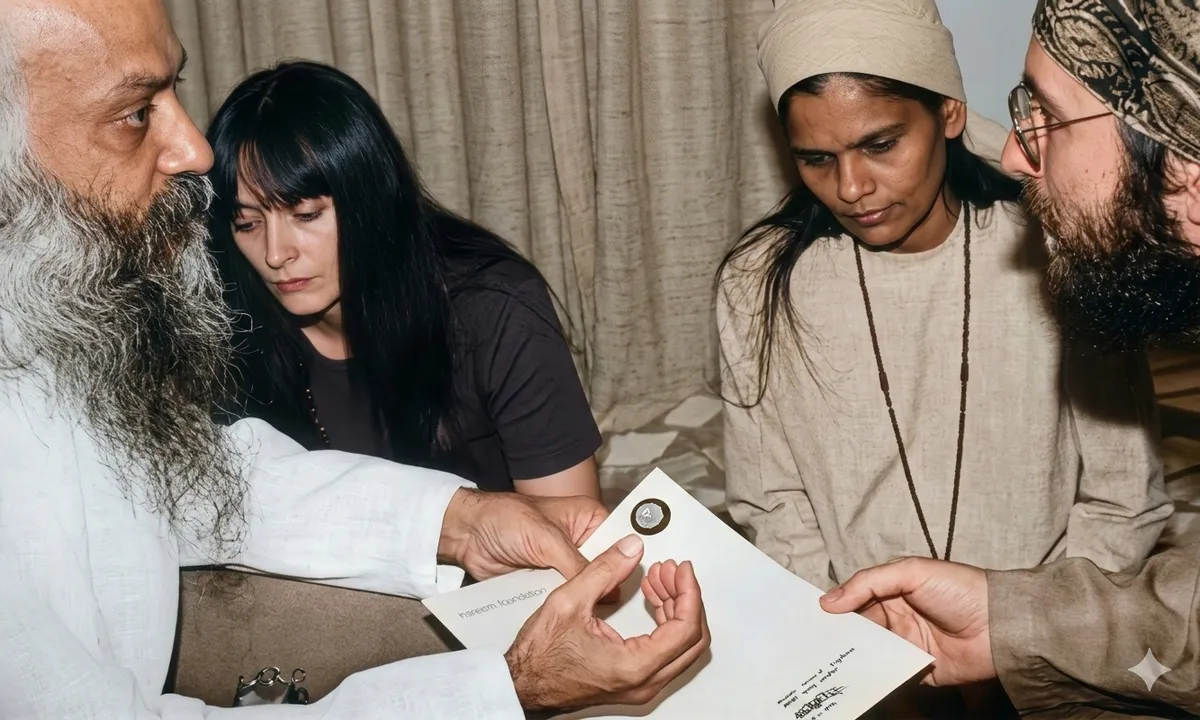
We don’t know who did it—probably some prudes worried about “decency”—but their fuss shows fear of nakedness, not real spirituality.
From the Discourses
Passages where Osho speaks to this question — each links to the complete discourse.
Osho, you said that in the courtyard of a hotel in Bombay, a nude statue of a Jain Tirthankara was made to wear underpants. I want to know: who put them on?
That is why people are angry with me. Because I want the temples of Khajuraho to be built again. I want aarti to be waved again in Khajuraho’s temples, lamps to be lit again. They should not remain merely as ruins. I want that men and women as wondrous as Mahavira and Lalla should again walk this earth. I want to make this country young again. But the old are angry—very angry! The pundits, priests, traditionalists are angry. They feel I am corrupting religion. They don’t even know their own culture. Morarji Desai says that my existence is very harmful to India’s image; news of me should not go out into the world—otherwise India’s image will fall. Open a little of India’s history! Just four or six days ago, newspapers reported that near Chitrakoot a small new Khajuraho has been found—buried in the jungle amid ruins. It is even more…Read the full discourse →
Osho! Recently, the English magazine “New Delhi” published several photographs related to the group-psychotherapy groups running in the ashram. There has been a lot of discussion about them in newspapers and elsewhere—along with some misunderstandings. While I was in Delhi, many editors asked me, “What do you have to say about this?” Kindly say something about it.
Krishna Prem! Nakedness is man’s birthright. Existence created man naked. Clothes are man’s invention. To deny nakedness is to deny existence. If clothes are invented for convenience, that’s fine—if it’s cold, wear something to protect yourself from the elements. But the fundamental invention of clothing is not to protect from nature; it is to hide oneself. Behind clothes there is hypocrisy. That’s why whenever someone stands naked, your hypocrisy gets hurt. When Mahavira was naked, there was great opposition. There was even more when Lalla, the woman mystic of Kashmir, chose nakedness. But they were isolated cases; somehow we tolerated them. In my view, nakedness should be natural and effortless. Whenever convenient, people should have the natural right to be naked. Clothes conceal—and in that concealment lies all pornography. In concealment lies obscenity. You will not find obscenity among tribals, because they are naked. The more you hide, the more…Read the full discourse →
Osho, was Mahavira’s nakedness a part of his character or of his vision?
There are many facets. In fact—as I said last night—Mahavira had to do many things that don’t occur to us. If they did occur to us, we would immediately see what belongs to what. His nakedness is a part of Mahavira’s knowing—of his realization—not of his character. It is a part of his knowing because, as I said, if one is to relate to this vast cosmos, this mute existence, then even clothing becomes an obstacle. Clothes are such a great hindrance we scarcely even suspect it. And the newer the fabrics, the greater the hindrance. The latest materials sever your body completely from the surrounding environment; very little comes in, very little goes out. Different fabrics do different things. Cotton separates in one way, silk in another, wool in yet another. Newer fabrics—those with plastic or glass-like components—break the contact in still other ways. So for one who wants…Read the full discourse →
Osho! At the Simhastha fair in Ujjain, there used to be a big crowd at the spot where Naga sadhus put on sexual displays—like pulling a jeep tied to the penis, etc. Why are people so curious to perform naked displays and to watch nudity, and why do they praise them? And when nothing of the sort happens in your ashram, why are people still angry with you and your ashram?
That’s why those who fast long fall into the illusion that their sexuality has ended. Nothing has ended; it has only dried up. Feed them again and it is back. Nothing has changed. Jain monks fall into the illusion that they have conquered sex. But they eat so little that even the minimal needs of the body are not met. Sex arises when enough food goes in that it creates energy beyond your needs—then sex arises. Think of sex as the flowering of your life. A tree that gets no energy—what flowers will it produce? It won’t even grow leaves, forget flowers. It will remain a dry stalk. For centuries man has been branded a sinner. The result is that deep down each person has become highly curious and avid for the very things that are forbidden. Prohibition has a quality: deny something—taste arises. In what you forbid, the relish…Read the full discourse →
A friend has asked, Osho, why should we be religious when neither the beginning nor the end is known, and there is no trace of God or soul? The enlightened ones speak of truth—if that truth is real, why can’t they make everyone experience it?
No one is telling you to be religious—at least Lao Tzu would not. The so-called religious people have created so much disturbance that it is better you do not become one of them. Lao Tzu does not say, “Be religious.” He simply says: be what you are. You may ask, why should I be what I am? Because that is the only thing you can be. There is no way to be anything else. Yes, you can try to be something else—and in that trying your life can be wasted. You may then say, why not waste life? No one can stop you. And precisely for this reason even the enlightened ones are defeated and cannot give you the knowledge of truth—because you say, why should we know the truth? What can the enlightened do? They can speak. They can try to awaken in you the thirst for the joy…Read the full discourse →