
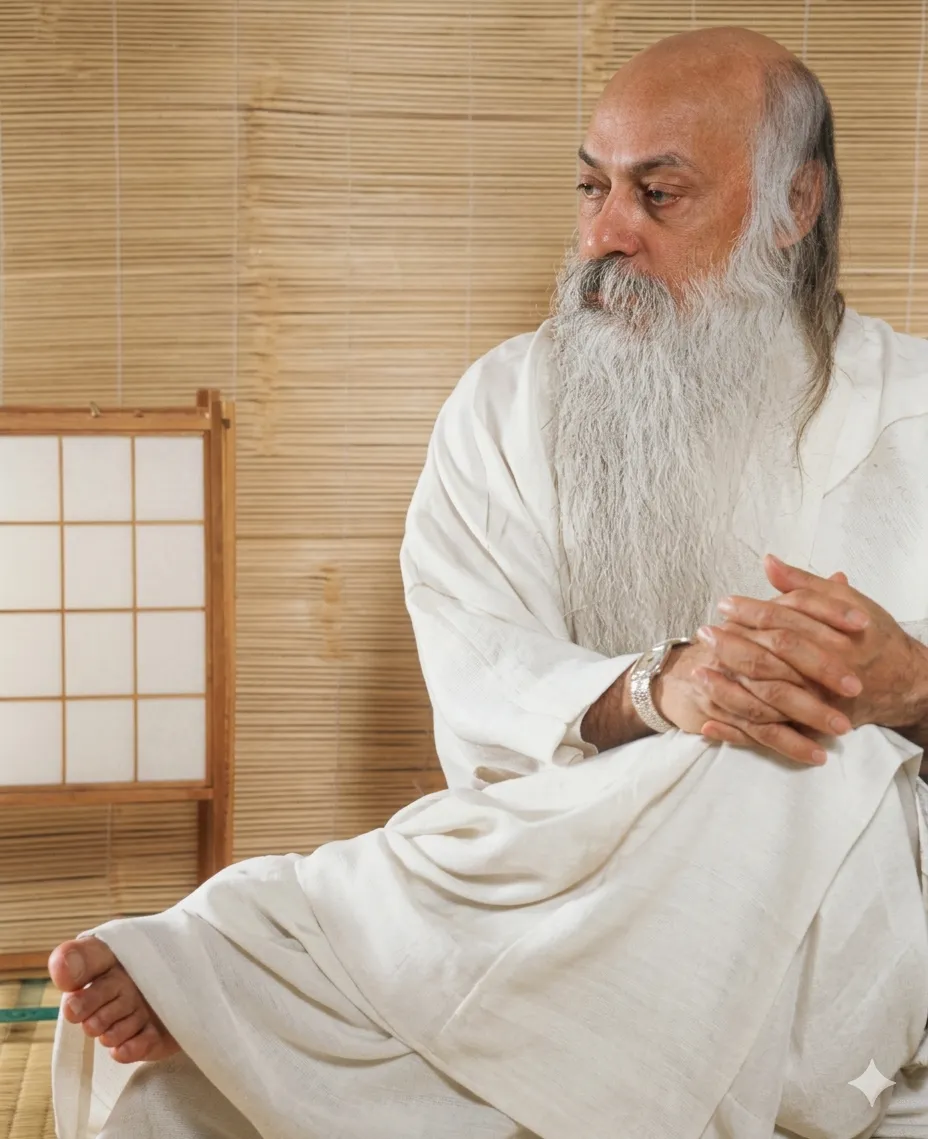
A 'confused mind' is just mind; real clarity comes when the mind stops—like when a storm ends and the calm ocean remains.
From the Discourses
Passages where Osho speaks to this question — each links to the complete discourse.
A friend has asked: Osho, confusion and clarity—what is that mind filled with delusion, so tangled, the confused mind? And what is clarity of mind? And what does it mean for the mind to be cleansed, fresh, and pure?
This needs a little understanding, because it will be useful for meditation and also for the art of dying. His question is precious. He asks, “What is this tangled mind?” But a mistake creeps in here. We say, “tangled mind, restless mind, confused mind.” That is where the mistake happens. What mistake? We are using two words: “tangled” and “mind.” The truth is, there is no such thing as a “tangled mind.” The state of tangling itself is what is called mind. There isn’t a confused mind; mind is confusion. It is not that there is an unquiet mind; the very name of unquietness is mind. And when unquietness is gone, it is not that the mind becomes quiet—rather, the mind is no more. Understand it this way: a storm has arisen on the ocean, the sea is turbulent, and you say “a restless storm.” Someone will say, “Restless storm?…Read the full discourse →
What is a mind filled with illusions? What is a very confused mind? What is clarity of mind?
This needs to be understood, because it will be useful for meditation as well as in learning the art of dying. He has asked a very significant question. He asks, "What is a confused mind?" But here we make a mistake. We say, "disturbed mind," "confused mind." This is where the mistake is. What is the mistake? The mistake is we are using two words -- confused and mind -- and the truth of the matter is that there is no such thing as a confused mind. Rather, the very state of confusion itself is mind. There is nothing like a confused mind. Mind is confusion. Mind is another name for confusion. And when there is no confusion does not mean that the mind has become peaceful; then there is no more mind at all. For example, there is a storm at sea, the sea is restless. Would you call…Read the full discourse →
You said last night that the more the mind grows, the more we know that the nature of the mind is confusion. But isn't it true that this growth of the mind also leads to clarity?
Whatsoever I was just saying is related to this. Yes, it leads to clarity, because only when you have a very mature mind do you become aware that you are confused. Even to become aware that mind is confusion, a very developed mind is needed. Those who are not aware that their mind is confusion are really not mature minds. They are childish, juvenile, still developing. Only a very mature mind can become aware of the quality of the mind, that it is confusion. And when you have developed the mind, only then is meditation possible, because meditation is the opposite goal. Meditation means no-mind. But how can you achieve a no-mind if you have not achieved a mind? So achieve a mind just to lose it. And don't think that if ultimately one has to reach the state of no-mind, then what is the use of achieving a mind?…Read the full discourse →
Osho, what is mind?
As I see it, mind is not an object—it is only a function. This fan is running. There is the fan’s moving state and there is its still state. When the fan stops, we do not ask where the “movement” went, because movement was not an object. Movement was simply an activity of the fan. The fan that was moving has become still. The being within us—its moving state is the mind, and its still state is the soul.Read the full discourse →
Beloved Osho, what is the difference between the emptiness of the child before the formation of the ego and the awakened childlikeness of a buddha?
Whether you are for it or against it doesn't matter -- your concern shows where your ego is hanging. And I will include the capitalist in it also: his whole concern is how to gather money, hoard money -- because money has power over matter. You can purchase any material thing through money. You cannot purchase anything spiritual, you cannot purchase anything that has any intrinsic value; you can purchase only things. If you want to purchase love, you cannot purchase; but you can purchase sex. Sex is the material part of love. Through money, matter can be purchased, possessed. Now you will be surprised: I include the communist and the capitalist both in the same category, and they are enemies, just as I include Charvaka and Mahatma Gandhi in the same category, and they are enemies. They are enemies, but their concern is the same. The capitalist is trying…Read the full discourse →