
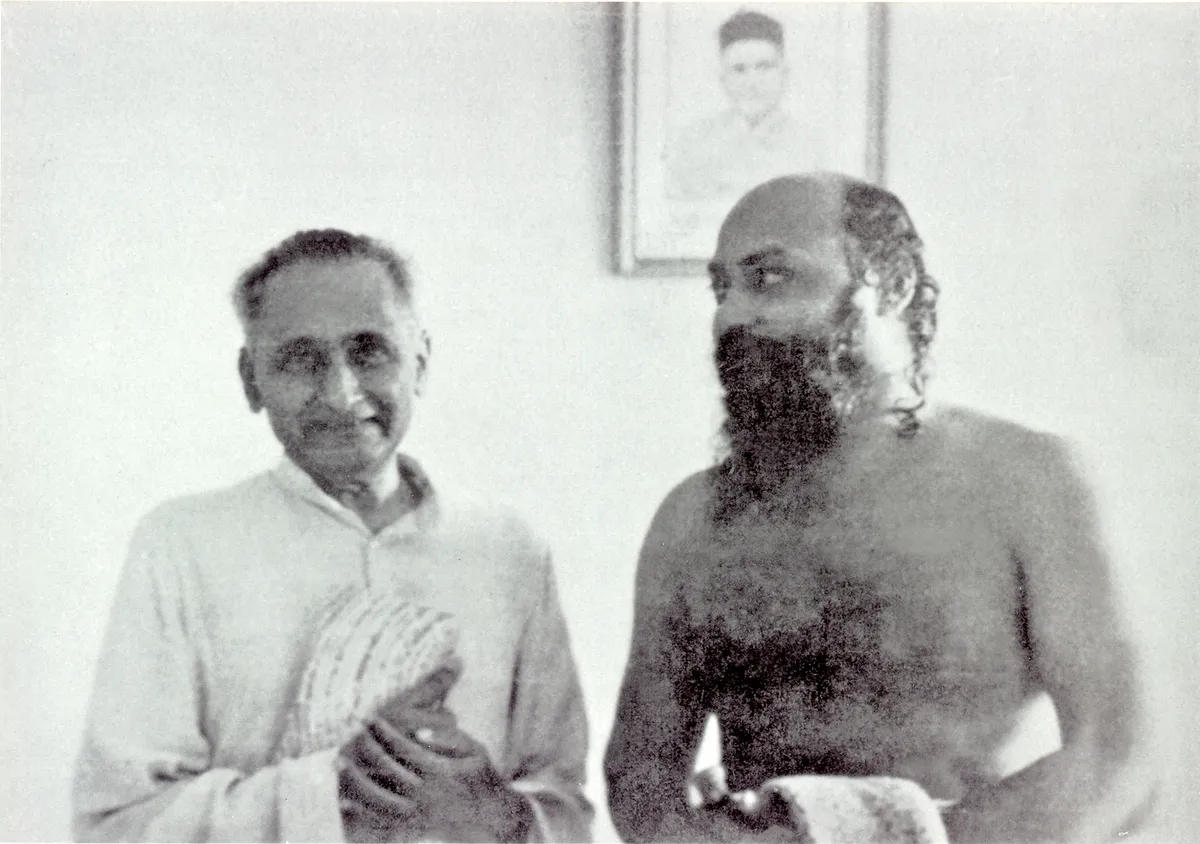
According to Osho, engaging inwardly with the master catalyzes a revolution: your old meanings fall away (mountains aren’t mountains), desires like sex, socializing, and even food may recede, and you can feel disoriented. Matured, this dialogue ripens into samadhi’s simplicity—mountains again are mountains—so you return to ordinary life, eating and working naturally, carrying the Himalayas within while living in the marketplace.
It first shakes up your usual likes and habits, then settles into a quiet ease where you live normally outside but are peaceful inside.
From the Discourses
Passages where Osho speaks to this question — each links to the complete discourse.
Question: AUM THAT IS THE WHOLE. THIS IS THE WHOLE. FROM WHOLENESS EMERGES WHOLENESS. WHOLENESS COMING FROM WHOLENESS, WHOLENESS STILL REMAINS. AT THE HEART OF THIS PHENOMENAL WORLD, WITHIN ALL ITS CHANGING FORMS, DWELLS THE UNCHANGING LORD. SO, GO BEYOND THE CHANGING, AND, ENJOYING THE INNER, CEASE TO TAKE FOR YOURSELF WHAT TO OTHERS ARE RICHES. CONTINUING TO ACT IN THE WORLD, ONE MAY ASPIRE TO BE ONE HUNDRED. THUS, AND ONLY THUS, CAN A MAN BE FREE FROM THE BINDING INFLUENCE OF ACTION. UNILLUMINED INDEED ARE THOSE WORLDS CLOUDED BY THE BLINDING DARKNESS OF IGNORANCE. INTO THIS DEATH SINK ALL THOSE WHO SLAY THE SELF. AUM PURNAMADAH PURNAMIDAM PURNAT PURNAMUDACHYATE PURNASYA PURNAMADAYA PURNAMEVA VASHISHYATE. What Carl Gustav Jung calls synchronicity explains exactly what happens between a Master and a disciple. It is not the same as what happens between a teacher and a student.Read the full discourse →
Osho, every time after speaking I feel I have been dishonest; only when I remain silent do I feel honest—completely honest with myself. Why is this?
At Harvard University, psychologists ran an experiment. They split a class into two groups. To one half, in a separate room, they said: “The problem on the board is very difficult. There is hardly any hope that any of you can solve it. Even students in higher classes struggle with it. Only great mathematicians can solve it. We’re giving it just to see—by chance, perhaps—there is no assurance at all—maybe one of you might head a little in the right direction. Solving it completely is impossible, still try.” They tried. Out of fifteen students, only three solved it. To the other fifteen, in another room, they said—about the same problem—“It’s very simple. So simple that if any of you fail to solve it, it would be surprising. Students in lower classes have solved it.” Amazingly, twelve solved it; only three failed. What happened? Your confidence is borrowed—others hand it to…Read the full discourse →
Osho, Sahjobai’s path is love, devotion, surrender, and worship of the guru. Then why does she begin to emphasize inwardness, the inner journey, and dispassion?
The guru is outside. But the outer guru is merely a ladder leading to the inner guru. When you lay yourself completely at the feet of the outer guru, open your eyes and you will find that the outer guru has bid you farewell. It was your outward mode of seeing that made the guru appear outside. Suddenly you find this music is resounding within. This is no one outside—someone within is speaking. I have heard: a fakir came to a mosque. Perhaps he was a little late; people were already dispersing. He said, “Brothers, the congregation is breaking up so quickly. Why such haste? Pray more slowly, more gently.” One man said, “You don’t blame yourself for coming late, and you blame the congregation. The Prophet has completed the prayer.” This is a story from Muhammad’s time. “The Prophet has completed the prayer. Now what is there to do,…Read the full discourse →
The song ends:
THE SUPREME UNDERSTANDING TRANSCENDS ALL THIS AND THAT. THE SUPREME ACTION EMBRACES GREAT RESOURCEFULNESS WITHOUT ATTACHMENT. THE SUPREME ACCOMPLISHMENT IS TO REALIZE IMMANENCE WITHOUT HOPE. AT FIRST A YOGI FEELS HIS MIND IS TUMBLING LIKE A WATERFALL; IN MID-COURSE, LIKE THE GANGES, IT FLOWS ON SLOW AND GENTLE; IN THE END IT IS A GREAT VAST OCEAN WHERE THE LIGHTS OF SON AND MOTHER MERGE IN ONE. Zen masters -- Bodhidharma, Rinzai, Bokuju -- they have been pictured in the first state. That's why they are so ferocious. They look like roaring lions, they look like they will kill you. If you look at their eyes, their eyes are volcanoes, fire jumps at you; they are like shocks. They have been pictured in the first satori state for certain reasons, because Zen people know that the first is the problem; and if you know Bodhidharma in this state, when the…Read the full discourse →
Osho, you spoke of the inner Sadguru. Please shed light on what it means. And kindly tell us when and how that Sadguru awakens.
Samadhi! The Sadguru is a symbol. It means that meditation awakens in you, awareness awakens in you; that you do not live in a stupor—just that much. In your getting up, sitting down, walking, there is wakefulness, discernment. Within you a lamp of alertness keeps burning. Whatever you do, do it with awareness. If someone abuses you, let anger not arise in unconsciousness. Let it not happen that afterward you have to repent—“Oh, what did I do? Why didn’t I remember?” If someone abuses you, respond to that too with awareness—calm, cool, descending within, seated in your inmost core, respond. And you will be amazed: then the response to abuse cannot be anger; it will be compassion. Wherever awareness comes, the embers of anger are extinguished. The very embers of anger become flowers of compassion. Right now, whatever you are doing is in unawareness. Walking, getting up, sitting—everything is mechanical.…Read the full discourse →