
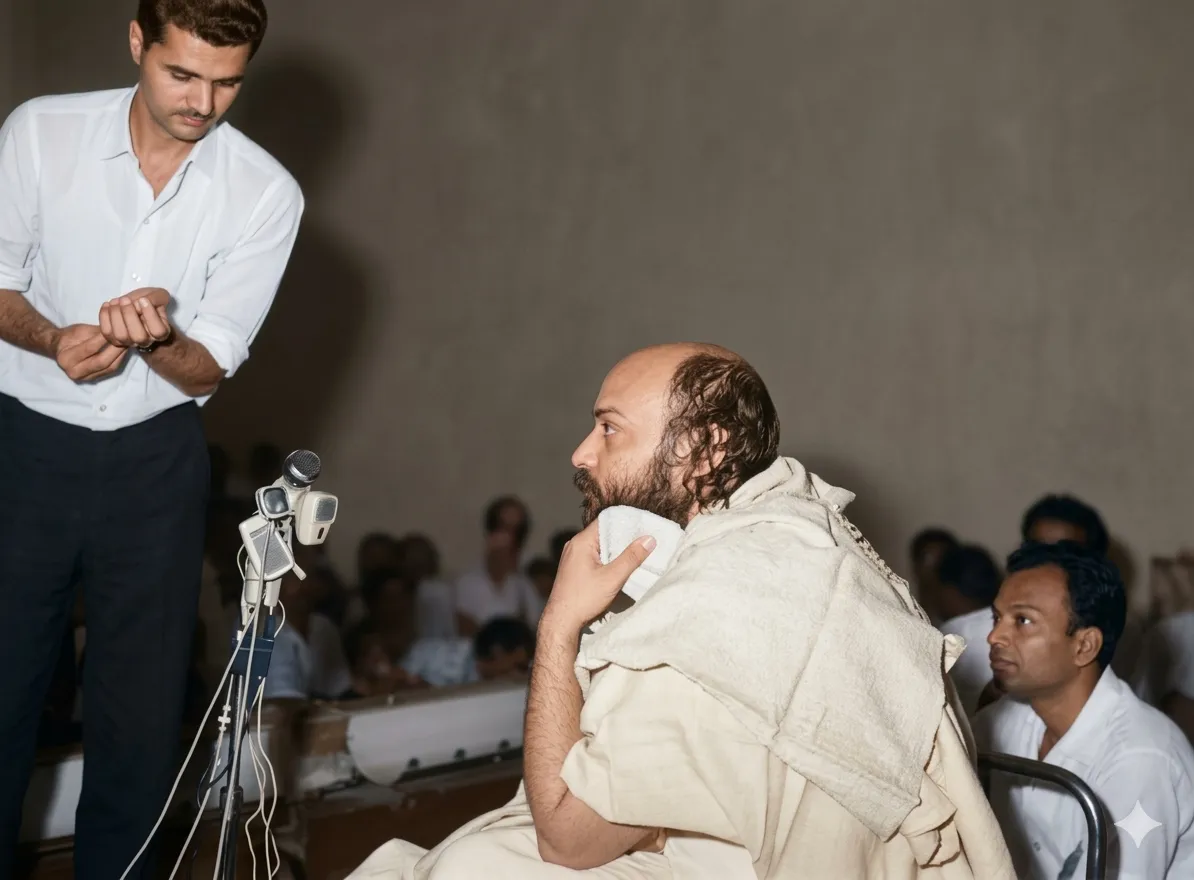
Osho's perspective on Zen
When Osho Spoke About Zen
Passages from the discourses where this theme comes alive.
Osho, what is the zen approach towards sex? The zen people seem to have a neuter gender, or asexual aura about them.
Remember, the business people are ascetic people. They have devoted everything to money. Now a man who knows love and has known the thrill of love and the ecstasy of it will not be competitive. He will be happy if he can get his daily bread. That is the meaning of Jesus' prayer: "Give us our daily bread." That is more than enough. Now Jesus looks foolish. He should have asked, "Give us a bigger bank balance." He asks only for the daily bread? A joyous man never asks for more than that. The joy is so fulfilling. It is only unfulfilled beings who are competitive, because they think life is not here, it is there. "I have to reach to Delhi and become the president," or to the White House and become this or that. "I have to go there, joy is there" -- because they know here there…
What is the difference between waiting for godot and waiting for god?
It is as if the sun has risen in the morning and you are sitting in your room with closed doors and windows, in darkness. Open the doors, you become available to the sun. The sun was already available -- just the meeting happens. You cannot wait for God. All waiting is for Godot. Godot means the one who never comes, who CANNOT come, whose arrival is impossible. And the only impossible thing is that which has already happened -- how can it happen again? You are alive, and you are waiting for life, Now, this is ridiculous. The real man of religion does not think in terms of God. He thinks in terms of life or, even better, of living -- because life can again become an abstract idea. Living, moment-to-moment living. In that very living, one knows what God is, because one knows who one is. Your idea…
Osho, why have you called this series of discourses: "walking in zen, sitting in zen"?
Concentration is not meditation, concentration is an effort of the mind to focus itself. It has certain purposes of its own. It is a method in science -- useful, but it is not meditation. Contemplation is a little vague, more abstract. In concentration, the object is more visible; in contemplation, the object is abstract. You concentrate on a flame of light; you contemplate on love. And in Christianity, contemplation and meditation have become synonymous. Meditation should be given a new meaning, a new fragrance -- the fragrance of Zen. Concentration is of the mind, meditation is not of the mind at all, and contemplation is just in between, in a limbo. It is something of the mind and something of the no-mind, a mixture; a state where mind and no-mind meet, the boundary. One has to reach to the absolute state of awareness: that is Zen. You cannot do it…
Question: BELOVED OSHO, HOW DOES THE MAN OF ZEN TAKE HIS TEA? For the man of Zen everything is sacred -- even taking a cup of tea. Whatever he does, he does as if he is in a holy space. There is a story about Moses. When he went on Mount Sinai to meet God and to receive the Ten Commandments, he saw a miracle happening: a green bush, lush green, and inside it a beautiful flame, fire. As he approached it somebody shouted from the bush, "Take your shoes off. This is holy ground." The Judaic interpretation is that the flame was God himself. That's why the bush was not burning, because God's fire is cool. And Moses unconsciously was entering into the area which was like a temple or a synagogue: the living God was there. He took his shoes off and went in.
You’re not lazy—truth is already inside you; relax, be aware, and let it show.
AI Confidence Score: 92%
Read Original Discourse →
Are the Upanishads and Zen the same?
definition
Upanishads are like learning by holding a wise teacher’s hand; Zen is like finding it alone—but both reach the same mountain top.
AI Confidence Score: 97%
Read Original Discourse →
It’s a playful riddle mixing “forever” and “next time” to stop thinking so you can feel the living moment.
AI Confidence Score: 97%
Read Original Discourse →
Could one define Zen as 'hitting the mark'?
definition
Zen isn’t about trying to hit a bullseye; there’s no bullseye—you’re already home, so just be.
AI Confidence Score: 98%
Read Original Discourse →
They teach the same clear watching of experience, but Zen didn’t directly come from that old book.
AI Confidence Score: 92%
Read Original Discourse →
Because Russia dropped belief in a boss-in-the-sky, it can more easily try Zen-like, no-belief meditation—if it keeps old religions out and learns simple here-now awareness.
AI Confidence Score: 92%
Read Original Discourse →
AI Confidence Score: 47%
Read Original Discourse →
How does one hand clap?
definition
It means there’s a quiet, always-playing sound of God inside you, heard when you relax, open up, and listen within.
AI Confidence Score: 97%
Read Original Discourse →
Drink tea like it’s holy—be silent, notice the sounds, smells, and each sip, feel grateful, and let your busy self rest.
AI Confidence Score: 98%
Read Original Discourse →
When it is real, your happiness keeps shining on its own; test it in everyday life, and if it fades, drop pretending and return to simple awareness.
AI Confidence Score: 84%
Read Original Discourse →
AI Confidence Score: 96%
Read Original Discourse →
Is Zen against politics?
definition
AI Confidence Score: 97%
Read Original Discourse →
Is Zen full of zest, zip, zap, and zing?
definition
Zen means stop waiting for later, drop extra thoughts, and joyfully live this very moment with full energy.
AI Confidence Score: 99%
Read Original Discourse →
Is Zen the path of surrender?
definition
Yes: Zen means stop struggling and trust life, like floating in a river instead of fighting the water.
AI Confidence Score: 78%
Read Original Discourse →
Zen doesn’t play “who’s best”; people wake up at different times, and teachers just help you find what fits you.
AI Confidence Score: 97%
Read Original Discourse →
Yes—Zen masters do surprising, playful things to wake you up inside, because what matters is awareness, not rules or winning.
AI Confidence Score: 97%
Read Original Discourse →
They’re just different ways of pointing you to feel around your belly button area; try below it, but find your own spot by quiet breathing and sensing.
AI Confidence Score: 94%
Read Original Discourse →
Most Western Zen is just talk from books; to make it real, drop the big thinking and ego and experience it yourself.
AI Confidence Score: 95%
Read Original Discourse →
If you feel a hit in zazen, it’s your mind pretending—like a dream—so just notice it and stay aware.
AI Confidence Score: 95%
Read Original Discourse →
Treat Joshu gently and pay close attention, because he’s about to wake up inside—like a bud about to bloom.
AI Confidence Score: 96%
Read Original Discourse →
Zen says nobody can hand you truth; you discover it in deep inner quiet, often awakened by a wise friend’s silent presence.
AI Confidence Score: 97%
Read Original Discourse →
What does it mean to have too much Zen?
definition
AI Confidence Score: 56%
Read Original Discourse →
Don’t try to grab Zen—stop reaching outward and relax inward, because you already are it.
AI Confidence Score: 96%
Read Original Discourse →
It means you were never really stuck—the trap was a dream, and by waking up you see you’re already free right now.
AI Confidence Score: 98%
Read Original Discourse →
When your mind gets very quiet, even thoughts of your teacher must be let go—pretend to cut them away—so you can be completely empty and free.
AI Confidence Score: 97%
Read Original Discourse →
Profound Quotes on Zen
Explore our structured collection of meaning-mapped quotes regarding Zen.