
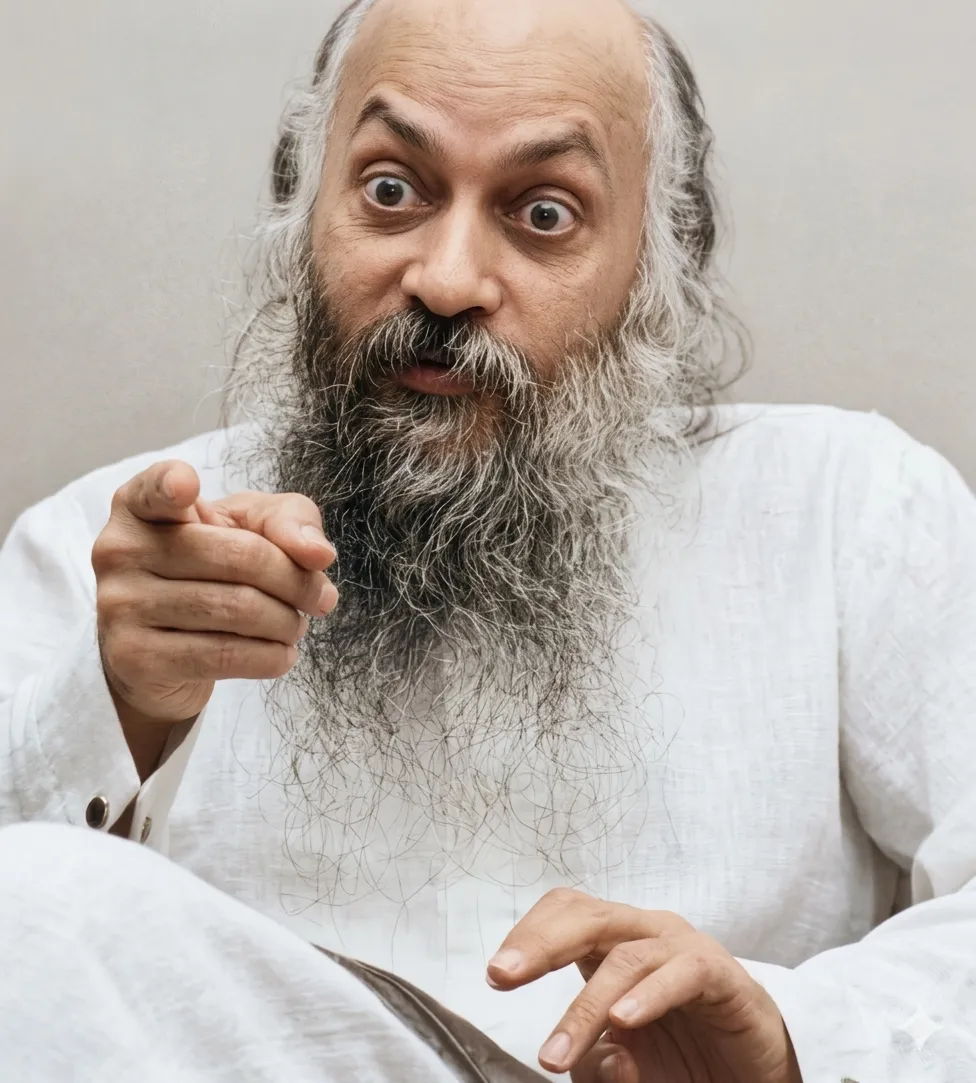
Osho's perspective on Wisdom
When Osho Spoke About Wisdom
Passages from the discourses where this theme comes alive.
Osho, it is a great surprise that all our questions are old and stale, while your answers are so new and fresh. What is the secret?
Because you think your questions. Whatever comes out of thinking becomes stale. Thinking can only be of the old; there is no thinking of the new. How will you think the new? That which you have not known at all, with which you have no acquaintance—how will its form arise in your mind? You search from memory. Even if you put a little paint and polish on it, your questions cannot be new; they remain old, because whatever is born of the mind is old. Mind is the name of the old. Mind means the dead. Mind means what has passed. Mind means what has already been experienced. So whatever you have experienced, heard, read, thought—this is the mind’s storehouse. From that you search out your questions; therefore they will be old and stale. When I give you an answer, it has nothing to do with the mind. I do…
ओशो, बड़े आश्चर्य की बात है कि हमारे सभी प्रश्न पुराने और बासी होते हैं, और आपके उत्तर इतने नये और ताजा होते हैं। इसका राज क्या है?
चूंकि आप प्रश्न सोचते हैं। जो भी सोच से आयेगा, वह बासा हो जायेगा। क्योंकि सोचना सिर्फ पुराने का हो सकता है, नये का कोई सोचना नहीं हो सकता। नये को तुम सोचोगे कैसे? जिसे तुमने जाना ही नहीं, जिससे तुम्हारी कोई पहचान नहीं, उसका रूप तुम्हारे मन में बनेगा कैसे? तुम स्मृति से खोजते हो। तुम थोड़ा रंगरोगन भी करो तो भी तुम्हारे प्रश्न नये नहीं हो सकते, वे पुराने ही रहेंगे क्योंकि मन से जो भी पैदा होता है, वह पुराना होता है। मन पुराने का नाम है। मन का अर्थ है, मरा हुआ। मन का अर्थ है, बीत गया। मन का अर्थ है, अनुभव हो गया।
What is the difference between waiting for godot and waiting for god?
It is as if the sun has risen in the morning and you are sitting in your room with closed doors and windows, in darkness. Open the doors, you become available to the sun. The sun was already available -- just the meeting happens. You cannot wait for God. All waiting is for Godot. Godot means the one who never comes, who CANNOT come, whose arrival is impossible. And the only impossible thing is that which has already happened -- how can it happen again? You are alive, and you are waiting for life, Now, this is ridiculous. The real man of religion does not think in terms of God. He thinks in terms of life or, even better, of living -- because life can again become an abstract idea. Living, moment-to-moment living. In that very living, one knows what God is, because one knows who one is. Your idea…
Osho, why does there seem to be so much conflict between the world and God?
It is as if someone were sleeping deeply in this garden. The cuckoo comes and sings, birds are chattering, the sun rises, breezes dance through the trees; but someone is fast asleep. The breezes touch him, the birds’ songs echo at his ears, the sun’s rays play on his face, but he knows nothing. Then someone comes and shakes him awake. His eyes open—the glory of the sun is revealed, the song of the passing breeze is heard, suddenly the cuckoo’s call, the fragrance of flowers. Do you think something new has happened? Everything was already there, just as it is. Only this man has become new—nothing else has changed. The same garden, the same sun, the same flowers, the same birds—everything the same; only a small difference: he was asleep; he is awake. The meaning of “world” is: you are asleep in God. The meaning of “God” is: you…
पहला प्रश्न: ओशो, संसार और परमात्मा में इतना विरोध क्यों लगता है?
फिर कोई आए और उसे झकझोर कर जगा दे। आंख खुले सूरज की महिमा प्रकट हो, पास से गुजरती हवा का गीत सुनाई पड़े, अचानक कोयल की आवाज आए, फूलों की सुगंध आए, क्या तुम सोचते हो कुछ नया हो गया? सब था, सब वैसा का वैसा है, सिर्फ यह आदमी नया हो गया और कुछ नया नहीं हुआ है। वही बगीचा, वही सूरज, वही फूल, वही पक्षी, सब वही है, सिर्फ इस आदमी में थोड़ा फर्क पड़ा है, यह सोया था, यह जाग गया।
Osho, what is wisdom?
Stephen Crane writes: I met a seer, he held in his hands the book of wisdom. "Sir," I addressed him, "let me read.""Child..." he began. "Sir," I said, "think not that I am a child, for already I know much of that which you hold." "Ah, much!" he smiled. Then he opened the book and held it before me. Strange, that I should have gone so suddenly blind. Wisdom is not knowledge. The knowledgeable person cannot see it, he is blind. Only the innocent person can see it, only a child, one who knows nothing, one who functions from the state of not knowing, can know what wisdom is. Wisdom has nothing to do with knowledge, not at all; it has something to do with innocence. Something of the purity of the heart is a must, something of the emptiness of being is needed for wisdom to grow. "Only those…
What is the meaning of the four types of movement: physical, intellectual, emotional, and wisdom?
definitionWhat is the message for elders?
definitionWhat is the secret behind the freshness of answers compared to the staleness of questions?
definitionWhat is the significance of the verse from the Srimad Bhagavatam regarding the foolish and the wise?
definitionWhat is true wisdom?
definitionProfound Quotes on Wisdom
Explore our structured collection of meaning-mapped quotes regarding Wisdom.