
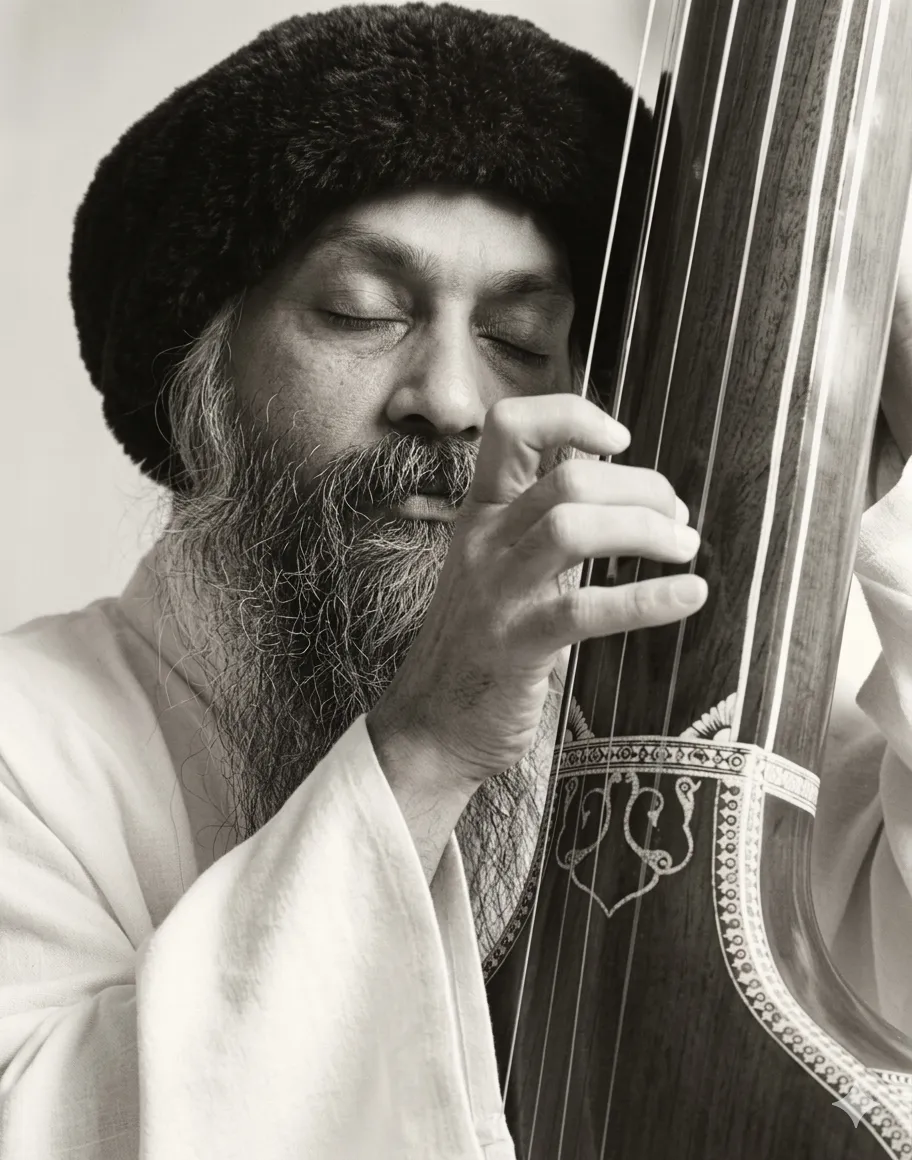
Believing in a God outside makes you a fearful follower; discovering truth inside makes you free, loving, and real.
From the Discourses
Passages where Osho speaks to this question — each links to the complete discourse.
Could one summarize the difference between a god-oriented religion and the quality of religiousness as the difference between a judge external to us, a projected conscience, and a witness within our consciousness?
A woman has to be out of the house just for one night. It does not matter whether she has made love to anybody or not. This is how Indian Mohammedans go on increasing their population. Obviously, one man with four wives, can give at least four children per year. The same is not possible for four husbands and one wife. They may not even give one child -- the four husbands may kill the child before it is born. So remember, your God-oriented religions are only conveniences for the society. They should not be called religions, they are only moral precepts to keep the society together, and in the least inconvenient way. It is not religiousness. Religiousness arises only as a blossoming of your own consciousness. God-oriented religions certainly create a conscience, but not consciousness. And many people have the false notion that conscience and consciousness are one. Their…
Osho, lately you have been speaking of godliness instead of God, and of religiousness instead of religion. Kindly explain godliness and religiousness in detail.
In the same way, I speak of religiousness instead of religion. For “religion” means fixed notions—beliefs, dogmas. “Religiousness” means a radiant state of consciousness: the inner becoming luminous, lit up. Right now there is darkness within—that is irreligion, or more precisely, non-religiousness. When the light of awareness spreads within, meditation awakens, the flame of meditation rises—that is religiousness. Religiousness is not a doctrine, just as godliness is not a person. Doctrines are worth two pennies; make them as you like, erase them as you like. A doctrine is a net of arguments—and man is the master of argument. The same logic can prove, the same logic can disprove. There is no trusting logic. What doctrine is there that cannot be refuted? What idea is there that cannot be supported? Logic is a prostitute—make it stand with anyone. Or say logic is a lawyer. There is not much difference between lawyers…
Religiousness means a man who is moving away from thinking to non-thinking, moving from mind to no-mind, moving from body to soul, moving from the outer to the inner. Ultimately religiousness makes you the center of a cyclone. All around you is a cyclone but you are a silent center, and out of that silent center has come all beautiful, still, small voices. The statements of the Upanishads are not the statements of people who belong to any religion. They are the statements of people who drown themselves in religiousness. Anything that is truthful, beautiful, good, has come out of the experience of religiousness. Satyam, shivam, sundram: truth, good, beauty. All the religions have beliefs, and every belief simply covers your ignorance. From the very beginning it is a belief -- you don't know. It is a blind man believing in light, it is a deaf man believing in music.
Osho, I was shocked to hear you say that god does not exist. Then the question arose in me: how can there be any religion without god? Isn't god the center and religion the circumference?
These are the three phases of the Hindu God: Brahma is the creative phase, he creates the world; Vishnu, the second phase, he maintains the world, and Shiva -- he destroys the world when the time comes to destroy it. In a way it is perfectly balanced; there are all the three functions that existence needs: creation, maintenance, and one day, de-creation. But if you look into the inner life of these three persons, you cannot believe it. One day, Vishnu and Brahma are quarreling about something. In the first place, the idea of a quarrel between two parts of God makes Him schizophrenic. If both your hands start fighting each other... and that's what you are doing in the mind -- one part fighting against the other part. Sometimes you become so split that you are already two persons, and sometimes you are many persons. God is already three…
Beloved Osho, what is religion?
In anger one day the archbishop took a motorboat and went to those three people who were sitting under a tree. He looked at them and he could not believe it: what kind of saints are these? In the very beginning he introduced himself and declared, "I am the archbishop." The three saints all touched his feet. Now he felt relaxed, "These are fools... and things are not yet gone so far that they cannot be controlled." He asked them, "Are you saints?" They looked at each other, and they said, "We have never heard the word. We are uneducated, uncultured. Don't talk Greek to us; just simply say what you mean." "My God," said the archbishop, "you don't know what a saint means? Do you know the Christian prayer?" Again they looked at each other, and nudged each other as if to say, "You tell him." The archbishop now…