
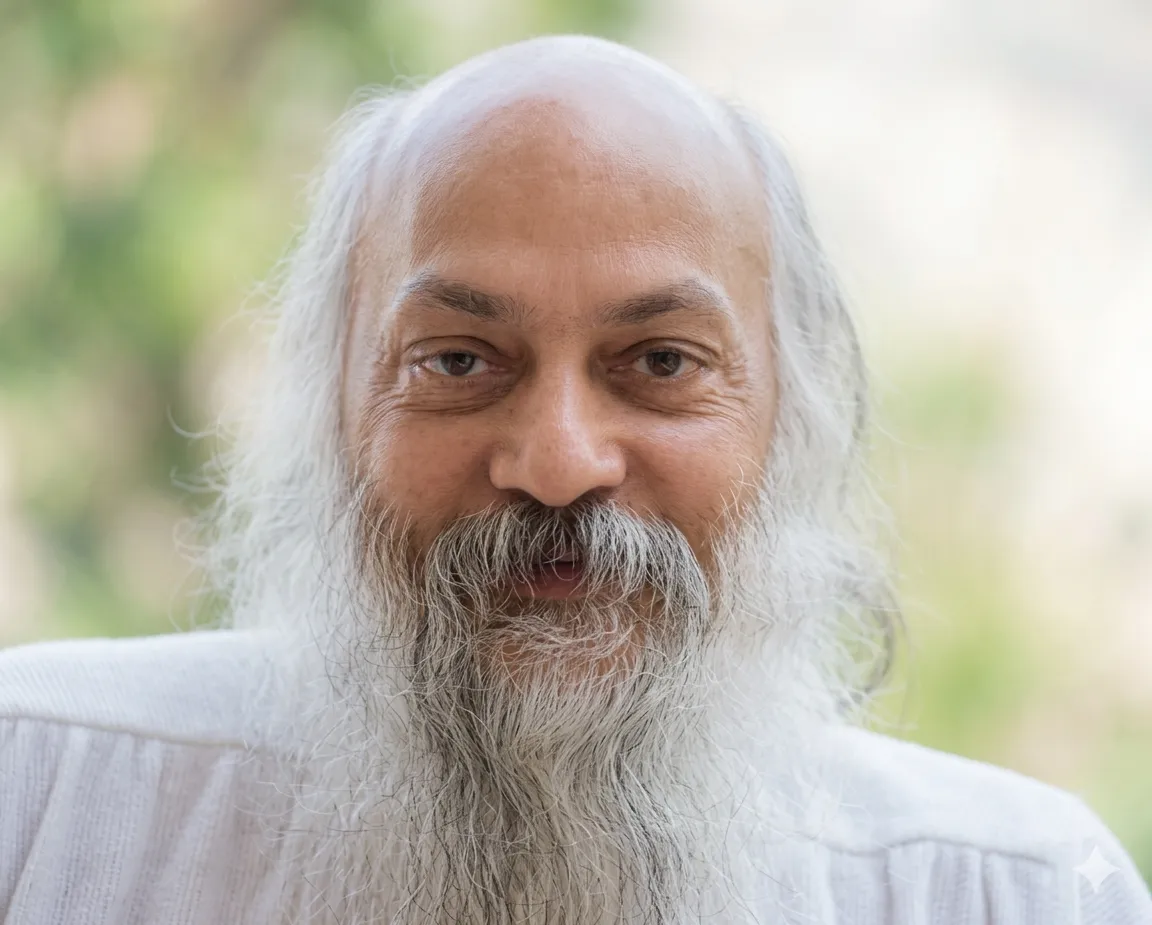
According to Osho, the truth Krishna knew cannot be uttered; the moment it's said, it becomes mere words. Calling him "Lord" and the Gita "scripture" are our projections that breed belief, not knowing. So the claim "I am the absolute truth" is, at best, a pointer - true only as silence behind the words. Real verification demands dropping concepts and entering wordless awareness yourself.
Words about truth aren’t the truth; get very quiet inside and discover it yourself instead of just believing Krishna or any book.
From the Discourses
Passages where Osho speaks to this question — each links to the complete discourse.
Are you saying that in the gita when lord krishna says "I am the absolute truth" he is not speaking the truth?
Firstly, I don't call him 'Lord Krishna'. It is our conception that he is a lord. It is our conception that the Gita is a scripture, it is our conception that it is religious, it is our conception that everything that is said in it is true. These are our conceptions. The moment we conceive of a thing as a scripture, then everything that is said in it becomes authoritative, true. Then there is no need to think about it. The truth can be known, but it cannot be expressed. Not even Krishna can express it. And the moment he expresses it, the truth becomes confined to words. If I have known the truth I can try to describe it, but it is never described. I can only try to describe the indescribableness of it. The only way I can help you is to deny your formulations. I can only…
Osho, will you regard the Gita as the authentic words of Krishna?
You ask whether I will regard the Gita as the authentic words of Krishna? If there has been a person like Krishna, then a discourse like the Gita would indeed be authentic. The question is not whether Krishna actually spoke it or not. The question is that if Krishna were to speak, he could only speak like this. And even if Krishna did not speak and Vyasa alone wrote the Gita, it doesn’t make much difference, because Vyasa could not write it unless there were a person like Krishna. In the end one has to say—let it be Vyasa who wrote it, it makes no difference—but Vyasa too would be speaking the Gita, no! What difference does it make? It makes no difference. Whether Krishna speaks, or Vyasa speaks, or A, B, C—someone else—speaks, to speak the Gita there must be someone within. This Gita doesn’t drop out of the…
Buddha said: that which carries you to the ultimate state is truth. We know no other criterion. “We call it a boat if it can carry us to the other shore. We know no other criterion.” It may be that what seems right by logic binds you to this shore. Will what seems right by reason be able to carry you across? And it may be that what seems wrong to this-shore logic becomes the boat to the other. Buddha said: the question is not what you believe; the question is what you become by believing it. The question is not your path; the question is what destination you reach by it. Path in itself is meaningless—destination! Logic in itself is meaningless—realization! And truth in itself is not meaningful—bliss! Krishna says, “Out of concern for your welfare, out of the wish for your good, I will speak.
Question: Osho, as your stream of discourse has begun to flow, the more we try to flow along with your verbal current, the more we run into difficulty. The trouble is that, like the straw you spoke of, we do not struggle; we too spread our hands and feet to float, yet your surge is so strong that we cannot flow. This morning there was a conversation about Sri Aurobindo. In The Way of the White Cloud you write somewhere: “Sometimes I take away the man, the subject, but do not take away the circumstances, that is, the object. Sometimes I take away the circumstances, but do not take away the man. Sometimes I take away both, the man and the circumstances, and sometimes I take away neither the man nor the circumstances.
Question: QUESTIONER: AS YOUR DISCOURSE GATHERS MOMENTUM WE ARE CARRIED AWAY WITH IT, WE GIVE UP RESISTING IT, RATHER WE TRY TO FLOW WITH YOU. BUT OUR DIFFICULTY IS THAT YOUR ENERGY IS SO POWERFUL THAT WE CANNOT KEEP PACE WITH YOU. IN THE BOOK NAMED "THE WAY OF THE WHITE CLOUD" IT IS SAID, "SOMETIMES I TAKE AWAY THE MAN, THE SUBJECT, BUT DO NOT TAKE AWAY THE CIRCUMSTANCES, THAT IS OBJECT. SOMETIMES I TAKE AWAY THE CIRCUMSTANCES, BUT DO NOT TAKE AWAY THE MAN. SOMETIMES I TAKE AWAY BOTH THE MAN AND THE CIRCUMSTANCES. AND SOMETIMES I TAKE AWAY NEITHER THE MAN NOR THE CIRCUMSTANCES." YOU SPOKE ABOUT SHREE ARVIND THIS MORNING. I AGREE WITH YOU TO A LARGE EXTENT, BUT I HAVE SOME RESERVATIONS IN REGARD TO YOUR INTERPRETATION OF ARVIND SEEING VISIONS OF KRISHNA.