
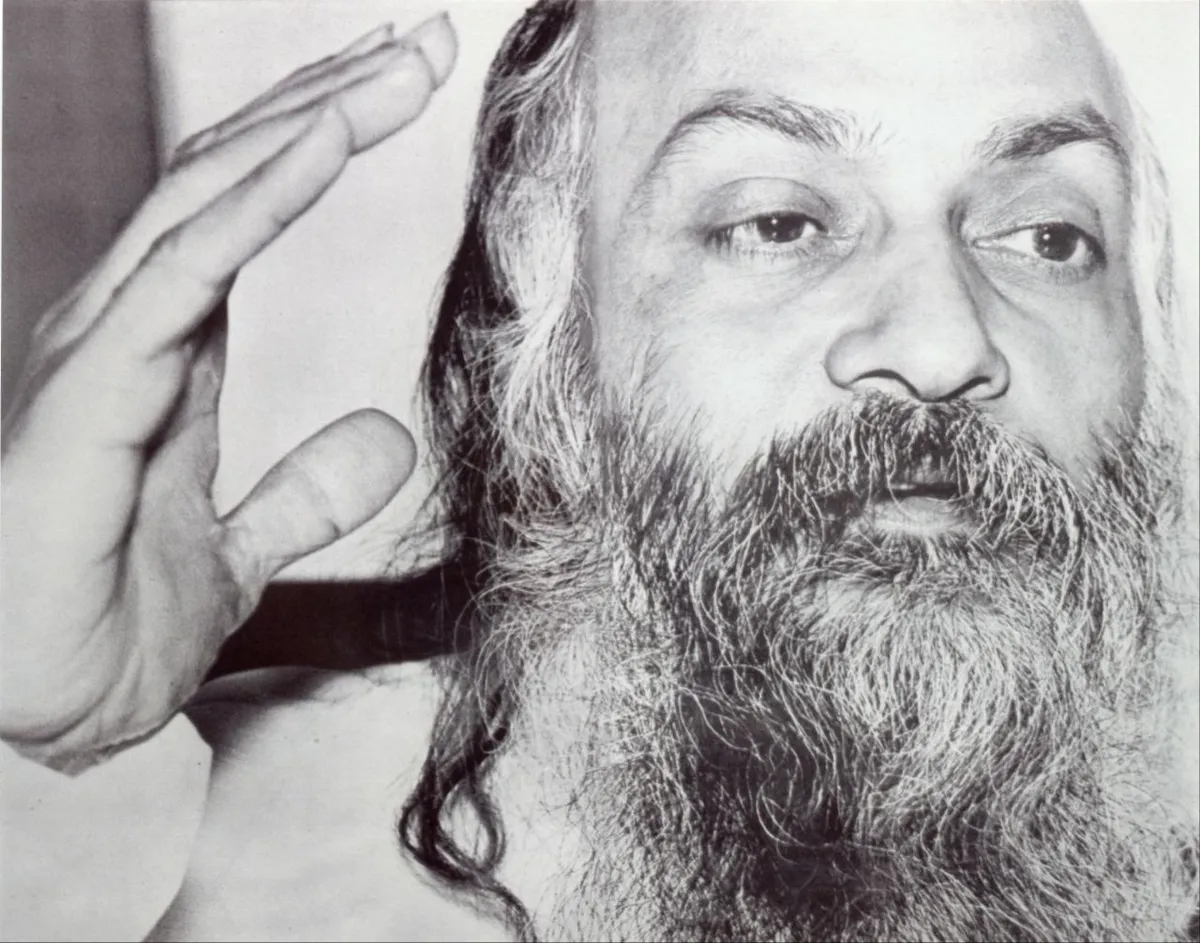
According to Osho, he 'beats the dead' to ensure that the ego—especially the politician’s lust for position—dies utterly and cannot resurrect at the slightest temptation. Satire is his scalpel: by exposing residual cravings, he prevents half-deaths that revive. True transformation demands the complete funeral of power-hunger and identity, leaving no shreds to return.
He jokes about the ‘dead’ so old ego and power-hunger are truly finished and can’t jump back to life.
From the Discourses
Passages where Osho speaks to this question — each links to the complete discourse.
Osho, why does love for the Lord make one mad?
People ask me: Where is the heart? One day a young man asked, “Where exactly in the body is the heart located?” I said to him, “Your head is inside you; you are inside the heart.” The heart is not inside you. Do not mistake these lungs, pumping air, for the heart—they are only an apparatus for purifying air. You are within the heart. The heart is bigger than you. The head is smaller than you. The web of thoughts that spreads inside the head—that is yours, your private world. It is not the world of truth; it is the world of falsity, the world of dreams. The moment your energy slips out of the noose of the head— the moment you step outside the head—the courtyard of the Vast opens: the courtyard of your heart. It is as vast as the sky. Within you lies a sky as immense…
Osho, Why does everyone praise a person after he dies—even those who spent his whole life condemning him? What’s the secret?
You ask, “Why do people praise a person after he dies?” They have to. That’s why at weddings people offer blessings and congratulations. The elders send blessings, contemporaries send best wishes—because the poor fellow is as good as dead! Finished! The end has come. They say when an ant is about to die it grows wings—well, the wedding wings have sprouted; the ant is near its end! Henceforth no future. Only darkness ahead. So give all the congratulations and blessings now. Bid a final farewell: “Brother, from here on, it’s between you and God!” That’s why you honor mahatmas and saints so much—the poor fellows are dead! Already dead! Walking corpses! If you don’t respect them, what else can you do? There’s nothing else left to do with them. If they were alive, there would be other ways to relate. Now all you can do is show as much reverence…
Question: OSHO! KILL ME, O LORD, KILL ME! KILL ME, I CRAVE DEATH. KILL THAT DEATH OSHO DIED AND SAW. I AM SUCH A STONE, I CAN NOT COMPLETELY MELT. I AM UPSET. WHAT SHOULD I DO? How does the ego die? The ego dies by accepting what you are. You say, I am fine as I am, where I am is good. I remain just as god made me. Whatever his will is, is my will. If you let go of tension for the future -- this should be, that should be -- the ego is gone. The ego lives on a foundation of past and future. Consider the fact a little. The ego claims that in the past I did this, I did that: it is all past. And ego says I will go on doing it, I will do it and show you. It is all future.
So the politician goes to temple and mosque; to the tombs of saints and seers; attends Ganesh festivals; if Jains invite him he lectures there; if Hindus invite him he praises the Gita; whatever you say—your wish! He only cares that you remain pleased with him. He doesn’t want to displease you. His life depends on you; if you are displeased, he is finished. Saints get into trouble because they say what the Divine wills. Understand the difference. Your will has no place. Whether you listen or not; whether you agree or get angry; whether you throw stones or nail him to a cross—it’s all fine; but his will is the Divine’s will. The Divine speaks what He wants to speak—and it often goes against your past. Against the style of life and thinking you have built. For the Divine speaks for your growth.
Question: Third question: Osho, why do you make so much fun of politicians? You are the flood, you are the drought—then why shouldn’t the farmer starve? You are the tractor, you are the trolley—have mercy, O merciful leader. If you’re beaten, we’re sad; we are slaves to your beard— Sometimes you keep it, sometimes you shave it—have mercy, O merciful leader. And what can you do with these leaders anyway! What use are they! Netaji has a great talent: between giving assurances and the regret of not keeping them, they put banknotes in their pockets and pull out an empty handkerchief! You’ve seen magicians: they put in an empty handkerchief and pull out banknotes. Leaders are magicians too: they put in banknotes—and pull out an empty handkerchief! The country is so tormented by these leaders—and not only this country, the whole world.