
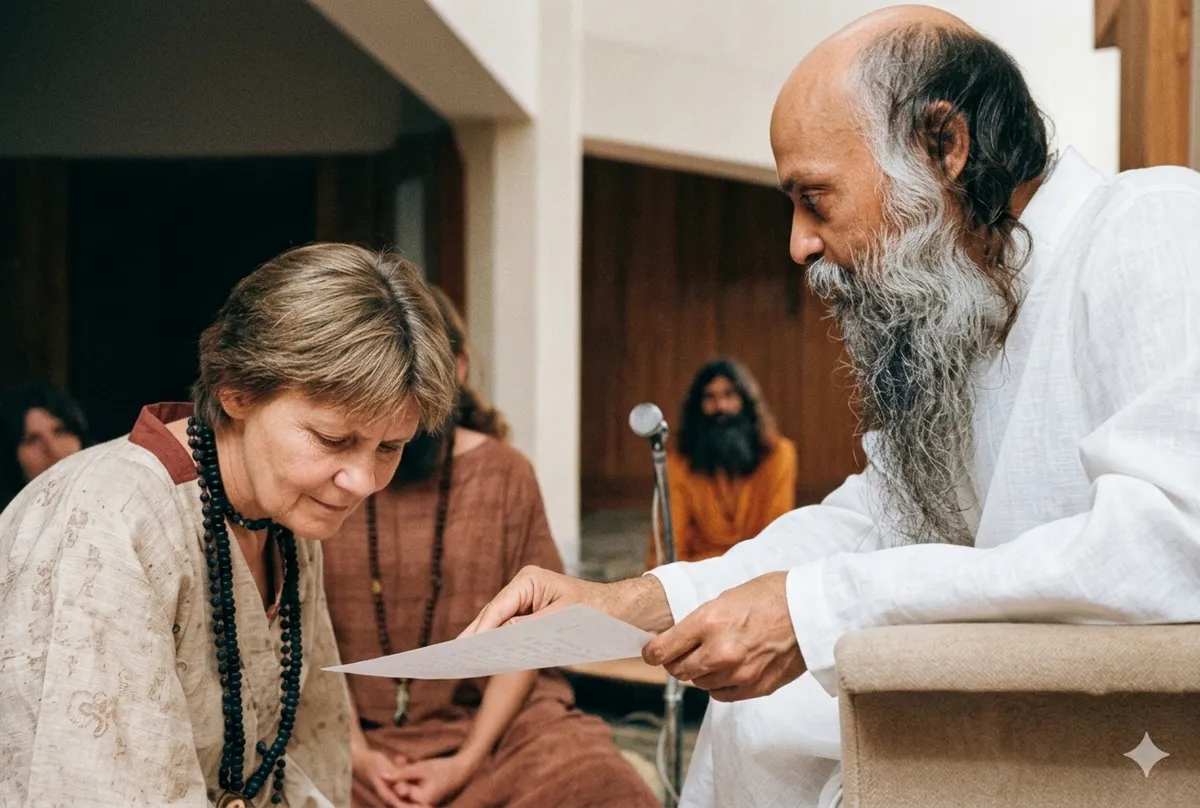
Zen doesn’t talk about love because it quietly lives it—you’re meant to feel it in someone’s presence, not hear it in words.
From the Discourses
Passages where Osho speaks to this question — each links to the complete discourse.
Question: Anando has asked: OUR BELOVED MASTER, LAST NIGHT I HEARD YOU REFER TO ZEN AS "THE GREAT LOVE AFFAIR." YET, RARELY ARE LOVE OR COMPASSION MENTIONED IN ZEN ANECDOTES OR DISCOURSES OF THE MASTERS. WHY IS THIS? Anando, when you love a person, you don't harass him by saying "I love you" again and again; otherwise, he will kill you. There is a limit to how much you can listen to "I love you." One gets fed up. Just try it on any lover and see how long the love remains. The boyfriend or the girlfriend will disappear, because you can eat sweets but there is a limit, otherwise sickness will follow. Zen never mentions love. My own understanding is that the man of Zen simply loves as he breathes. It is not something special, there is no need to mention it.
Osho, you are showering immense love on your disciples and others. But why aren't other enlightened beings like you, so full of love and compassion? Is it not true that love and compassion dawn with enlightenment? Why do other masters seem to be so dry and mere intellectuals in comparison with you?
His name is Karpatri. Karpatri simply means a man who eats from his hands, who uses his hands as a begging bowl. That is the meaning of the word karpatri: hands being used as a begging bowl. That's his only great achievement: that he uses his hands as a begging bowl, not that he is not eating well. You have to put sweets into his hands, then he will eat, then you have to put all kinds of things... It is such an unnecessary thing -- he can take them from the plates himself! One person is needed to take them from the plates and put them in his hands, then he eats them. This is his great spirituality! He is worshipped for it: that he does not use any plates, any spoons; nothing is being used, just his hands. But this has been worshipped for thousands of years. Mahavira…
Question: BELOVED OSHO, ONE DAY, WHILE NAN-SEN WAS LIVING IN A LITTLE HUT IN THE MOUNTAINS, A STRANGE MONK VISITED HIM JUST AS HE WAS PREPARING TO GO TO HIS WORK IN THE FIELDS. NAN-SEN WELCOMED HIM, SAYING, "PLEASE MAKE YOURSELF AT HOME. COOK ANYTHING YOU LIKE FOR YOUR LUNCH, THEN BRING SOME OF THE LEFTOVER FOOD TO ME ALONG THE ROAD LEADING TO MY WORK PLACE." NAN-SEN WORKED HARD UNTIL EVENING, AND CAME HOME VERY HUNGRY. THE STRANGER HAD COOKED AND ENJOYED A GOOD MEAL BY HIMSELF, THEN THROWN AWAY ALL PROVISIONS AND BROKEN ALL THE UTENSILS. NAN-SEN FOUND THE MONK SLEEPING PEACEFULLY IN THE EMPTY HUT, BUT WHEN HE STRETCHED HIS OWN TIRED BODY BESIDE THE STRANGER'S, THE LATTER GOT UP AND WENT AWAY. YEARS LATER, NAN-SEN TOLD THE ANECDOTE TO HIS DISCIPLES, WITH THE COMMENT, "HE WAS SUCH A GOOD MONK -- I MISS HIM EVEN NOW.
When bankei held his seclusion-weeks of meditation, pupils from many parts of japan came to attend. During one of these gatherings a pupil was caught stealing. The matter was reported to bankei with the request that the culprit be expelled. Bankei ignored the case.
LATER THE PUPIL WAS CAUGHT IN A SIMILAR ACT, AND AGAIN BANKEI DISREGARDED THE MATTER. THIS ANGERED THE OTHER PUPILS, WHO DREW UP A PETITION ASKING FOR THE DISMISSAL OF THE THIEF, STATING THAT OTHERWISE THEY WOULD LEAVE IN A BODY. WHEN BANKEI HAD READ THE PETITION HE CALLED EVERYONE BEFORE HIM. 'YOU ARE WISE BROTHERS,' HE TOLD THEM. 'YOU KNOW WHAT IS RIGHT AND WHAT IS NOT RIGHT. YOU MAY GO SOMEWHERE ELSE TO STUDY IF YOU WISH, BUT THIS POOR BROTHER DOES NOT EVEN KNOW RIGHT FROM WRONG. WHO WILL TEACH HIM IF I DO NOT? I AM GOING TO KEEP HIM HERE EVEN IF ALL THE REST OF YOU LEAVE.' A TORRENT OF TEARS CLEANSED THE FACE OF THE BROTHER WHO HAD STOLEN. ALL DESIRE TO STEAL HAD VANISHED. I was reading in some history book that twenty persons were expelled from England; they were sea robbers.…
The monk zuigan used to start every day by saying out loud to himself, "master, are you there?" and he would answer, "yes sir, I am." then he would say, "better sober up." and he would reply, "yes sir, I'll do that." then he would say, "look out now, don't let them fool you." and he would answer, "oh no sir, I won't, I won't."
In America, the whole market depends on how you can befool the customer, how you can create an idea in the minds of others. Now, a two-car garage is a must if you want to be happy; in America, a two-car garage is a must. Nobody asks why. If you are not happy with one car, how can you be happy with two cars? If there is fifty percent happiness with one car, how can you be happy with two cars? With one car you are unhappy; with two cars you will be doubly unhappy, that's all. The mathematics is simple. But there is advertisement, propaganda; the whole society exists by manipulating others. Happiness is something like a commodity in the market -- you go and purchase it, it has to be purchased. How can happiness be purchased? Happiness is not a commodity, it is not a thing; it is…