
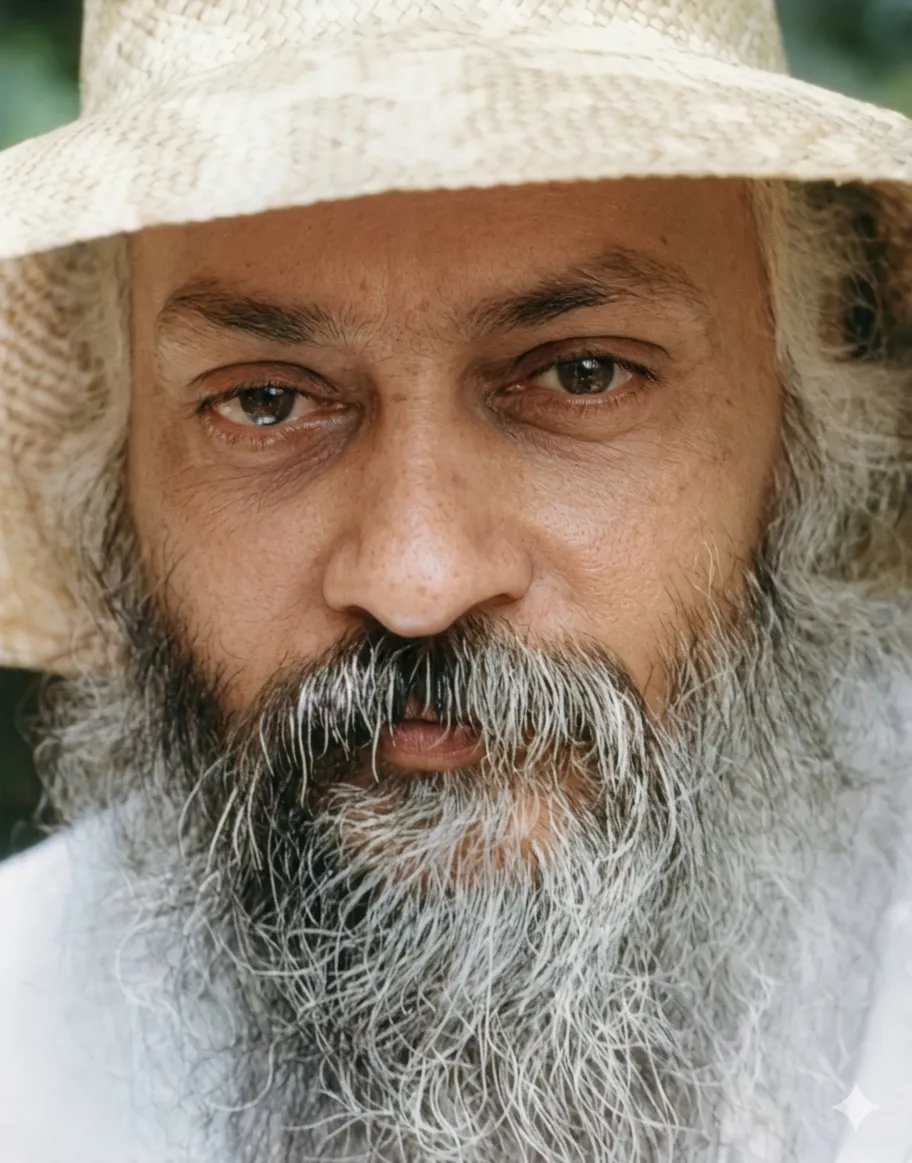
You can't explain real truth; you must drop beliefs and feel it directly, right now.
From the Discourses
Passages where Osho speaks to this question — each links to the complete discourse.
Hakuju served as a distinguished lecturer at the tendai-sect college. As he was lecturing with his customary zeal on the chinese classics one hot summer's afternoon, he noticed that a few of the students were dozing off. He stopped his lecturing in midsentence and said, "it is a hot afternoon, isn't it? Can't blame you for going to sleep. Mind if I join you?" with this, hakuju shut his textbook, and leaning well back in his chair, fell asleep. The class was dumbfounded, and those who had been dozing were awakened by his snores. All sat up in their seats and waited for the master to awaken.
Remember, I am not saying "perfect". His each moment is TOTAL. What is the difference? A perfect man, maybe, will never be angry. That is the idea of a perfect man: he will never be angry. But a total man can be angry. You can only be promised one thing, that he will be totally angry. It cannot be said he will not be angry. Only one thing can be said, that he will be totally angry; if ever he is angry he will be totally angry. It happened a scholar came to Raman Maharshi, and he was arguing and arguing and arguing; and nobody had seen Raman Maharshi ever being angry. Raman was saying again and again, "I am not a philosopher, and I don't believe in proofs and arguments, and I don't know any logic. I say'God is' because I have experienced it so." But the scholar wouldn't…
Once a tyro asked a zen master, "master, what is the first principle?" without hesitation the master replied,"if I were to tell you, it would become the second principle "
That's why people don't look inside: a hope one may be there. The day you look in, you are not. The day you look in, suddenly there is vast emptiness... and it is tremendously blissful, beautiful, peaceful. You are not there; then there is no noise. That's what Hui-neng means when he says, "There is no mirror of the mind. Where can the dust gather? To know this is to know all." Look within. People think "We are bad" but you are not, so how can badness gather? People think "We are good," but how is it possible? You are not there; how can you be good? People think "We are moral and immoral and this and that," but everything hangs on the idea of "I". To be good the "I" is needed first, to be virtuous the "I" is needed first. To be a sinner or to be a…
Osho, what is zen?
Sagar, IT IS ALMOST IMPOSSIBLE TO ANSWER because Zen is not a philosophy, it is not a doctrine. It is an experience, an experience of your own interiority, of your own subjectivity -- not an objective experience. If it were some object outside you, there would be a possibility of describing it, of analyzing it, of defining it. It is indefinable by its very nature; it is not within the grasp of intellect. It is an experience of dropping out of your mind, disappearing from your mind into your being, slipping out of the mind and entering into your being. The mind is a false entity; your being is your real face, your original face. The mind is created by the society, hence there are different kinds of minds -- Hindu mind, Christian mind, Jewish mind -- but the being is one; it is neither Christian nor Hindu nor Mohammedan.…