
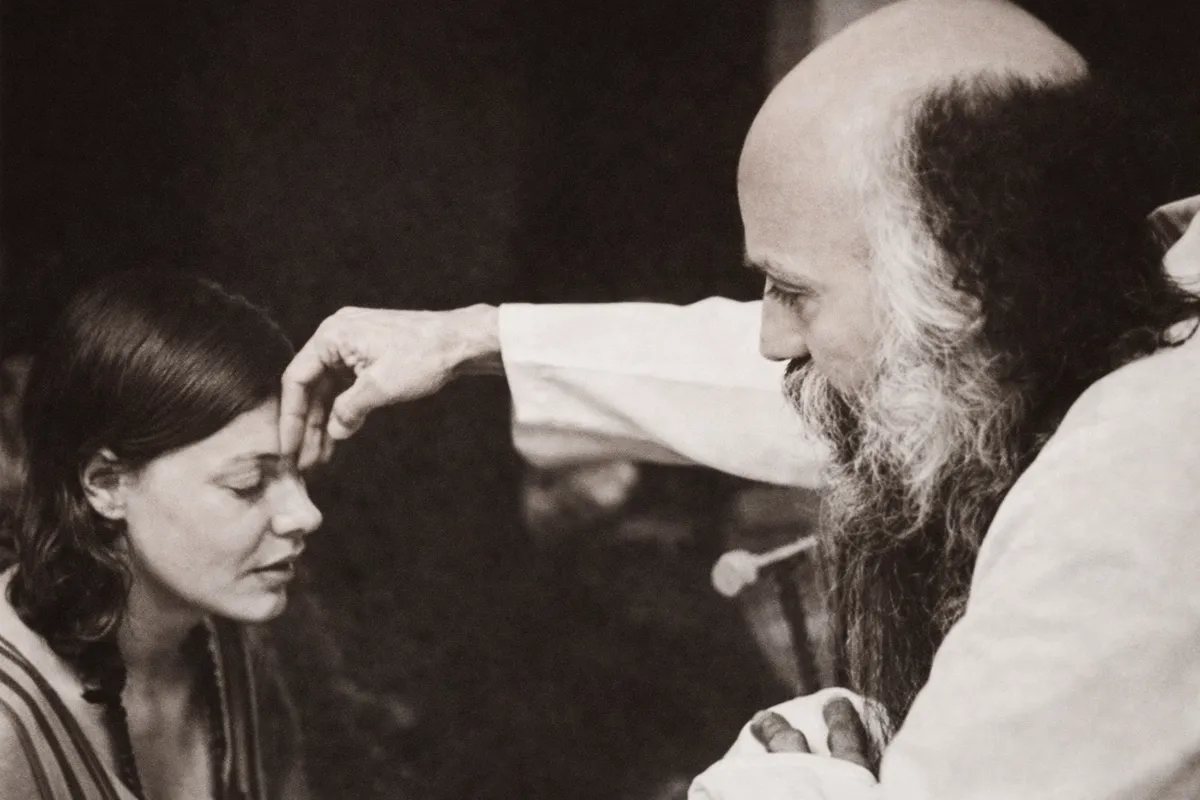
According to Osho, love’s intoxication is a sacred ecstasy in which the ego dissolves and you merge with existence itself—its beauty, splendor, and timelessness. In a single silent moment, infinity feels yours: truth, God, and liberation are tasted. There is childlike innocence, clear seeing, joyous freedom, and a dancing participation with wind, rain, rivers—the whole.
It feels like so much love that your small self disappears and everything becomes one peaceful, joyful dance.
From the Discourses
Passages where Osho speaks to this question — each links to the complete discourse.
OSHO: Love is the most intoxicating phenomenon. It is the wine that wells up within. It is not something chemical that comes from the outside, it is not even part of the body, not part of the mind either. It is the dance of the heart in tune with the whole. Love is your heart in deep harmony with the heart of the universe. Then there is great intoxication. And yet the intoxication does not make you unconscious; on the contrary it makes you more conscious than ever. That's the paradox of love: on one hand one is intoxicated, on the other hand one has never been so aware before. It is an intoxication that makes you wake up. HER SIX-YEAR-OLD DAUGHTER: PREM GARIMA, GLORY OF LOVE. NENE BECOMES MA PREM KUNDAN OSHO: It is by passing through the fire of love that one becomes one's real self.
Beloved Osho, modest though my experience of awareness is, when it is happening I feel intoxicated. It is a far more subtle, but headier drunkenness than anything that makes one unconscious. Is this a case of illusion or a case of divine wine?
You may have heard about sleepwalkers who get up in the middle of the night and without waking, with open eyes, without stumbling, reach directly to the kitchen, find the fridge, open it, eat anything to their heart's content, and in the day they are dieting! And the doctor is puzzled and they themselves are puzzled -- "What is the matter? The more I diet the more my weight is going up." And there are almost ten percent of people capable of somnambulism. They can walk in their sleep, they can do things, and in the morning they will be disturbed: "Who has done this?" And not just ordinary people; there are cases on record of very great geniuses. Madame Curie, one of the first women ever to receive a Nobel Prize, was struggling for three years to solve a mathematical problem, and was becoming almost hopeless. Every angle, every…
Question: Fourth question: Osho, for an hour to an hour and a half after the daily discourse, a kind of intoxication descends. In that time, far from talking, I don’t even feel like looking at anyone. A strange smile spreads on my face. Sometimes tears come, and then I want to be alone. If anyone disturbs me at that time, I feel irritable. Please say something. It’s going well. This is exactly how it should be. This is no temple; this is a tavern. If the intoxication doesn’t come here, then nothing has happened. If you don’t get blissfully drunk here, you’ve missed. There is no preaching on scriptures going on here; here wine is being poured. Here it’s the work of drunkards. The weak have no passage here. Here, drink me. And drown here so deeply that you lose all your senses.
Osho, you sit in the tavern and, every morning and evening, you pour brimming goblet after goblet of wine. I do get intoxicated by your wine, but I don’t lose consciousness. What should I do?
That is why even a Sufi like Omar Khayyam has been misunderstood. Whatever notion you have about Omar Khayyam is wrong. The wine he spoke of is not the wine sold in taverns. The beloved he praised is not flesh-and-bone. He called the Beloved—God. And he called wine—devotion. Fitzgerald, who first translated Omar Khayyam into English, because of whom Omar became world-famous, did not understand him. Fitzgerald thought wine meant wine. He was a Western man. He took two plus two to be four. He took “wine” as wine and “beloved” as beloved. The subtle intention of the Sufis fell into a great misunderstanding. On the basis of Fitzgerald’s version the whole world translated him, and the mistake spread everywhere. Today taverns are named “Omar Khayyam.” Nothing could be more foolish. Temples should bear Omar Khayyam’s name—not taverns. Because the tavern he spoke of is of another kind. There is…
Osho, an ecstasy is spreading within me, but I’m afraid it might slip away!
He says: I know—but it does not come to the tongue. If one knows “I am Brahman,” what fear remains then—that Muslims will be annoyed, that they will hang me, who will say what, what trouble may come? Even that fear? Whenever Mansoor was intoxicated, that one sound arose. Then the master banished him. Mansoor bowed and left, wandering from village to village. But that cry kept resounding. When Mansoor was in his senses, he would not say it. But there were moments when the flood rose—Mansoor disappeared and only God spoke. Then what could Mansoor do! He was arrested. When he was arrested, the caliph asked the master to give a written certificate that this man is a heretic, a kafir, because what he is saying is blasphemy. They say Junaid wrote it. And Mansoor was hanged. But to Mansoor it made no difference. On the day the guards…