
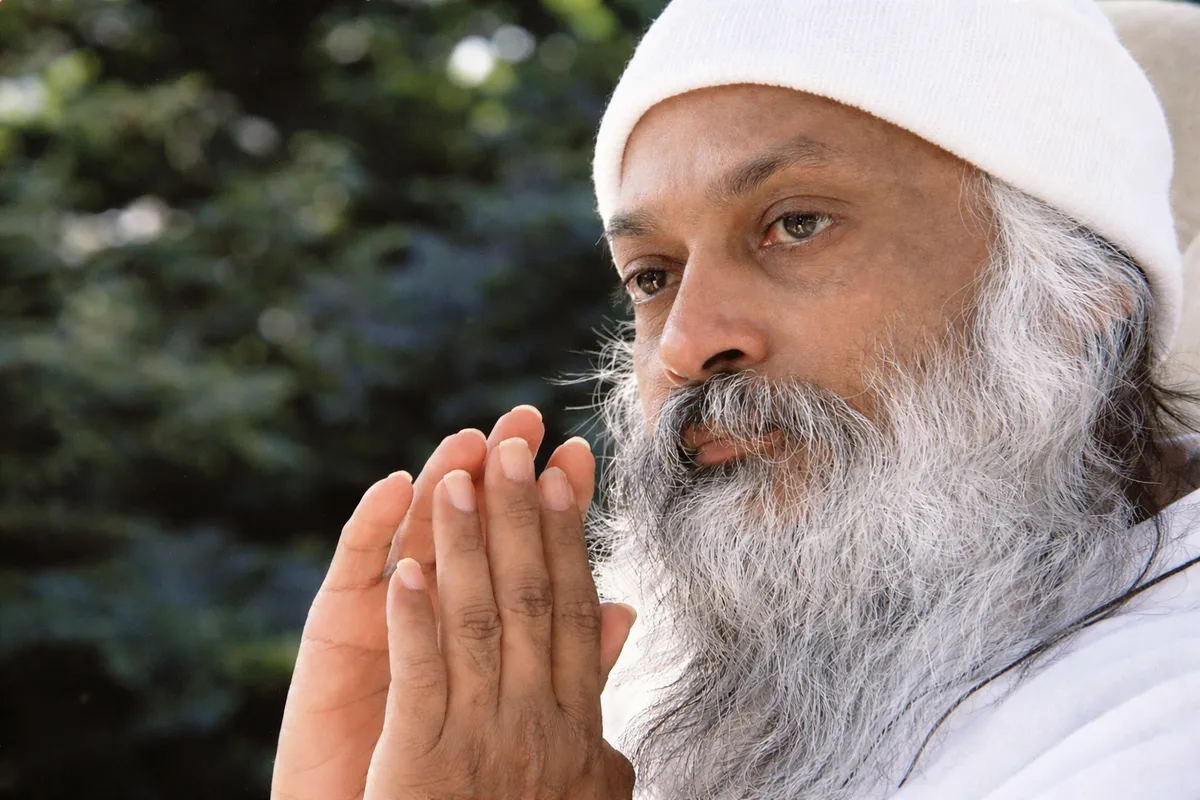
If you live simply and honestly, not fighting your own nature, your life will end peacefully and rightly.
From the Discourses
Passages where Osho speaks to this question — each links to the complete discourse.
Question: BELOVED OSHO, WHAT IS A NATURAL DEATH? It is a significant question, but there are many possible implications in it. The simplest and the most obvious is that a man dies without any cause; he simply becomes old, older, and the change from old age to death is not through any disease. Death is simply the ultimate old age -- everything in your body, in your brain, has stopped functioning. This will be the ordinary and obvious meaning of a natural death. But to me natural death has a far deeper meaning: one has to live a natural life to attain a natural death. Natural death is the culmination of a life lived naturally, without any inhibition, without any repression -- just the way the animals live, the birds live, the trees live, without any split...
Question: BELOVED OSHO, DOES A NATURAL DEATH ALSO TRANSCEND NATURE? Narda said, "I will be here. Don't be worried, you can just tie me to the tree so I cannot escape." He was tied to the tree and Balmik rushed to his home and asked his wife. His wife said, "I have nothing to do with your responsibilities. It is your responsibility to feed your wife; how you do it I have no concern for." And the same was the response of everybody. Even the mother said, "It is your responsibility to take care of your old father and mother. Now how you are doing it -- that you have to work out. We have not told you to kill people and rob people; you are doing it on your own. We are simply not responsible for any of your acts.
Someone asked Osho's views on death and dying.
There is nothing as sure as death. Where there is life, there is bound to be death. He who bears not this fact in mind, wastes life, whereas he who knows this truth, obtains that which is immortal. I do not feel depressed at anybody's death, because there is no need to feel anything about it. However, it is a matter of sorrow, no doubt, if I see a life wasted. We have not to grieve after a dead body, but over a wasted life. You know, King Janak was called 'videh', i.e., without or beyond the body. Once, a young minister of his asked him, 'Your Excellency! How can you be considered without a body, when you do have a physical body? The king smiled but said nothing. After a few days, however, the king invited the minister for lunch. Such an invitation from the king himself was a…
Osho, when I was young I never even thought of death, and now that I have grown old, death keeps frightening me all the time. What should I do? Is it possible to get rid of death?
Ramnath, Freedom from death is not possible. But who told you that you will die? You have never died before, nor can you die now. The one who dies is not you; it is someone else. The body dies—that is merely a sheath. The mind dies—that is a subtler sheath. Within these two peripheries sits the master, the indweller, who is neither born nor dies. This life has happened many times. You are not new. You have come many times and gone many times. But the one seated within is eternal. Neither birth touches it, nor death touches it. Until you know and recognize that inner witness, this fear will go on tormenting you. When a person is young, naturally the worry about death does not take hold. Why should it? Human vision is not far-seeing. Our sight is shallow, small. We see just a few steps ahead. We have…
Osho, you say, “As He wills, let us become mere instruments; whatever role in life we have been given, let us fulfill it.” But letting what happens happen—i.e., flowing along with the body, mind, and ego—gives rise to suffering. So should we keep applying the principle of instrumentality even in relation to the body, mind, and ego, and go on suffering? How do we solve the riddle between the principle of instrumentality and the continuous reality of suffering?
That supreme bliss is beyond both pleasure and pain. It is neither like night nor like day. It is twilight. The sun has set, night has not yet come; the light remains—very gentle, sweet, non-aggressive—that is twilight. Morning has come, the sun is not yet risen, the night has gone—such is the twilight. One who abides in that twilight—that is what we call prayer. That is why Hindus call their prayer sandhya. Sandhya means one who has stopped in between the dualities, who has found the truce between the two. Between pleasure and pain, love and hate, victory and defeat, night and day, life and death—one who has found the pact and stands in that concord. Seek that interval of conjunction. Krishna says, it is simple to find. If you cease to be the doer, you will find it instantly. It is only through your doer-ship that you keep missing.…