
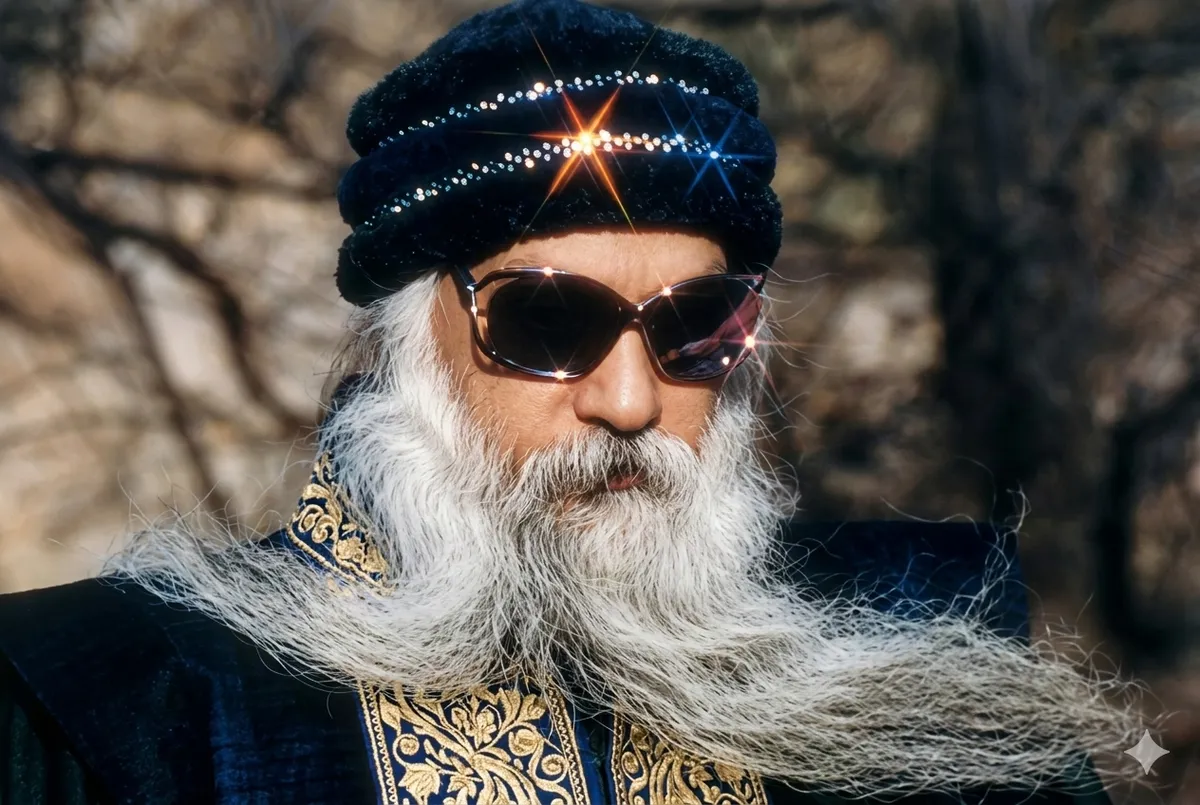
They’re not bragging; they’ve lost the self that brags, but we hear bragging because we still have one.
From the Discourses
Passages where Osho speaks to this question — each links to the complete discourse.
Do all enlightened masters sound as egoistic as you do?
It is bound to be so. They sound egoistic because they cannot be humble in the sense you understand humility. Try to understand. It is a delicate point. Whatsoever you call humbleness is a function of the ego. It is a modified ego. The enlightened person has no ego so he cannot have a modified ego. He cannot be humble. In the sense you can understand it, he cannot be humble. Otherwise Krishna would not be able to say to Arjuna: "Leave all, and come to my feet. I am the God who created the whole existence. SARVA DHARMAN PARITYAJYA MAMEKAM SHARANAM VRAJA. Come to my feet." What egoism! Jesus would not be able to say: "I am the door, I am the way, I am the truth." "I and my Father in heaven are one." "Those who follow me will be saved... only those who follow me will be…
Is it possible to be conscious of enlightenment, and be enlightened? Can the thought of being enlightened create ego in one? Kindly explain.
THE first thing to be understood is: what is ego. The ego is not very substantial. In fact it is not. It is just an idea, a substitute without which it will be difficult for you to live. Because you don't know who you are, you have to create a certain idea about yourself; otherwise you will simply go mad. You have to fix some indicators so that you can know, "Yes, this is me." I have heard, once a fool came to a big city. He stayed in a dharmasala. There were many people there; he had never slept before with so many people. He was a little worried and scared. The fear was that when he will fall asleep, in the morning when he will be awake again, how will he recognize that he is really himself. So many people. He had always slept in his room, alone,…
Osho, all through the Gita Krishna appears supremely egotistical. Yet in your morning discourse you said that it is precisely because of egolessness that Krishna could say, “Abandon everything and come into my refuge; I alone am all,” and so on. But Buddha and Mahavira don’t speak like this. Are their egolessnesses different? What is the fundamental difference?
The final remembrance that dawns for Buddha and Mahavira is remembrance—not the fruit of practice. But we observe: “He circled the village twenty times; then he remembered.” Another went one time; he remembered. Another went not at all; he remembered. From outside we conclude: “He remembered after twenty rounds—let us also do twenty.” There is no causal link between Mahavira’s doing and his awakening. If there were, then Jesus could not awaken—he did none of what Mahavira did. Nor the Buddha—he didn’t do what Mahavira did. If water boils at one hundred degrees, then in Tibet, India, China, America—wherever—you will get steam at one hundred. That is causal law. Spiritual life is not causal. Therefore it can be free. Causality is bondage—each thing bound to what precedes and to what follows. If water becomes steam, it was bound by the laws of water; now by the laws of steam; if…
Osho, you said that it is ego, isn’t it, when someone takes oneself to be an avatar?
Yes, that is the ultimate, extreme form of ego. Otherwise, there is no reason for it. The moment a person attains perfect samadhi, he will not even know “I am,” let alone that I am separate from you. He will not even know that he is separate from you. But things are like this. Claims are very strange. Rama Tirtha went to America—a sadhu from Punjab. He became very renowned; his writings became very renowned; his lectures were quite remarkable, and he spoke on Vedanta there with great passion. He returned to India and stayed in Kashi. There, a pandit remarked, “He keeps harping on Vedanta, and he can’t even speak two words of Sanskrit!” He certainly did not know Sanskrit; he had been educated in Persian. At just this remark he became so enraged...! For fifteen years no one had seen anger in Rama Tirtha. People believed he had…
Questioner: throughout the geeta krishna appears to be utterly egoistic, but this morning you said it was because of his egolessness that krishna asked arjuna to surrender to him, giving up everything else. But buddha and mahavira don't say this to their disciples. So is there a difference between their kinds of egolessness? If so, what is the basic difference between them?
If water is heated to the boiling point it turns into vapor, so there is a causal connection between vapor and heating. But the spiritual life is not subject to the law of cause and effect. And that is why spiritual life can be absolutely free. Freedom is not possible within the chain of cause and effect. The law of cause and effect is a kind of bondage: every effect is tied in with its cause. Cause and effect are dependent on each other one cannot be without the other. And as a cause turns into an effect, so an effect turns into a cause for some other effect. So everything is bound up with everything else, and-there is no end to it. It is a kind of cause-and-effect continuum. When water turns into vapor it becomes subject to the law of vapor as it was subject to the law…