
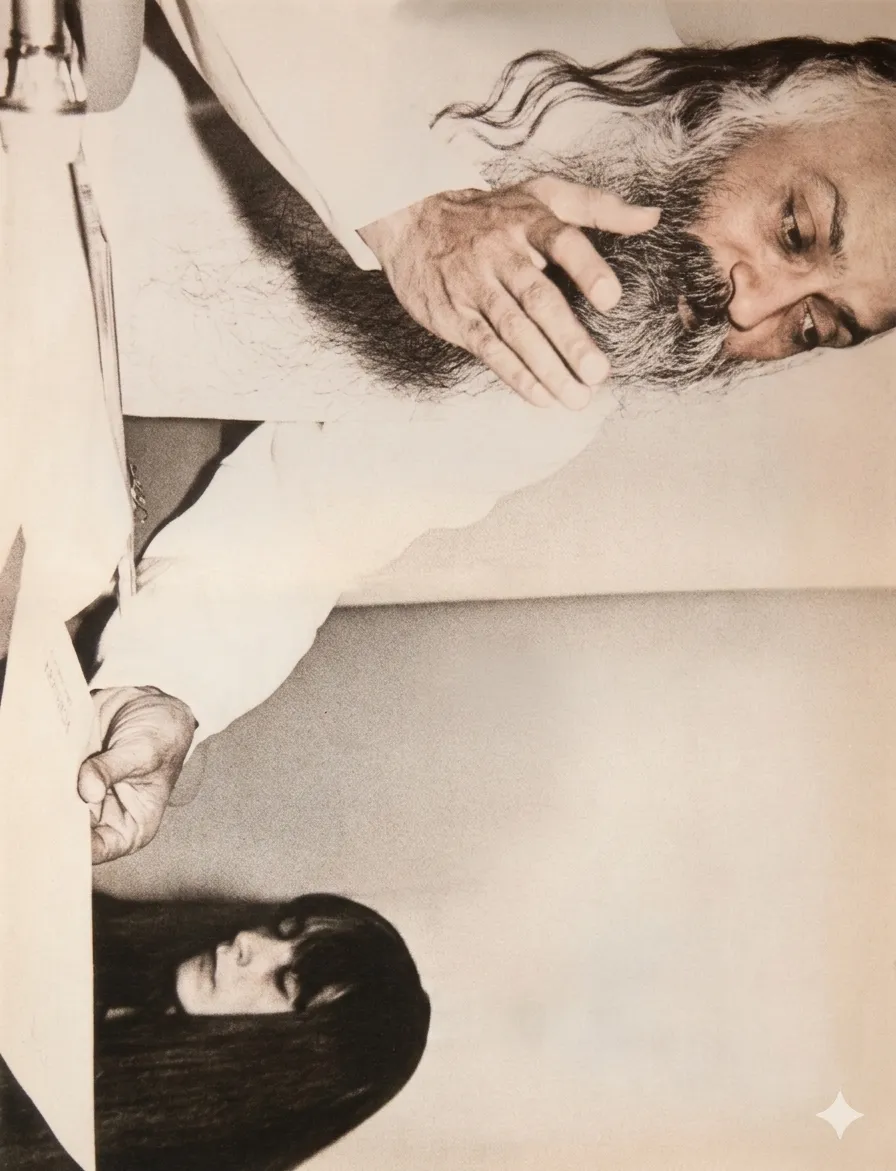
He jokes about booze, but means he’s ‘drunk’ on God and the Now, not on alcohol.
From the Discourses
Passages where Osho speaks to this question — each links to the complete discourse.
Question: The final question: Osho, do you also drink alcohol? And there is nothing else truly worth drinking. For years I haven’t drunk water—that much I can assure you; for ten years at least I haven’t touched it. I drink soda and wine. Soda on the outside, wine on the inside. I believe in balance—a little of the outer, a little of the inner. There is a wine that has never been distilled; toward it no one has ever been able to gaze. There is an elixir like that. I drink this undistilled wine. I live on this unseen elixir! And I want to make you drunkards too. Bhakti means wine. Shandilya means a drunkard. The devotee’s temple is a tavern—intoxication, sweetness, mellowness. Drink the Divine; then no other wine will remain worth drinking.
Beloved master, the other day I read that taru met you once in the streets of bombay while you were carrying a bag of gin and whisky in both hands. Are you really a drunkard? 5
Prem Aditya, if Taru says so, it must be so. I am such a drunkard that I can't remember! Yes, vaguely I remember Taru meeting me on the streets of Bombay. I can remember her hug -- it is difficult to forget! But my memory is not very good... so maybe I was carrying bottles of whisky in both of my hands. That has been very usual for Zen masters in Japan. That is the last stage of enlightenment! To be enlightened means to be utterly drunk -- drunk with the divine. Maybe those bottles of whisky were empty. They must have been, because a drunkard like me cannot keep those bottles full very long. The moment I get them I drink them. I don't postpone anything! But my memory is not very good.... "Doctor, I have a very serious problem," Max began. "I am losing my memory -- maybe…
Osho, you sit in the tavern and, every morning and evening, you pour brimming goblet after goblet of wine. I do get intoxicated by your wine, but I don’t lose consciousness. What should I do?
That is why even a Sufi like Omar Khayyam has been misunderstood. Whatever notion you have about Omar Khayyam is wrong. The wine he spoke of is not the wine sold in taverns. The beloved he praised is not flesh-and-bone. He called the Beloved—God. And he called wine—devotion. Fitzgerald, who first translated Omar Khayyam into English, because of whom Omar became world-famous, did not understand him. Fitzgerald thought wine meant wine. He was a Western man. He took two plus two to be four. He took “wine” as wine and “beloved” as beloved. The subtle intention of the Sufis fell into a great misunderstanding. On the basis of Fitzgerald’s version the whole world translated him, and the mistake spread everywhere. Today taverns are named “Omar Khayyam.” Nothing could be more foolish. Temples should bear Omar Khayyam’s name—not taverns. Because the tavern he spoke of is of another kind. There is…
Osho, we saw the cupbearer weeping in the tavern—ever since we saw the revelers turning Rajneeshee.
So I give sannyas to alcoholics too. And I tell them, take it without anxiety! You are better than the pundits—at least you are humble. At least you ask, with your head bowed, “Am I also eligible? Do I too have the worth? Will you accept me?” That pundit with the tilak does not bow his head; he stands stiff with pride. He is worthy already! He is a “fit vessel”! He was born in a Brahmin home! He was born knowing Brahman! The drunkard is a hundred thousand times better than that. At least his head is bowed; he is humble. He makes no claim to worthiness. There is no ego, no self-importance. I accept him. And it has been my experience that as soon as a person begins to descend into meditation, alcohol begins to drop away. I am not an advocate of prohibition. I want people to…
Osho, yesterday you said that when anger is watched consciously, it dissolves. But why is it that when sexual desire arises, even in awareness its intensity persists? Why is it so?
There is no entanglement in the breath. If you try to practice on anger… Anger is not happening every moment; it happens sometimes. And when it happens, it happens with such intensity that you are already going deep into it; so much is at stake in those moments that you may think, “We will look into awareness later; first let’s settle this now.” Lust is very deep, because existence has made it so deep; life depends on it. If lust were so easy that you decided and were freed, perhaps you would not even have been born—because many before you would have become free, and the possibility of your being would have been almost nil. But your parents, and their parents, did not become free; therefore you are. You too will not get free so easily, because your children are also to be—they are waiting: “Do not run away midway.”…