Explore Osho’s teachings across key topics such as meditation, love, ego, and awareness. Each topic contains structured questions, quotes, and insights derived from discourses.
Heaven unfolds not as a distant realm but as a vibrant state of consciousness, where spontaneity, love, and beauty flourish, while hell manifests through psychological chains of expectation and guilt; by shedding these burdens, one discovers that paradise is an immediate embrace of pure awareness.
In the depths of the third stage of Dynamic Meditation, as fear surfaces, surrender completely and embrace the transformative 'great death' of ego, trusting in the guiding light of a master to dissolve into the vastness of existence.
In the stillness of meditation, where the chattering mind fades, one awakens to the realization that problems are mere projections of illusion, dissolving effortlessly in the clarity of authentic awareness.
In the radiant embrace of a white aura, all the colors of one's essence converge in harmonious balance, creating an invisible rainbow that reflects total presence and sharing, symbolizing integration and the pinnacle of spiritual potential, unlike the limitations of single-colored or black auras.
Osho reveals that the subtle realm serves as an invisible blueprint from which the tangible world emerges, underscoring that by transforming this finer reality, we naturally reshape the manifestations of our lives.
Embracing the spirit of Osho, one finds that true debate transcends mere exchange; it demands a candid confrontation with significant adversaries, where the quest for genuine truth flourishes in the presence of those wielding real influence.
In the dance of words, a profound resonance awakens the essence of our innermost reality, revealing a paradox where the seemingly new is but a gentle reminder of forgotten truths, echoing Osho's belief in the cyclical nature of self-discovery.
In the dance of existence, Osho illuminates that while the 'masculine' mind flourishes in urgency and effort, the 'feminine' spirit thrives in surrender and playful receptivity; embracing your true nature without dilution leads to harmonious fulfillment.
In the embrace of let-go, a serene, thought-free state, witnessing flourishes like a blossoming flower; together, they cultivate pure awareness, transforming mere existence into a profound celebration of joyful presence—the essence of life itself.
In the embrace of your true essence, insight naturally unfolds, much like a raincloud overflowing with rain; once the illusion of self dissolves, existence orchestrates a harmonious symphony, where sharing emerges effortlessly, as an intrinsic part of the dance of life.
In the spirit of Osho's teachings, true respect emerges from the heart's sincerity behind a question, where even playful inquiries can embody profound trust and love; devoid of inner trust, solemn queries become hollow, masking genuine disrespect. Thus, before seeking answers, one must reflect within, allowing questions born of trust to flow freely.
In the essence of non-doing, one finds a profound rest in pure being—silent and egoless—as the boundaries of self dissolve, merging with the symphony of existence, where each moment transforms ordinary tasks into a creative dance infused with joy and wonder. Embracing this presence, even in stillness, allows life’s mysteries to flow through every action.
In the spirit of Osho's teachings, embracing one’s chosen path—whether minimalist or maximalist—fosters a profound connection to abundance, while wavering between extremes breeds stagnation; true transformation flourishes in unwavering commitment.
In the spirit of Osho's teachings, technology emerges as an unstoppable force that, when harnessed with love and awareness, can transform our world into a sanctuary of health and understanding, rather than a tool of destruction under misguided intentions.
Modern media often dulls our senses and distracts us with a barrage of superficial stimuli, urging us to embrace radical selectivity; by curating our experiences, we can reconnect with the essence of existence, finding depth in silence and nature rather than in the chaos of headlines.
In the dance of separation, where joy and sorrow intertwine, the devotee finds both the ache of longing and the sweet resonance of the Beloved, as tears and smiles blend into a profound rhythm, echoing Osho's wisdom on the paradox of existence.
In the embrace of resolve, where consciousness converges upon a singular intention, the discord of conflicting desires dissolves, allowing for a harmonious integration that transforms us into indivisible beings, free from inner turmoil.
In the journey toward Shunya, meditation unveils the courage to confront the abyss of emptiness, inviting us to relinquish fixed identities and conceptual crutches, while embracing awareness over anesthesia, allowing silence to reveal a profound new existence.
When genuine love and grace envelop us, the sense of unworthiness emerges—not as a flaw, but as a doorway to humility that nourishes authentic transformation and gratitude; in its absence, love risks becoming a mere reflection of the ego.
In the dance of thoughtlessness, Osho reveals that true awakening arises not from the coercive grip of concentration, which breeds tension and hypnotic stupor, but from the serene union of thoughtlessness and pure consciousness, effortlessly attained.
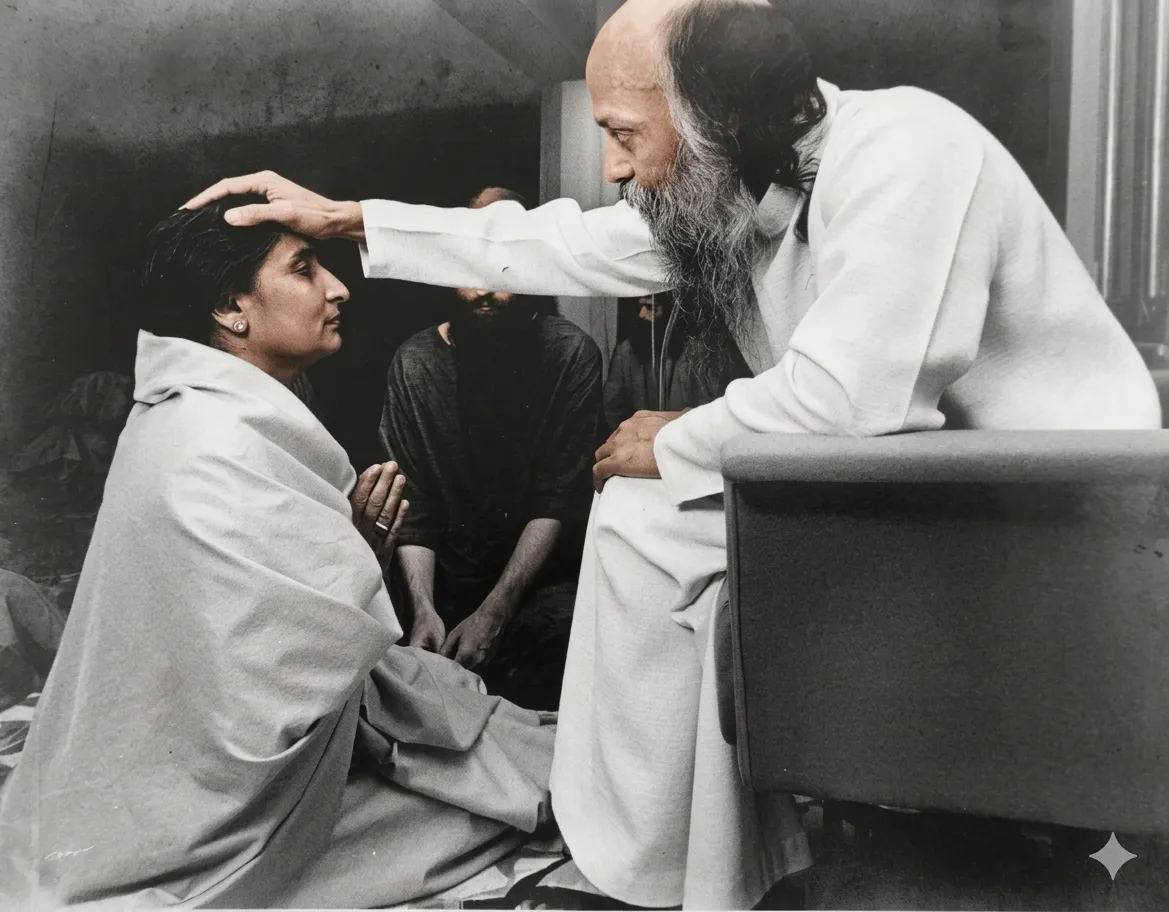
In the essence of Osho’s wisdom, the guru-disciple relationship transcends mere teaching, blossoming into a silent communion where the guru, embodying truth without ego, invites the disciple—through trust and reverence—to partake in a shared realization that defies the confines of thought.
Life and death dance before the witnessing presence of consciousness, revealing that our true essence transcends dualities; like a lotus untouched by the pond, we find serenity in recognizing our eternal nature beyond mere existence.
When the fourth stage blossoms, the path forward becomes clear: practice persists only as necessary, allowing earlier stages to fade naturally. Yet, Osho cautions against promises, for the mind may cling to them, hindering the essential journey through the first three stages that dismantle fear and repression; embrace them fully, and let spontaneity unfold, revealing what ultimately remains or falls away.
Acting embodies a profound spiritual journey, inviting one to immerse fully in the role while nurturing the silent witness within; this delicate balance transforms the art of living, reminding us that true engagement requires awareness, lest we confuse the performance for reality.
Don't have an account? Sign up