
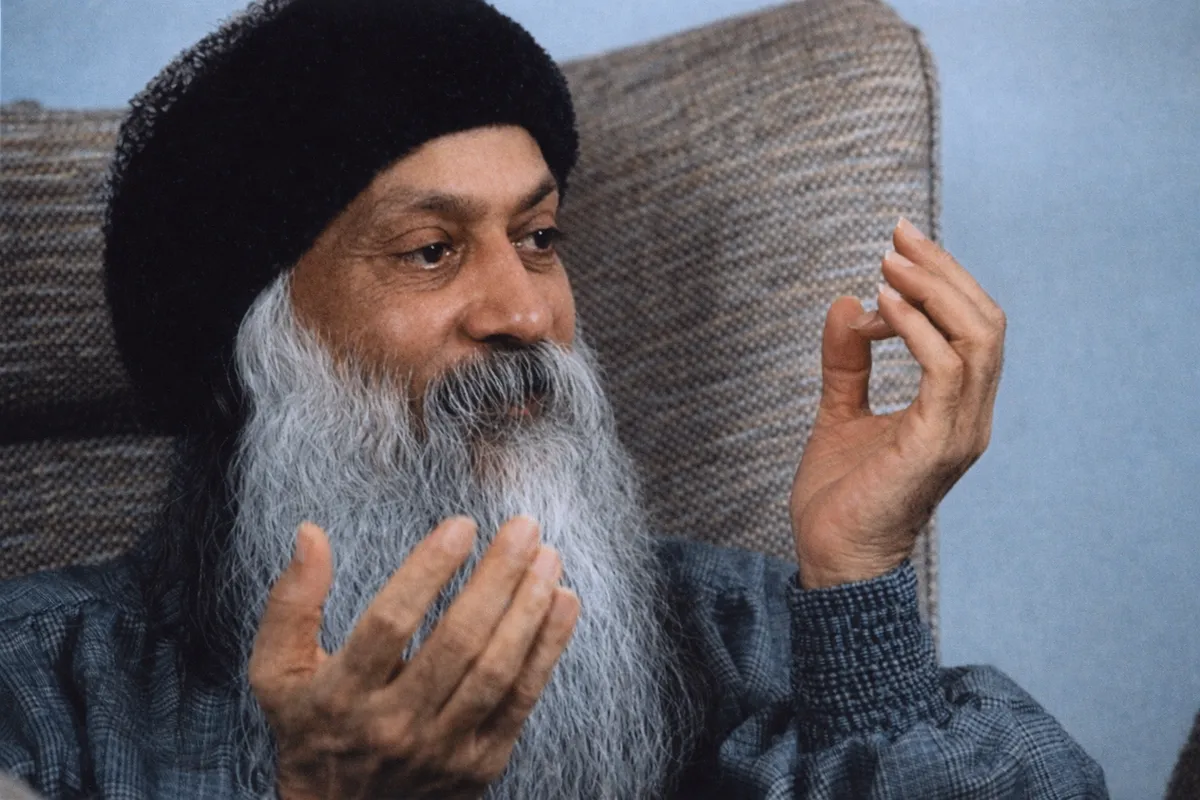
You can’t study your true self like a thing; you can only be it by quietly being aware.
From the Discourses
Passages where Osho speaks to this question — each links to the complete discourse.
The eyes cannot approach it, neither can speech nor mind. We do not, therefore, know it, nor do we know how to teach it. It is different from what is known and it is different from what is unknown. Thus we have heard from our predecessors who instructed us about it. What speech cannot reveal but what reveals speech -- know thou that alone as brahman and not this -- anything objective -- that people worship here. What mind does not comprehend but what comprehends the mind -- know thou that alone as brahman and not this that people worship here.
God is not indubitable. Remember this: God is not indubitable. He can be doubted -- not only doubted, he can be disproved. And really, when someone doubts God you cannot prove his existence. You can only convince those who are already convinced, but you cannot convert a new man; that is impossible. Not a single atheist can be converted because he needs proof and you cannot prove God. God is not indubitable. He can be doubted, rejected. The whole hypothesis can be said to be false. There is no proof that can help. So Descartes goes on discussing, inquiring, and he says that unless he comes to a point, to something in existence that is indubitable.... Not that it can be proved -- no. Rather, it cannot be doubted. And ultimately he comes to the self and says that the self is a greater reality than God. It is, because…
So, you ask, how can the self be known? Since only the object can be known, how can the knower be known? Where there is knowledge there is both subject and object, there is both the knower and the object that is known. And isn't trying to know the knower like trying to see your eye with your eye? Have you ever noticed a dog trying unsuccessfully to catch its own tail? The tail moves away from him as quickly as he tries to grab it. He can never catch it; it is impossible. In the same way, you cannot make the self the object of knowledge. I cannot know myself in the way I can know everything else. Self-knowledge is so simple, and yet it is so complicated, so difficult. Self-knowledge is not the same kind of knowledge with which we are familiar. Not at all.
Osho, you said that you don't know who you are. Don't you really? Do we never know who we are?
But it has been a great problem for the scholars: "Why did Eknath treat his own god in this way?" They don't have any answer. At least he could have looked at him, at least he could have said, "Please sit down on the brick." I have talked with many Maharashtrian scholars who are followers of Eknath; they don't have any answer. I said, "It is so simple. The story may be bogus, and I know that it is bogus. There is no Vithoba; nobody ever comes, whether you keep your door open or locked. But one thing is certain: Eknath was really an authentic man. When he was doing one thing, he was doing it totally. When God comes he says, "Stand there, don't bother me till I am finished with my work." To me this is the implication in my saying that if death comes to my sannyasins…
Osho, say something more about self-knowledge. That's my whole interest and inquiry.
But both are being half true. And remember: a half-truth is far worse than a total lie. At least the total lie has one quality about it: it is total -- the quality of totality. And one thing is beautiful about a total lie: it cannot deceive you long -- because it is such a lie, even the stupid person will be able to see sooner or later that it is a lie. But the half-truth is dangerous -- even an intelligent person can get lost into it. And then there is the third way: the way of the mystic. He accepts both, and rejects both. That is my way. He accepts both because he says, "On one plane both exist -- the knower and the known, the subject and the object, the inner and the outer. But on another plane, both disappear and only one remains -- which is…
Suppose you contemplate something beyond perception, beyond grasping, beyond not being. -- you.
I AM EXISTING. THIS IS MINE. THIS IS THIS. OH BELOVED, EVEN IN SUCH KNOW ILLIMITABLY. You can use any mantra: RAM, RAM, AUM, AUM -- anything. You can use Jesus Christ; you can use Ave Maria. You can use any word and monotonously chant it; it will give you deep sleep. You can even do this: Raman Maharshi used to give the technique WHO AM I? And people started using it as mantra. They would sit with closed eyes and they would go on repeating. `Who am I? Who am I? Who am I?' It had become a mantra. That was not the purpose. So don't make it a mantra, and sitting, don't say, `I am existing.' There is no need. Everyone knows, and you know already that you are existing; there is no need, it is futile. Feel it -- I AM EXISTING. Feeling is a different thing,…