
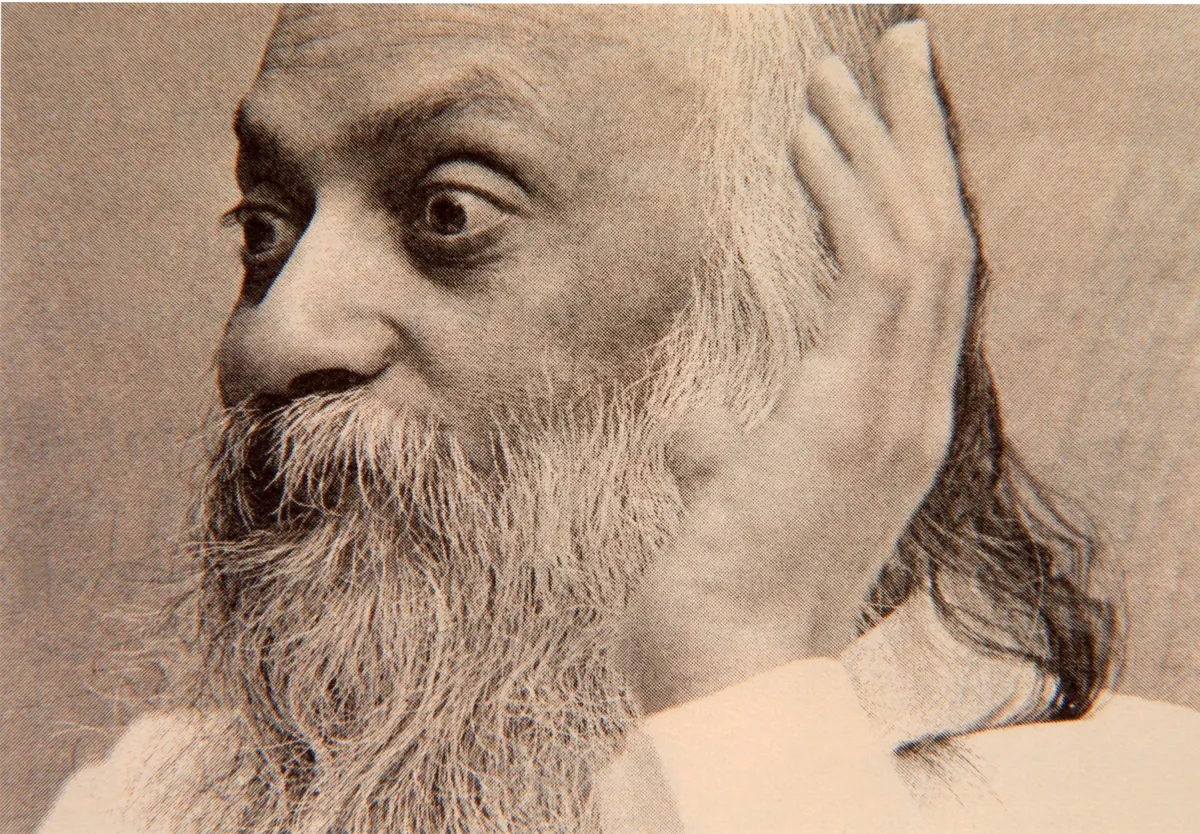
Notice how your mind keeps grabbing new things—even not-grabbing—and just watch it kindly while you live and laugh; then the grabbing fades.
From the Discourses
Passages where Osho speaks to this question — each links to the complete discourse.
Osho, I have dropped all my attachments; but still subtle attachments remain. I am even attached to non-attachment, to no-mind, to no no-mind. I am aware of the subtle ego. How should we go beyond this vicious circle?
Why start it in the first place? I am not telling you to drop attachments, I am telling you to just understand them. That's enough. Just see what your attachments are with no effort to drop them, with no judgment, no evaluation. Just see what they are. Whatsoever they are, they are there. What can you do? -- Just as you have eyes and hands and legs and a certain color of hair and skin, so your attachments are there. Accept them! In that acceptance the revolution begins. The moment you accept your attachments and you start understanding them, with NO idea to drop them... Remember, if there is the idea to drop them behind your understanding, your understanding cannot be profound and total; that idea will be a hindrance. Why drop attachments? God has not dropped the attachment to his world -- why should you drop your attachments to…
Osho, what is attachment? Why do we become so attached to things, ideas and persons? And is there freedom from attachment?
“So do one thing,” she told the courtesan. “I will pay you whatever you ask. Go to him at midnight. He meditates at midnight—has done so for thirty years. I want to know whether meditation has happened or not before I die. His hut door is only latched; no one ever goes there. Open it and go in. Whatever he says, notice every word and tell me. Go and embrace him—then come back and report. Before I die, I want to be sure that my service was not in vain.” The courtesan went. She opened the door. The monk was startled. He opened his eyes—he had been sitting in meditation—and shouted, “You wicked woman! Why are you here? Get out! What need have you to come at midnight?” But his tongue faltered; his body trembled. The woman had taken her money; she went right in. He cried, “Stay back! Why…
Mind is always imitative. Mind is a monkey, literally a monkey. It is curious, very curious about everthing, but it has no perseverance, no patience. It goes on jumping from one branch to another branch. It never sticks to anything; it never digs any well really deep but goes on scratching the ground here and there. That is not the way to dig a well. One has to be totally involved, one has to put all one's energies to the work. Mind cannot do that; only the heart is capable of doing it. It is the heart that gets involved and committed. Mind is always a Judas, it can never become a Christ. Judas was the most knowledgeable disciple of Jesus. All the other apostles were illiterate; he was the most cultured. And it is natural, not accidental, that he betrayed Jesus.
This non-attachment—someone has asked—how can it arise in an ordinary person?
All are ordinary until non-attachment arises. So the question is not how it can come to “ordinary” people. Until it comes, everyone is ordinary; only when it flowers does extraordinariness bear fruit in life. Hence there are not two paths—one for the ordinary and one for the extraordinary—because “extraordinary” only means one who has attained non-attachment. Ask instead: how to attain it? How is this non-attachment to be realized? And before we ask that, first see how it was missed in the first place. How have we gone astray from non-attachment? In Krishna’s vision, non-attachment is our very nature. How did we miss our nature? So it is not that we have to do some special practice to acquire non-attachment. We only need to understand how we drifted from our nature. How did we lose non-attachment? Someone came to me and said, “I am searching for God.” I asked him,…
Osho, “man eva manuṣyāṇāṁ kāraṇaṁ bandha-mokṣayoḥ. Bandhāya viṣayāsaktaṁ, muktyai nirviṣayaṁ smṛtam.” That is, the mind alone is the cause of human bondage and liberation. The mind that is attached to objects becomes the cause of bondage, and the one that turns away from objects is said to be the cause of liberation. This aphorism from the Shatyāyanīya Upanishad is quite well known; it also appears in many other scriptures. Osho, would you kindly explain this sutra for us?
Chidananda, the sutra is indeed precious—but when it falls into ignorant hands, even the most precious thing is made worthless. The Kohinoor becomes just a pebble. These immortal Upanishadic utterances, once grasped by certain hands, were turned to poison. The whole message was inverted; what was meant became its opposite. The entire country is rotting in that pain. The Upanishads are voices arising from the very life-breath of awakened beings. When the unstruck veena sounds, such incomparable music is born. But when pundits begin to “comment,” they drag the lotus back into the mud. True, the lotus arises from mud—but the lotus is not mud; it is a transcendence of mud, an expression of that within the mud which is not mud. To smear it with mud again is to turn the beautiful into the ugly, truth into untruth. Commentary has not honed truth; it has layered it with dust…