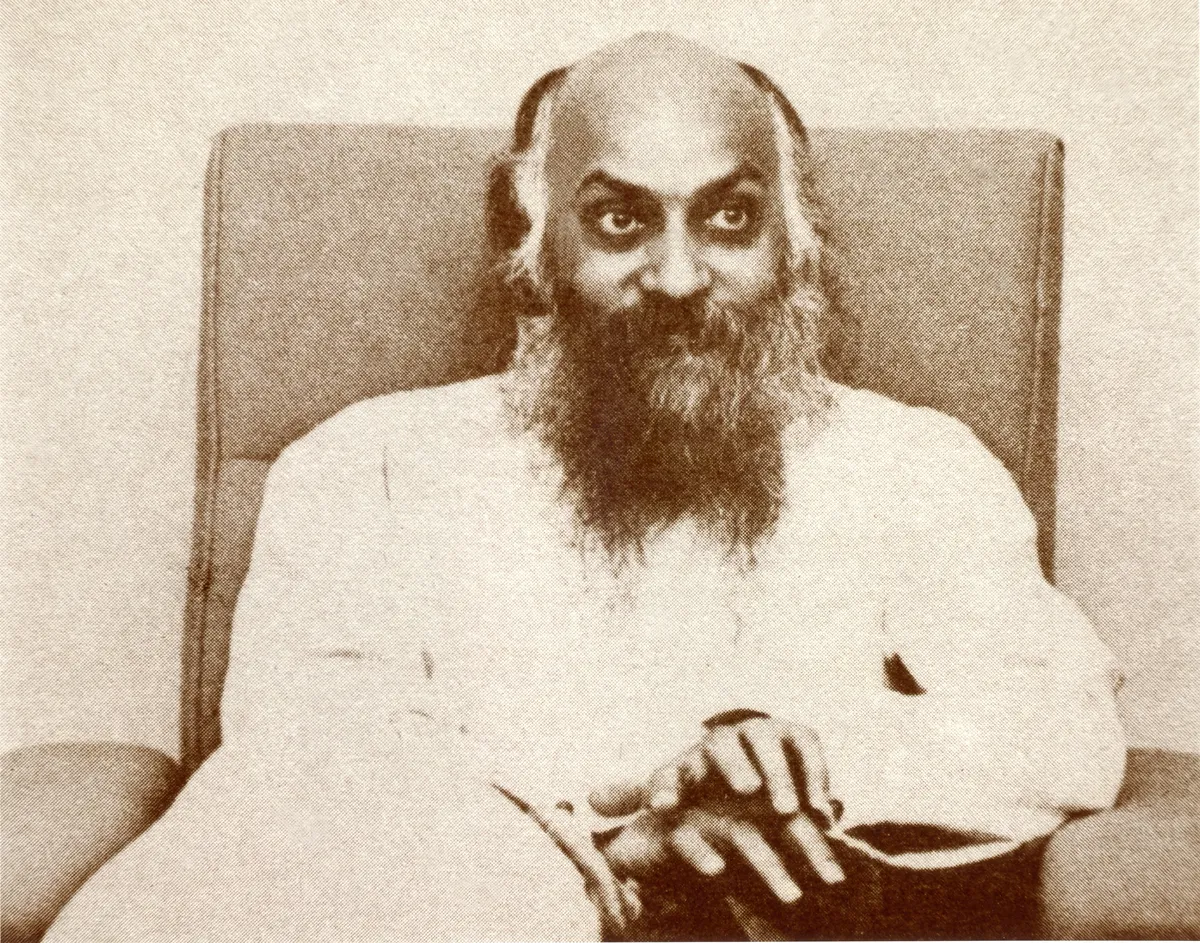
Explore Osho’s teachings across key topics such as meditation, love, ego, and awareness. Each topic contains structured questions, quotes, and insights derived from discourses.
In the therapeutic relationship, the client and therapist exist as separate entities, akin to a mind-plumber and patient, yet in the realm of the disciple and Master, the disciple dissolves into oneness, transcending the need for techniques, surrendering instead to the profound presence of the Master.
Senility, in its essence, represents the paradox of aging without the blossoming of true maturity; as vitality fades, the suppressed child emerges not in sacred innocence, but in a foolishness that belies the richness of a life deeply lived.
In the spirit of Osho's teachings, the art of mediumship flourishes through a receptive, feminine openness, where the medium, akin to a finely tuned radio, consciously empties their inner space to invite communication with disembodied souls, highlighting the importance of deliberate intention over fear-driven encounters.
In the dance between gravity and grace, Osho reveals that the sensation of soaring beyond the physical realm isn't madness but a profound glimpse into our true essence, where deep meditation enhances awareness, guiding us to discern the inner lightness from fleeting illusions.
In the pursuit of self-actualization, we awaken from the potential of mere existence to the vibrant bloom of our true selves, transcending desire and finding effortless bliss in the realization that fulfillment lies within, dispelling the haunting sense of lack.
Fantasizing, often dismissed as a trivial distraction, can entrap the mind in a web of words and dreams, yet when these illusions fade, a profound emptiness emerges, revealing the boundless love, silence, and bliss that lie beyond thought, inviting true freedom.
Indulging in passions and suppressing them alike stem from ignorance, yet through vigilant, non-reactive awareness, one can simply observe desires as they arise—transforming lust, anger, and greed into pathways for authentic self-knowledge beyond societal facades.
Emerging from a backdrop of unprecedented affluence and existential boredom, the hippie movement reflects a profound rebellion against materialism, echoing Osho's belief that true fulfillment lies not in wealth but in a deep, chaotic exploration of spirituality and self-discovery.
In the dance of life, commitment and spontaneity intertwine, where imposed dedication feels like death, yet true commitment blossoms from spontaneous awareness, nurturing a vibrant fidelity to one’s own insights and experiences rather than to mere beliefs.
Embracing life’s challenges, rather than fleeing from them, ignites our spiritual awakening, revealing that true peace and understanding emerge not in avoidance but through the transformative friction of existence, where the soul truly comes alive.
In the dance of existence, love and death intertwine, for to truly love is to dissolve the ego and embrace the surrender that frightens us; only through this inner death can we bloom into the divine, where birth, love, and death are but expressions of the same eternal truth.
In the essence of Osho's teachings, 'prakriti' transcends mere constitution, embodying the primordial fabric of existence that underlies all creation, while 'srishti' represents the manifestation and 'pralaya' the inevitable dissolution, akin to the materials that form a house, distinct yet inseparable from its design.
Embracing your inherent uniqueness, untouched by comparison, unveils the essence of your being, free from the ego's grasp; in this sacred presence, rather than striving for superiority, you discover a profound inner peace and the purity of simply existing as you are.
Scientology, often viewed as a hollow construct that misuses the allure of science and technology, entraps seekers in a web of measurable mind-states, while true spirituality, as Osho might suggest, lies in transcending ideologies and embracing the profound silence of our inner selves.
Blissfulness, the essence of our being, blossoms through meditation into a profound silence and ecstatic dance, where gratitude emerges as a natural overflow, honoring the divine essence that pulses within every moment of existence.
In the depths of nigod lies the primal realm of dormant souls, shrouded in utter darkness and ignorance, where liberation is a distant whisper; from this unconscious abyss, souls gradually awaken, journeying through the dreamlike samsara towards the luminous freedom of moksha.
In the journey through the gunasthanas, once one reaches the thirteenth, the ascent to the fourteenth—ultimate liberation—becomes inevitable, unless, driven by profound compassion, one chooses to remain in form, illuminating the path for others like a guiding light in the darkness.
In the spirit of Osho, the youth's embrace of love and meditation as a revolutionary force reflects a genuine evolution of the Left, where creativity and compassion replace ideological conflict, transforming the 'impossible' into a tangible path for social change.
In the realm of spirituality, the visions of deities like Krishna or Christ reflect mere psychological projections; true spiritual awakening emerges only when consciousness transcends objects, resting in the pure essence of self beyond the confines of the mind.
Self-repression often arises not from conscious choice but as a survival mechanism, shaped by childhood conditioning; the love and approval we crave can transform into an internalized guilt, policing our desires and stifling our true selves long after the threat has vanished.
Preoccupation, laden with prejudice and pride, clouds our perception, distorting the present with the weight of past beliefs; by shedding these distractions, we awaken to a fresh, unfiltered awareness where meditation and the divine can truly flourish.
In the dance of existence, disembodied souls often seek refuge in living bodies, particularly when fear and contraction leave a person vulnerable; yet, through awareness and inner sovereignty, one can cultivate a sanctuary that repels such intrusions while inviting noble souls to inspire compassion.
Nagarjuna’s Shunyavada eloquently mirrors the Buddha's silent wisdom, revealing that the essence of emptiness—like the vast, empty sky—serves as the fertile ground from which all existence emerges and ultimately dissolves, transcending the distinction of method.
In the realm of contemporary thought, J. Krishnamurti embodies a profound spiritual inquiry, urging seekers to cultivate choiceless awareness and personal freedom, while Osho highlights his rejection of authority as a guiding light to self-discovery and inner awakening.
Don't have an account? Sign up