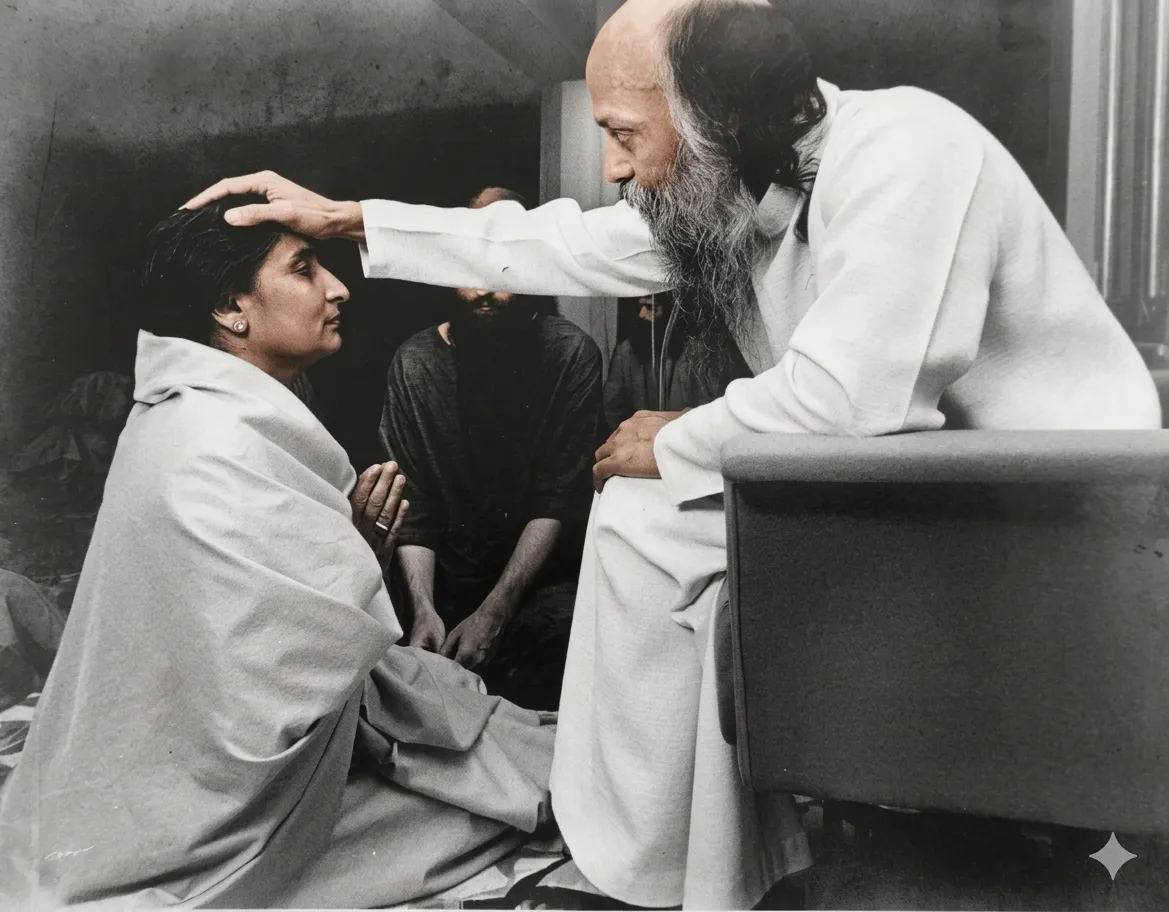
Explore Osho’s teachings across key topics such as meditation, love, ego, and awareness. Each topic contains structured questions, quotes, and insights derived from discourses.
In the dance of existence, where beginnings and endings intertwine, non-attachment emerges as a seed that, through conscious practice and the shedding of old patterns, blossoms into effortless spontaneity, inviting us to embrace the journey with a heart free of desire.
True seeing unfolds in the embrace of patience, where the restless mind surrenders its desires, allowing clarity to emerge effortlessly from the stillness of the present moment, revealing the profound beauty that lies within.
In the dance of impermanence, the essence of the eternal whispers through our senses, where words serve merely as metaphors guiding us inward; it is in this inner awakening that we feel the pulse of the deathless within the fleeting.
The Tirthankaras, starting with Adinath, embodied the essence of Aryan sages within the Shramana tradition, imparting wisdom on liberation through dedicated effort, while Mahavira ultimately crystallized their teachings into the distinct identity of Jainism, echoing Osho's belief in the transformative power of inner resolve.
Life unfolds as a vast dream for those still asleep, where even the Master's wisdom becomes mere illusion; yet for the awakened, reality shines with clarity, revealing the intrinsic light within, as his teachings serve as a gentle alarm clock urging us to awaken from our slumber.
Embracing the transient nature of life, Osho invites us to recognize that true immortality lies not in preserving the body but in awakening the timeless consciousness within, where the essence of our being transcends mortality through awareness and meditation.
The Master embodies both the purifying fire of death and the essence of Brahman, dissolving the ego and false hopes, allowing the true, deathless self to emerge; in surrendering to this transformative process, one awakens to the radiant Great Life within.
Equanimity blossoms when one recognizes that both joy and sorrow spring from the same source, inviting us to embrace each as a gift; sorrow, far from an adversary, refines our spirit and elevates us closer to bliss, transforming life's challenges into sacred steps toward the divine.
In the spirit of Osho's teachings, Krishna Consciousness emerges as a vibrant awakening, inviting us to transcend the confines of intellect through kirtan and dance, revealing a profound inner revolution that breaks down old paradigms and leads us toward a deeper understanding of our true selves.
In the dance of existence, forcing the river of life only breeds frustration, while surrendering to its currents reveals that even adversaries can be profound teachers; true victory emerges when we cease striving and allow ourselves to flow with the essence of being.
Osho illuminates the notion that true sainthood transcends egoic labels, rejecting the divisive dichotomy of saints and sinners, and instead embraces choiceless awareness, recognizing that each individual is a sacred part of the unified consciousness.
Utopia, as envisioned by Osho, emerges from our sacred discontent with the status quo, inspiring a relentless pursuit of better education, relationships, and social structures, while awakening us from the hypnosis of authority to embrace a more liberated and humane existence.
In the dance of existence, helplessness clings to fear and craves support, while refuge-lessness celebrates inner strength and self-reliance, inviting joy and meditation to flourish in the solitude of the soul, as Osho might illuminate.
Becoming is a mirage; true awakening lies in shedding the layers of imagination that obscure our essence, much like revealing the Kohinoor from beneath the mud, where clarity emerges as ego dissolves and reality unfolds in its purest form.
An inferiority complex emerges from a hidden assertion of superiority, where the illusion of being the world's center clashes with reality; this dissonance fuels remorse and anguish, revealing that the pursuit of dominance often births the very sense of inadequacy one seeks to escape.
True renunciation springs from a place of choicelessness, where the desire to gain is relinquished; in this surrender, one discovers that mastery and genuine fulfillment emerge effortlessly, revealing that true freedom lies in embracing loss rather than pursuing it.
In the spirit of Osho's teachings, the essence of Advaita reveals that true awakening transcends mere virtue; it is in the flowering of consciousness that genuine character emerges effortlessly, illuminating the path beyond the shadows of hypocrisy and guilt.
Hate cannot be vanquished through action, for such efforts only deepen the cycle of aversion; instead, by embracing a choiceless awareness of its presence, one can fully experience its toxicity, allowing it to dissolve naturally, much like a snake shedding its skin.
Ambition, often born from fear and an inferiority complex nurtured by a comparison-driven education, fades when true understanding emerges, allowing individuality to flourish and transforming the competitive mind into a garden of love.
Embracing the essence of Osho's wisdom, one discovers that true liberation lies in the gentle acceptance of resistance itself; by witnessing it without struggle, we sever its lifeline, allowing it to fade away naturally.
By transcending the confines of museums and conventional art, one discovers the profound inner aesthetics that Osho emphasizes—a sensitive, poetic vision and the unstruck music within, where true enlightenment flourishes in the silence and receptivity of life itself.
In the spirit of Osho's wisdom, true progress blooms from thoughtful reflection, as clarity and calm focus illuminate the path forward, while worry merely fragments our energy, stalling meaningful growth in the outer world.
True protection of a beloved teacher lies in our inward growth, where maturity and divine attunement flourish; it is through our transformed lives, vibrant love, and the cool flame of unconditional sharing that we embody and preserve the essence of their teaching.
In transcending the confines of the mind, the unknown transforms into the unknowable, inviting us into the sacred realm of existence where experience eclipses explanation, and the essence of being unfolds in a profound, wordless communion.
Don't have an account? Sign up