
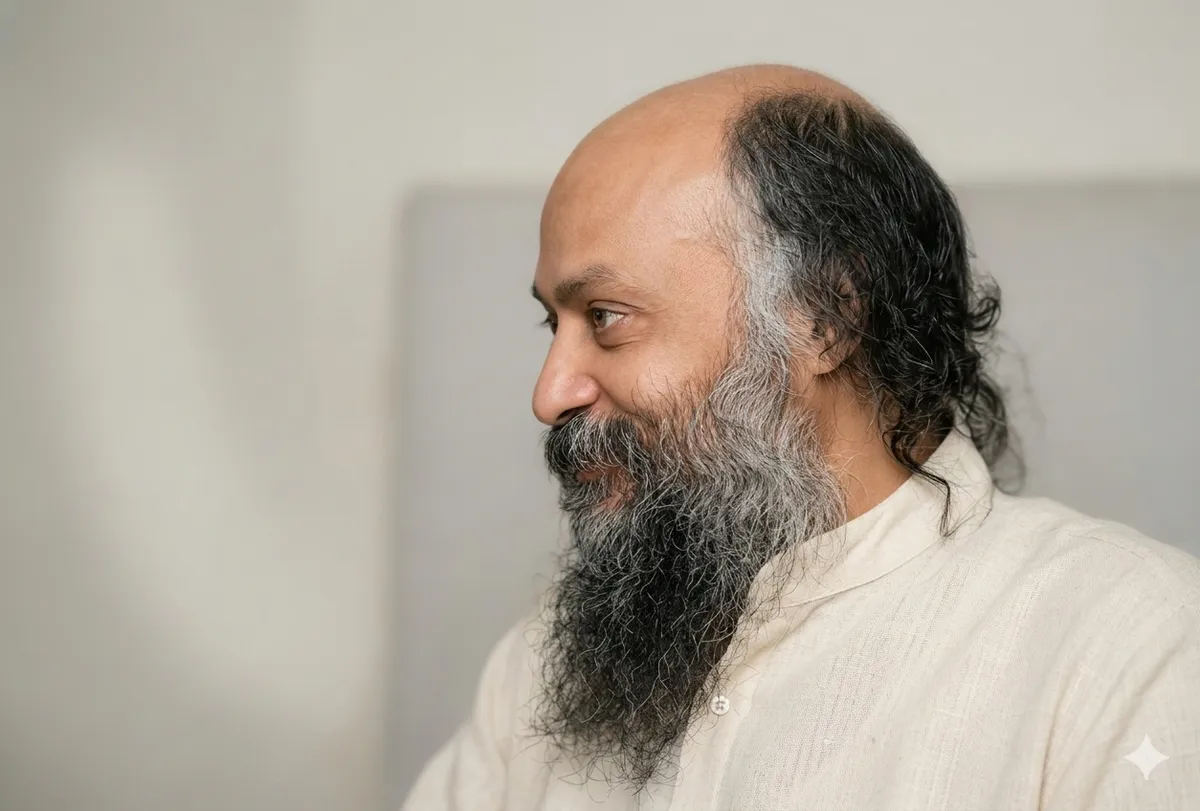
Kabir started alone without a big group or famous name, and people were scared to leave their old groups, so not many joined him.
From the Discourses
Passages where Osho speaks to this question — each links to the complete discourse.
Osho, Kabir, who said “I have found the whole,” with one foot in Islam and the other in Hinduism—why did he not become as effective a religious leader as he ought to have been?
Such was Kabir’s situation. Both viewed him with suspicion. With me it is even more tangled, because it is not just a matter of two. I speak on the Jews and on the Christians, on the Buddhists too—so the tangle is greater. People try from every side to protect their darkness—whatever excuse they can find. So you ask rightly, “Kabir did not have as much impact as he should have.” But has anyone ever had as much? Do you think Buddha had as much impact as he should have? Do you think Mahavira had as much as he should have? Lao Tzu? Zarathustra? Who had it? If it had been as much as it ought to have been, this earth would be a different place—heaven. No one’s impact has been “as much as it should have been.” These people bring great light, but we are lovers of darkness! We stand…
Osho, where Sahjobai’s devotion culminates in nonduality, Tulsidas’s devotion retains duality. Please shed light on this difference.
A psychologist at Rajasthan University researches rebirth. Someone brought him to see me. He said, “I am trying to prove, by psychological research, that rebirth exists.” I asked, casually—he didn’t quite grasp it—“When it is proved, it will be proved. But do you already believe that rebirth exists?” He said, “Definitely! I believe in rebirth; now I am trying to prove it.” I said, “Now I’m in difficulty. Without proof, how have you already believed? You’ve believed first, and now you’re proving! Then your proof will be false. You will select only what confirms you, and discard whatever does not. This is not a scientific mind; it is biased. It’s like a judge who first decides you are a thief and then sets out to prove it: he will record all evidence that you are a thief, and ignore all that you are not. Is this a way to prove?…
Verse (Sanskrit): ओशो, प्रवचनमाला के आरंभ में हम आपके चरणों में अपना नमन निवेदित करते हैं। संत सिरोमणि कबीर के पद हैं: माया महाठगिनी हम जानी। निरगुन फांस लिए कर डोलै, बोलै मधुरी बानी।। केसव के कमला होइ बैठी, सिव के भवन भवानी। पंडा के मूरत होइ बैठी, तीरथ हू में पानी।। जोगि के जोगिन होइ बैठी, राजा के घर रानी। काहू के हीरा होइ बैठी, काहू के कौड़ी कानी।। भक्तन के भक्ति होइ बैठी, ब्रह्मा के ब्रह्मानी। कहै कबीर सुनो भाई साधो, यह सब अकथ कहानी।। ओशो, कृपापूर्वक इन पदों का मर्म हमें बताएं। Transliteration: ośo, pravacanamālā ke āraṃbha meṃ hama āpake caraṇoṃ meṃ apanā namana nivedita karate haiṃ| saṃta siromaṇi kabīra ke pada haiṃ: māyā mahāṭhaginī hama jānī| niraguna phāṃsa lie kara ḍolai, bolai madhurī bānī|| kesava ke kamalā hoi baiṭhī, siva ke bhavana bhavānī| paṃḍā ke mūrata hoi baiṭhī, tīratha hū meṃ pānī|| jogi ke jogina hoi…
A friend has asked, Osho, there have been many rare devotees—Chaitanya, Meera, Kabir, Raidas, Tulsidas, Narsi—and they spread devotion throughout the land on a vast scale. Yet despite all this, today the country seems empty of devotional feeling. What is the reason?
But if the master is alive, you cannot accept him. A guru dead two thousand years ago—you accept only him. Something seems amiss. In fact, you want to be rid of the master. A dead master is good; he cannot pursue you. A living master will put you in difficulty. Therefore a dead master suits you. With a dead master you can do whatever you like. With a living master you cannot do as you please; he will do with you what he wants. Hence with a dead master friendship is possible. No one wants a dead wife, no one wants a dead husband. Everyone wants a dead master. Because people want to escape from the master; they are engaged in evasion. Narsi is there, Kabir is there—why worry about them! Even today, people of that very quality are present. But you will talk about them two or three hundred…
And now the same happens — Nanak’s religion is as dead as Hindu, Muslim, Jain were in his time. If a Satguru appears now, the followers of Nanak will stand against him — for someone will stop going to the gurdwara, someone will close the Guru Granth — forgive me — the Satguru always appears as the enemy of sects. He is not the enemy of Dharma — he re-establishes Dharma — but he is the enemy of sect. Sect means dead religion — like keeping your father’s corpse in the house and worshiping it because he was dear in life. A sensible man does not do this. He loved his father; he weeps, beats his chest — yet he lays the bier and carries him to the burning ground. Dear he was, the bond was deep — but he died — the matter is over.