
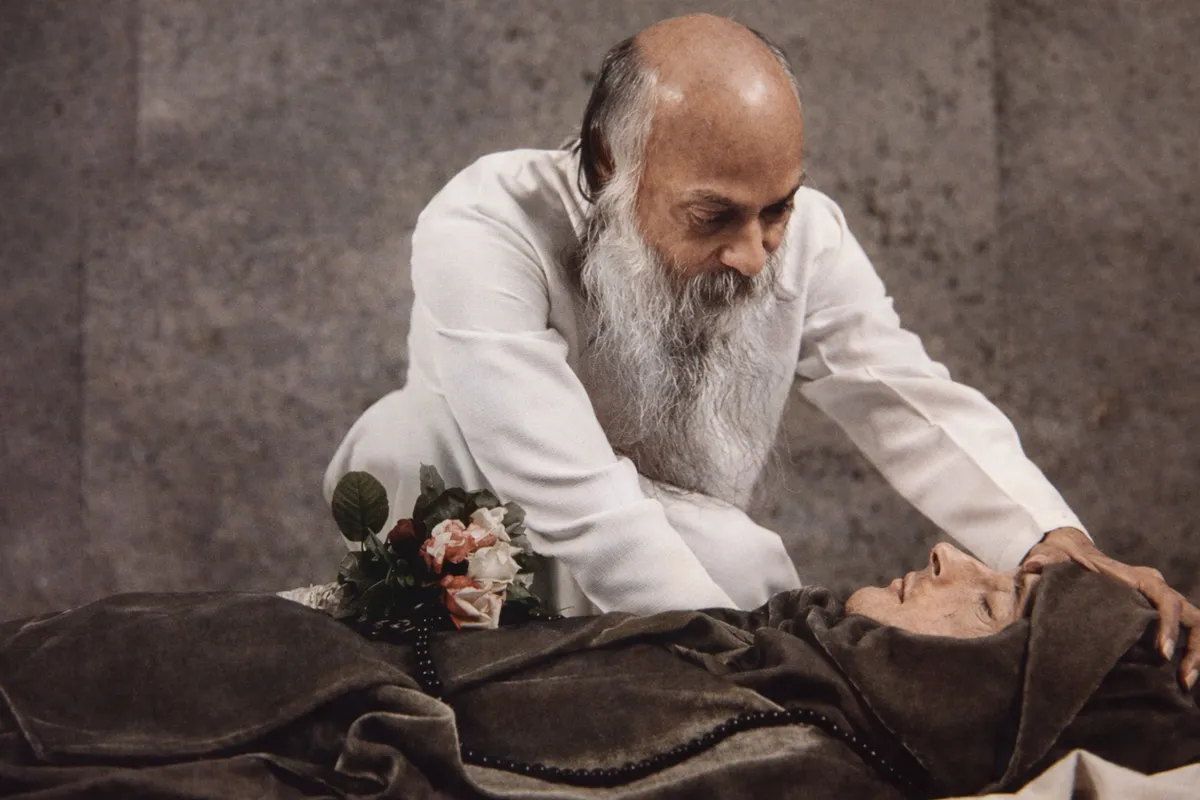
We hide who we are because we care more about others’ eyes than our own, and we stop when we truly know ourselves.
From the Discourses
Passages where Osho speaks to this question — each links to the complete discourse.
Osho, you yourself have said, “We are busy hiding what we are and showing what we are not.” From my own experience I can say how true this is for ordinary people. But why is it that among all creatures only the creature called man falls prey to this disease of show?
Often—Bertrand Russell writes in an essay, and I find it apt—if there is a crowd and someone’s pocket is picked, the pickpocket, if he wants to save himself, must make the most noise: “My pocket’s been picked! Catch the thief!” Then no one will suspect him—he seems a saintly man, running to catch the thief. Often those in society who loudly denounce others’ character, who make the biggest uproar over someone’s character, are the very people trying to hide their own character in that noise. If a prostitute is caught, those who rush first to stone her are often her customers—because they think, “If I don’t go to throw stones, the townspeople will suspect I too was a customer.” So you will find the biggest customer throwing the first stone. There is such a mention in the life of Jesus. A woman was brought—an adulteress. The people said, “We will…
Osho, using the example of the onion you said that each person has many faces, masks—stolen masks. And these masks will be there, under all circumstances they will be there. One only needs to distinguish between good masks and bad masks. I hate someone, but when he comes to me I welcome him with a smile. This is an artificial face I present before him. Yet at the same time my mind is filled with immense pain, with sorrow, and still I smile. So this face, this mask, would be my good mask. A mask there will certainly be.
By “mask” I mean: the false faces we impose upon ourselves—do not impose them. That does not mean faces will not change in life. Your face will change every day, but it should be your own face. When darkness spreads, tears will come to the eyes; tomorrow a friend may die—tears will come. And tomorrow a long-lost companion may return—then the heart will throb with joy and songs will arise. Your face will change moment to moment; it should. One should be responsive. But the face must be your face. I am not saying keep one face fixed. That would be a stone face; life cannot move like that. Then you would need a single face of stone. I have heard that an American multimillionaire was approached by a man asking for a small donation. The millionaire said, “I have a rule: one of my eyes is artificial—made of stone—and…
Osho, Zen Master Hogen of Seiryo Monastery was just about to give his discourse before the evening meal when he noticed that the bamboo screen hung for meditation had not yet been put away. He pointed to it, and immediately two monks rose from the assembly and began to put it away. Observing that very moment, the Master said: “The first monk’s state is good, but the second’s is not.” Osho, please explain the purport of this Zen enlightenment story.
A Marwari, dying, told his lawyer: “To every servant who has served me for five years, I bequeath fifty thousand rupees.” The lawyer couldn’t believe it—he knew the man; he never gave five paise. Fifty thousand to each—and there were many servants. He asked, “Are you in your senses?” The Marwari said, “More than you. There is no servant in my house I let stay for five years! I’ll give nothing—but the news of my charity will spread.” Even at death, the relish is in reputation. The mask doesn’t drop, not even in the last moment. What people say after you die is important; what you are is not. You have no taste for being—only for others’ opinions. That is the mark of the householder. The sannyasin’s mark is: what I am is my relish. What people say—what is the use? That is their business. What I am—that is mine,…
What we go on showing others, day after day—slowly we ourselves begin to believe that we are that. Life becomes utterly artificial and false. Our love false, our character false, our personality false, our mind false, even our very prana false. With such an unnatural personality, a barrier inevitably rises. Where all is false, a wall immediately stands. What is true in our personality? What is spontaneous in us? Almost everything is contrived. Even the way we speak is contrived; our gait is contrived. Have you ever noticed? When you walk alone on the road, you walk one way; let four people come toward you, you walk another way. In your bathroom, alone—you are a different man; in your drawing room, seated—you are altogether different. What kind of personality is this that changes by the eyes of others? If those four happen to be “important” people, you change even more.
The intelligent man inevitably lives in society only theatrically. His relationship with society is a drama. But if the theatricality becomes inward, trouble begins. Wear a face for the other—if that pleases the other, what harm? But when you are alone, at least then, put the face aside. For whom are you wearing it? Whom are you deceiving now? If this is conscious, personality is not a bondage—it becomes a skill. In relationships, it works as a lubricant; it reduces friction, saves needless abrasion. But for yourself, in your solitude, if you sit with that mask, you are killing yourself. With society, personality; with yourself, no personality. Until the bonds of personality loosen, the secret of the soul does not begin to open. For within the knot of personality the secret is hidden. Let us see what personality is, and how it can loosen. You forget.