
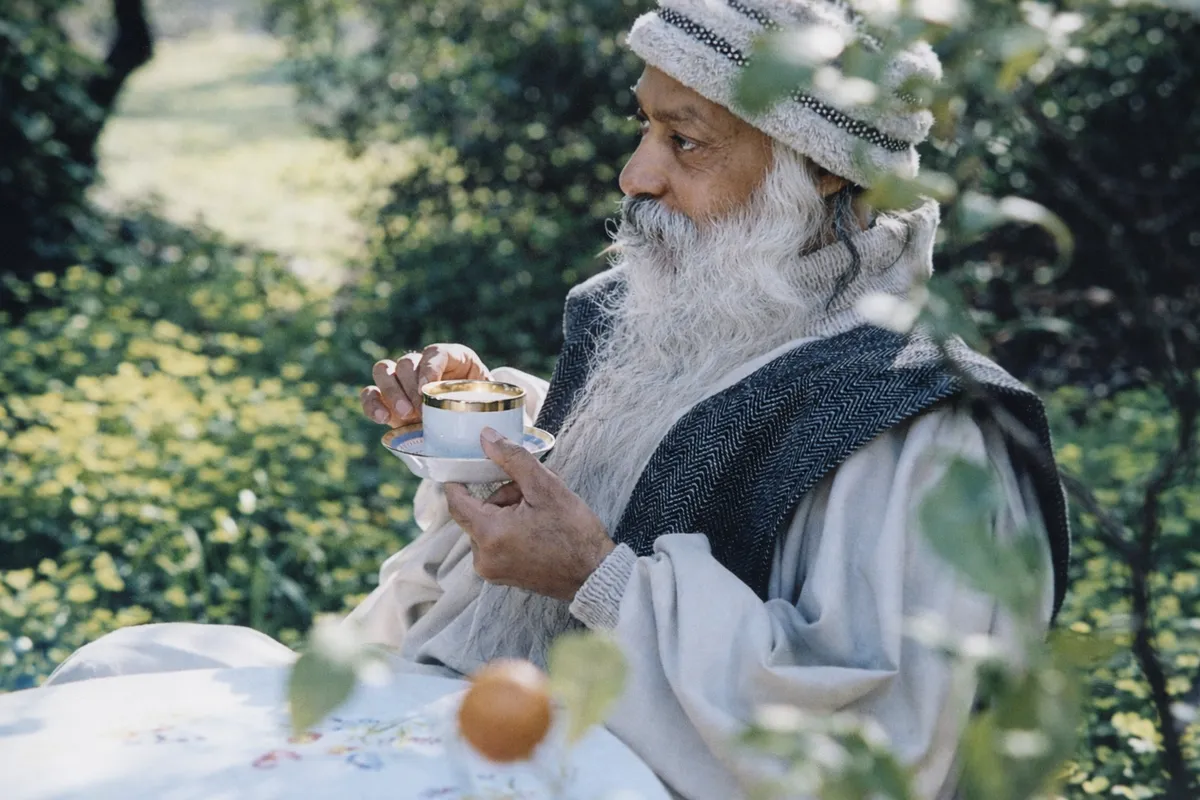
He rejects secondhand, rule-book religion and wants you to discover truth inside yourself through brave, transforming experience.
From the Discourses
Passages where Osho speaks to this question — each links to the complete discourse.
Osho, in the classical tradition the sannyasin turns away from māyā and sensual enjoyment and orients himself toward God-realization; yoga and bhoga are known to be mutually opposed. But in your sannyas there is no emphasis on dispassion from enjoyment. Therefore, kindly clarify your conception of sannyas!
So first thing: religion is not tradition. Religion is ever ancient and ever new. It is a paradox. It has always been—and yet each time it must be discovered anew. When the sun of religion rises, it is private, personal, not collective. It does not become society’s property or legacy. If you do not trust Buddha, Buddha has no way to make you trust. Have you thought about this? If you say, “We doubt you: you claim God-experience, but how are we to believe it?” Buddha will shrug his shoulders: “What can be done? What happened is private, personal. There is no way to spread it out on the table before you. It happened within; there is no device to bring it out. It happened so deep that it cannot be exhibited for all to see.” That is why there have been so many perfectly awakened ones, yet atheism has…
Osho, what is the definition of God?
Words are very small. If you say God is light, then what of darkness? The scriptures have said that God is light. Suppose we accept this as a definition—then what about darkness? Where will darkness go? Darkness is too; in fact it is far more than light. Light sometimes is and sometimes is not; darkness is always, eternal. Where will you place darkness? If you say God is light, darkness is left out. If you say God is darkness, then light is left out. If you say God is both darkness and light, a contradiction arises: they cannot be together. Try to have both darkness and light in the same room. If you bring in light, darkness disappears; if you preserve darkness, you cannot have light. Then how can both be together? That becomes an impossibility. So you cannot say “both” either. Then the fourth device is to say: it…
Rajneeshism allows everyone into its fold, states Osho
Our religion should not be categorized with any other religion of the world because it has not tradition or dogma and it allows everybody without any discrimination into its religious fold. Rajneeshism does not ask anyone to renounce their religion and does not have any conflict with Buddha, Christ, Krishna, Lao Tzu, etc. Basically Rajneeshism has the essential core of all religiousness. The other religions are against each other's traditions and attitudes. In fact, these other religions are fanatic and each believes and fights that theirs is the true religion and others are false. This is not the case with me or Rajneeshism. A Christian can become a Rajneeshee and he is not asked to drop his love for Jesus, in fact he finds Jesus in me. The same is true for a Buddhist or a Mohammedan. Our commune consists of people from all religions who have found their religion's…
Beloved Osho, are you trying to destroy all of our previous ideas about religion?
That has been my trouble. My whole life I have been attacking. Unless I attack your belief system, your ideology, I cannot be of any help to you; I cannot share myself with you. There is a wall, a thick wall. I can go on shouting; you will not hear me. I have to hit the wall continuously, hammer it, at least make a hole in it, so I can see you, you can see me -- face to face. And I can revive what has been taken away from you. I can give you back your innocent childhood, and only from there a real inquiry into truth begins. Only from there religion is possible; otherwise you can only talk about religion. So, Sheela, it is true. I absolutely want you to become completely free of all jargon that has been given to you by others. And I am not…
Osho, the twenty-one-day ritual you have hinted at—was that practice or elemental realization in any way traditional? Because from your mode of expression it continually seems that you surely represent some teacher’s or Tirthankara’s method. Within this I also want to dare to ask: do you want to add a link to some established spiritual lineage, or, like Buddha, are you attempting to cut a new path through the mountains?
Nor is the issue one of tolerance. It is a matter of sky-like spaciousness, not tolerance. Not mere forbearance. Not that a Hindu “puts up with” a Muslim or a Christian “puts up with” a Jain. Forbearance already holds violence within it. I do not say the Quran and the Gita say the same thing. The Quran says something quite different; it has its own individual voice—that is its greatness. If it only repeated what the Gita says, it would be worth two pennies. The Bible says something else again, which neither the Gita nor the Quran says. Each has its own voice. Mahavira does not say what Buddha says; they say very different things. And yet from these differing statements one ultimately arrives at the same place. My emphasis is on the oneness of the destination, not on the oneness of the paths. My emphasis is that in the…