
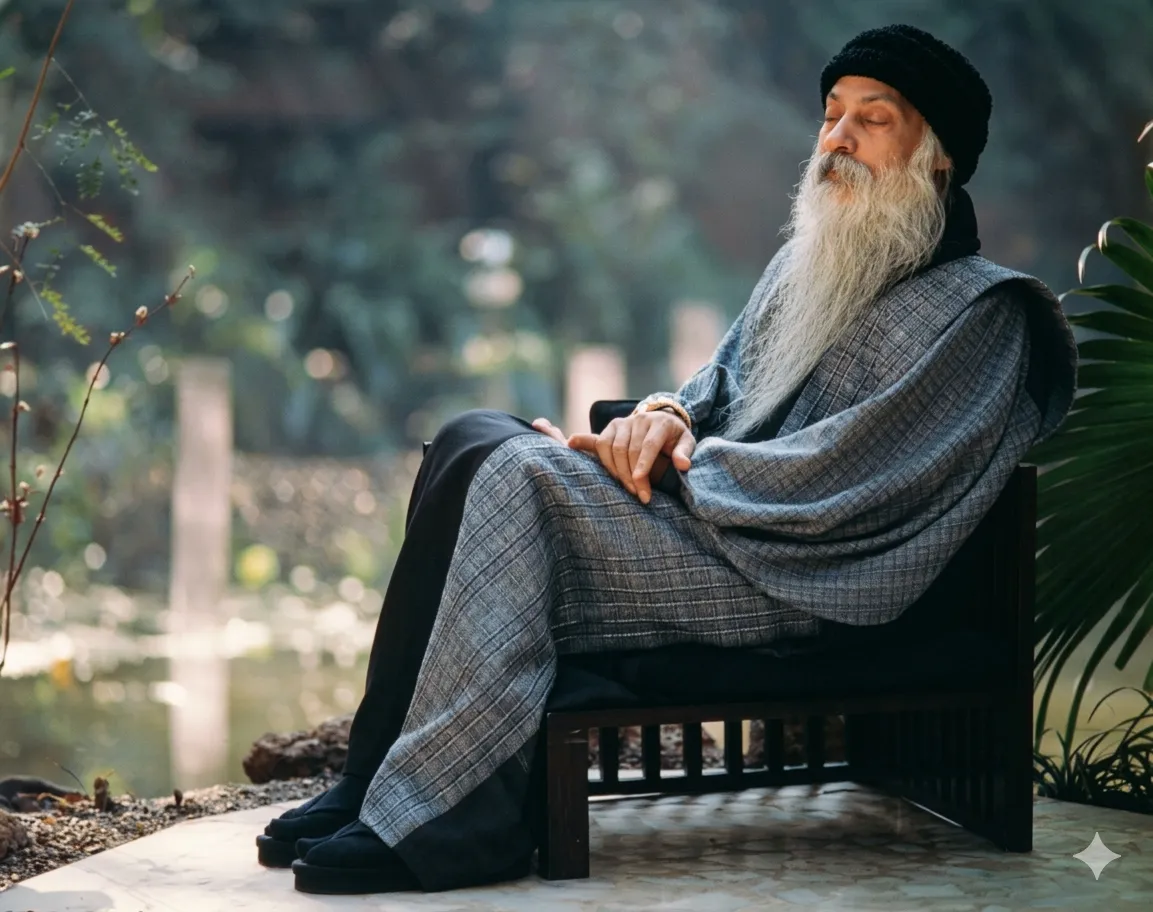
Meditation isn’t to get something later; it’s just being here and now without chasing past or future.
From the Discourses
Passages where Osho speaks to this question — each links to the complete discourse.
Osho, what is the goal of meditation?
Even Ananda, Buddha's closest disciple, asked one day when they were walking through a forest. It was autumn and leaves were falling from the trees and the whole forest was full of dry leaves and the wind was blowing those dry leaves about and there was a great sound of dry leaves moving here and there. They were passing through the forest and Ananda asked Buddha, "Bhagwan, one question persists. I have been repressing it, but I cannot repress it anymore. And today we are alone; the other followers have been left behind so nobody will know that I have asked you. I don't want to ask it before others. My question is: Are you telling us all that you have discovered or are you still hiding something? -- because what you are telling us does not clarify your bliss, your peace. It seems you are hiding something. " And…
Meditation means a state of absolute silence where not even a single thought is creating any noise, any flutter; where no desire is creating any ripple; where there is no memory, no desire, no past, no future, no thought process at all; where you are simply relaxed, totally at rest, utterly silent -- that state is meditation. And this is the goal, because once you are absolutely silent you become aware of the immense beauty of existence, you become aware that you are part of the whole. You also become aware that you have never been separate, that the separation was only an idea, a dream -- you have always been one with the whole. Existence is an organic unity, it is a cosmos. And because you thought yourself separate you created so many unnecessary anxieties, problems, worries. They were all by-products of the basic error that "I am separate".
Question: BELOVED OSHO, WHAT IS THE GOAL OF LIFE AND HOW CAN IT BE ACHIEVED? To live in the moment needs a thoughtless awareness, because even a small thought is bigger than the smallest atom of time -- the moment. Hence my insistence on meditation. It is nothing but a method to drop thoughts and to be available to the present moment. Live it as deeply as possible. The next moment will be born out of this moment. If you have lived this moment totally, intensely, your next moment is going to be still more golden. And that's how life goes on growing -- otherwise people only grow old. If you have a goal you will grow old. If you don't have a goal you will grow up. And these are two different processes. Growing old you reach to death; that is the goal.
Beloved Osho, before I came to know you, I had never heard about enlightenment. But I was searching for something. Now, after four years of living in a commune, I feel further away from reaching somewhere than ever before. I'm just grateful to be here and to feel your friendship and compassion. Is enlightenment still the goal? Is there any goal at all?
This is a troublesome question. Enlightenment has never been the goal. Its very nature prohibits making it a goal. The goal is always in the future somewhere; and enlightenment is always now and here. Enlightenment is an experience in the present. But this is one of the troubles of the mind, that it makes goals out of everything. If you love the idea of enlightenment, then immediately the mechanism of the mind makes it a goal: you have to achieve it -- and that's where you go on the wrong path. Enlightenment is a by-product of the understanding that to live in the past is foolish, because it is simply memory. But millions of people are wasting their time in memories. Millions of others are living in the future. You cannot live in the future; it is making castles in the air. To understand that past and future are both…
Therefore, o sariputra, it is because of his non-attainmentness that a bodhisattva, through having relied on the perfection of wisdom, dwells without thought-coverings. In the absence of thought-coverings he has not been made to tremble, he has overcome what can upset, and in the end he attains to nirvana. All those who appear as buddhas in the three periods of time fully awake to the utmost, right and perfect enlightenment because they have relied on the perfection of wisdom.
Buddha is powerful, powerful in his peace, in his silence. He is as powerful as a roseflower, he's not powerful like an atom bomb. He's as powerful as the smile of a child... very fragile, very vulnerable; but he's not as powerful as a sword. He is powerful, as a small earthen lamp, the small flame burning bright in the dark night. It is a totally different dimension of power. This power is what we call divine power. It is out of non-friction. Concentration is a friction: you fight with your own mind. You try to focus the mind in a certain way, towards a certain idea, towards a certain object. You force it, you bring it back again and again. It tries to escape, it runs away, it goes astray, it starts thinking of a thousand and one things, and you bring it again and you force it. You…