
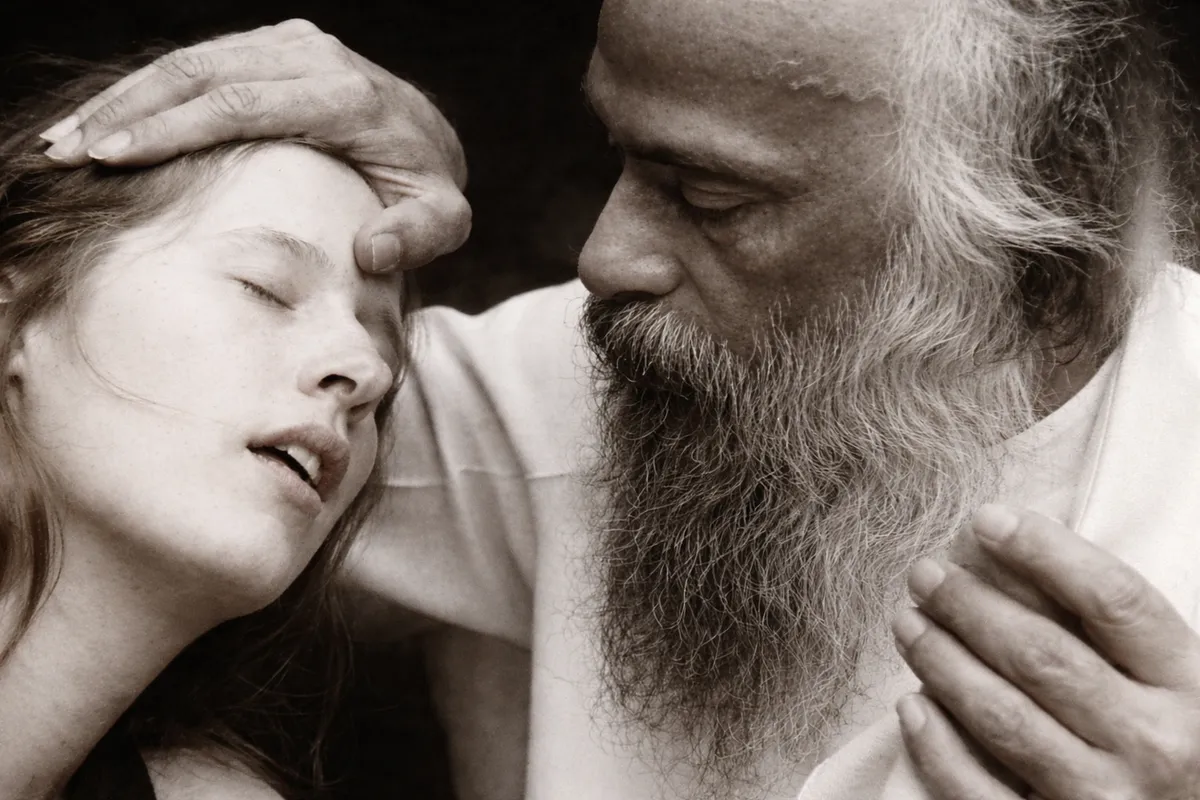
When thoughts and the feeling of ‘me’ stop, life moves through you effortlessly—joyful, clear, and beautiful.
From the Discourses
Passages where Osho speaks to this question — each links to the complete discourse.
Osho, in the thought-free state you describe, consciousness would have to be passive in its very being. So if the conscious mind becomes completely thoughtless and inactive, what difference remains between that and inert existence? When there is nothing to do and mere being is the goal, is there any difference between such a state and dead stillness? What purpose could the existence of consciousness have for us? Please explain the difference between the existence of a wooden chair and a thought-free, inactive human existence.
Then Huxley wrote that that day it occurred to him: LSD itself does nothing; it is a consciousness-expanding drug. For a few moments your awareness expands a little. And with just that small expansion, the chair became alive! So Huxley wrote, “Now I can believe those who looked at a stone and bowed as if before God; their consciousness must have had some other expansion.” He also wrote, “Now I can believe someone like Van Gogh, who painted a chair.” Why paint a chair? Can you imagine sitting down to paint and choosing a chair? And a unique painter like Van Gogh labors for months to paint a chair—must he be mad? Is a chair worth painting? But Huxley said that until then he had never understood why Van Gogh painted a chair; then he understood Van Gogh must have seen this chair in another moment of consciousness, which he…
Osho, is there any practical process for being in the realm of existence beyond thoughts, in the void?
The way to thin them out is non-cooperation. Right now we are their makers—that is, we are the ones maintaining them. When we sit idle, some thought or other is running, because without our cooperation they cannot run. Withdraw your cooperation from whatever thoughts are running, and do nothing else; regard just this as samayik, as meditation. If all thoughts dissolve, you will feel no ego and no person within. You will know only being—only being will be known, in which the distinction “I am an individual” or “I am the whole” will not be felt. Only pure being will remain—pure existence. In truth, because of the thoughts accumulated upon that pure existence, we appear to be a person. This sense that I am “A,” you are “B,” you are “C”—the A, B, C we have pasted on—is our thought-power. We commonly say, “I will become liberated”—this is not quite…
The appearance of things has only been imposed upon oneself. By eliminating it, the self becomes absolute brahman, who is the whole, one without a second and without action. The appearance of the self in the form of the world of division is false, because one that is without change, form, and organs cannot have any divisions.
THE CONSCIOUS SELF IS FREE FROM THE FEELING OF THE OBSERVER, THE OBSERVATION, AND THE OBSERVED. IT IS INNOCENT AND FULL LIKE THE SEA OF THE ULTIMATE FLOOD, WHICH DESTROYS THE WHOLE EXISTENCE. AS DARKNESS DISSOLVES IN THE LIGHT, SO THE CAUSE OF ILLUSION DISSOLVES IN THE SUPREME WHO IS WITHOUT A SECOND. AND THAT SUPREME BEING WITHOUT ORGANS... HOW COULD THAT SUPREME HAVE DIVISIONS? THE SUPREME REALITY BEING ONE, HOW COULD THERE BE DIVISIONS IN IT? IN THE STATE OF DREAMLESS DEEP SLEEP, sushupti, THERE REMAINS ONLY BLISSFULNESS. SO HOW COULD THERE BE DIVISIONS IN IT? This UPANISHAD is basically against mind, and not only this UPANISHAD, upanishadic teaching as such is against mind. Really, religion is against mind, because mind creates all illusions, all dreams. Mind creates everything that we call the world. Mind IS the world; try to understand this. This is one of the basic truths.…
Osho, the presence of a person seems indispensable for the experience of bliss. But if all around is only the expansion of me, then who will experience bliss? Just as sannyas seems essential for life to become blissful, isn’t the person equally essential for the experience of bliss?
It is precisely because of the person that bliss is not happening. The person is necessary for the expectation of bliss; for the experience of bliss, he is a barrier. For the longing and the craving for bliss, the person is needed; for the realization of bliss, the person is not needed at all. When bliss happens, you are scarcely there. In fact, only when you are not, bliss is. You yourself have tasted this, at least in unpremeditated moments: whenever you were not, a glimpse flashed. Your beloved comes home; you sit hand in hand. For a moment the presence of the beloved absorbs you so totally that you disappear—no thought of yourself remains. A drop slips in, the nectar begins to flow. Have you ever watched the sun rise? You sit on the riverbank. The sun begins to climb. This morning breeze, the coolness of the water, the…
Osho, I too have begun to feel that it is not valuable.
If you decide to do social service—uplift the “Harijan,” redistribute land, do this and that—and you think self-realization will result, you are mistaken. Self-realization will not come from that. You may become a good and popular person; you will taste a subtle pleasure of ego—and nothing more. You will enjoy the pleasure of being “a servant,” but you will not taste the joy of service. The pleasure of the role of “servant” is one thing; the joy of service is entirely another. But if you enter religious practice, which is utterly personal, then a day will come when that sadhana will transform your life into service. Now life is self-interest; then life will be service. In self-ignorance, life is self-centered; whatever you do, some form of self-interest is present. In self-knowledge, life is service; whatever you do, self-interest cannot remain. For me, religion is fundamental; its result will surely come.…