
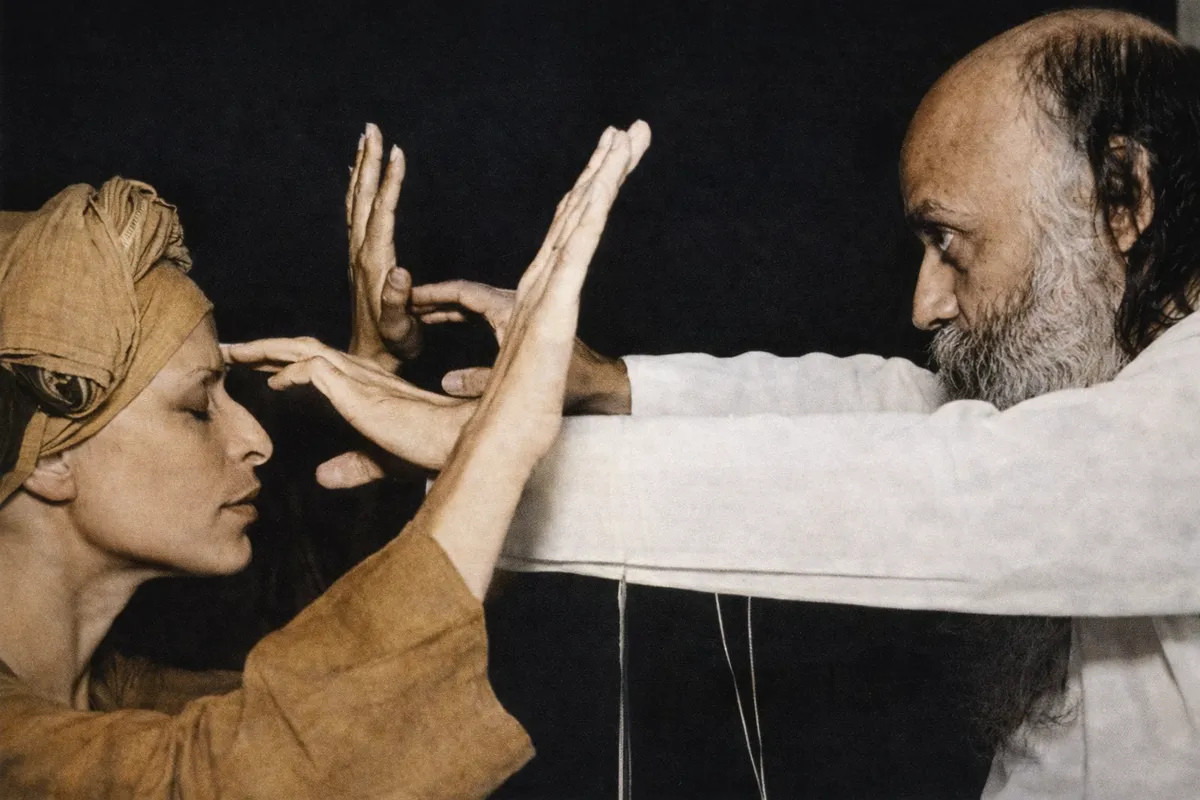
It’s not thinking hard about a thing; it’s being so quietly aware inside that there’s no thing to think about.
From the Discourses
Passages where Osho speaks to this question — each links to the complete discourse.
Beloved master, what does it mean to "meditate over" something? I know what it means to "think over" something; that's what the mind is continuously doing: remembering, analyzing, planning, imagining, etcetera. I also came to know a state of meditation where the "I" is no more, where all the boundaries are lost, just a melting into the whole, a disappearing, weightlessness, light, and bliss. But what, beloved master, do you mean when you say to us, "meditate over it"?
When you use dhyan, it does not mean on what. It simply means going beyond the mind. And the moment you go beyond the mind, you go beyond all objects. You simply are. Dhyan is not a process, but a state of being. Not a duality between subject and object, but simply a dewdrop slipping from the lotus leaf into the ocean. Talking to you, when I say, "Meditate over it" I know the word I am using is wrong. But the reason that I am using the wrong word is because only the wrong people are around me! All the misfits of the world... they fit me very well! But you can be reminded that language should not become a barrier. Meditation is a state. You are simply silent -- no thought to concentrate on, no subject to contemplate, no object to meditate over. The other has disappeared. And…
Osho, please explain how I can meditate over something without using my mind.
Meditation has nothing to do with mind; meditation simply means a state of no-mind. The functioning of the mind is the only disturbance in meditation. If you are trying to achieve meditation THROUGH mind you are bound to fail, doomed to fail. You are trying to achieve the impossible. A Zen initiate was meditating for years and whenever he would come to his Master, whatsoever experience he would bring to the Master, the Master would simply reject: "It is all nonsense. You go back and meditate again." One day the Master came to the but of the disciple -- he was sitting in a Buddha posture. The Master shook him and told him, "What are you doing here? If we needed stone Buddhas we have many in the temple! Just by sitting like a stone Buddha you will not attain to meditation. Do what I have been telling you to…
Osho, what is meditation?
He said, "I had no idea whether I was standing or sitting, or where I was. The subject was so absorbing that I went totally with it. I don't know when the snow started falling or when the whole night passed. I would have died, but I would not have come to my senses because the subject was so absorbing. I was still unfinished it was a whole theory, and you have awakened me in the middle. Now I don't know whether I will be able to get hold of the unfinished theory." It is just like you are dreaming and somebody wakes you up. Do you think you can catch hold of your dream again by just closing your eyes and trying to sleep? It is very difficult to get back into the same dream. Contemplation is a kind of logical dreaming. It is a very rare thing. But…
He would not like to know the truth through others, he would like to experience it himself -- because unless you drink the water your thirst is not going to be quenched. Buddha may have drunk the whole Ganges -- that is not going to make any difference to you. Just a glass of water will do for you but you have to drink it. But people are so foolish that they go on worshipping Buddha and Krishna and Christ, and hoping that their thirst will be quenched they go on worshipping scriptures -- Dhammapada, Koran, Bible. It is like a thirsty man worshipping a book of chemistry which explain that water is H2O. You can go on worshipping the book; you will remain thirsty. You are simply proving yourself silly and nothing else. Or you can go on repeating the mantra "H2O, H2O, H2O...
Deva means divine and dhyana means the state of meditation -- divine state of meditation. The word 'meditation' is not as adequate as dhyana, because nothing like dhyana has ever existed in the West so no western language has any appropriate word for it. Meditation comes closest but still misses the target. Meditation means contemplation, to think about, and dhyana means not thinking at all, just being. So meditation is an activity and dhyana is a state of being. Meditation is still thinking -- maybe more concentrated. Christians say 'meditate upon god.' We cannot say that in the East, because if you meditate upon something it is no more meditation. You will think about god -- what else will you do? You will think of the attributes of god, the qualities of god -- that god is compassionate, that god is infinite, that god is this and that.