
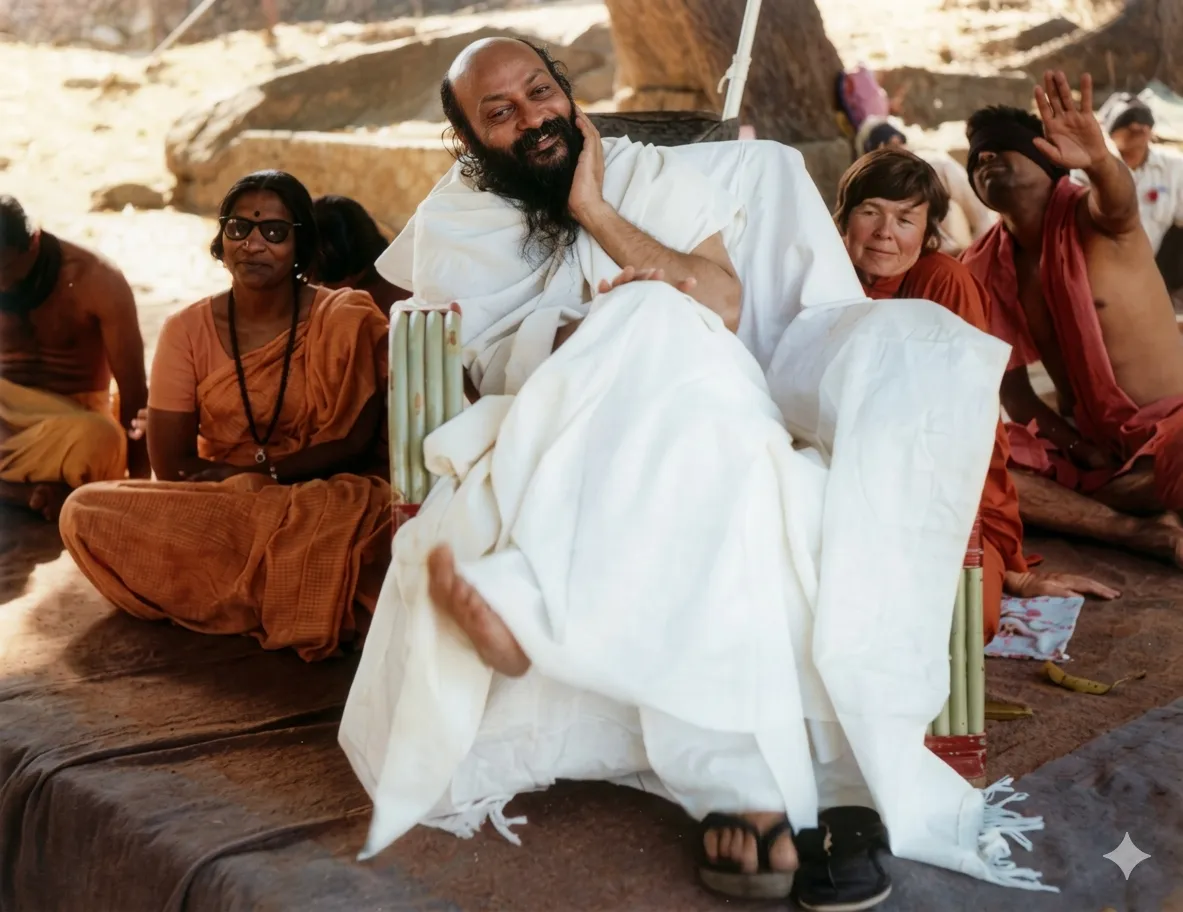
According to Osho, surrender has no 'how': it is not a technique or doing but a happening born of total helplessness after every effort and method fails. True surrender is unconditional, irreversible trust—ego, intellect, and personal decisions are put aside, and you allow the master/existence to lead completely. Only strong souls can choose such totality; partial or conditional surrender is false.
You don’t learn surrender like a trick; when you can’t manage anymore, you stop fighting and trust fully, letting a wise guide or life lead you.
From the Discourses
Passages where Osho speaks to this question — each links to the complete discourse.
Beloved Osho, I have always heard you speaking about surrender, and it seems to me that surrender is the only important factor in achieving transformation. Then how to surrender? What is the meaning, method and process of it? And what contribution does the active meditation make in reaching the state of surrender?
Mahavira succeeded -- the other seeker in the same part of the world. He was doing certain techniques and he succeeded. Through techniques he succeeded in dissolving his ego. That is why Jainas and Buddhists are bonafide enemies. They cannot come to any reconciliation, they cannot come to any compromise, because they are so absolutely opposite. Mahavira succeeded through technique, so the whole teaching of Mahavira is of method. Buddha succeeded through failure, so his whole teaching is of effortlessness: "Do not do anything." These are the two dimensions. Both are good, but my suggestion is to first try to follow technique. If you succeed, it is okay. If you fail, then surrender will be possible. Then it too is okay. I am for both; that is why I look contradictory. One young man reached me today and he said, "You are so contradictory that it is impossible to follow…
On the path of surrender, how does the seeker come to the right technique out of one hundred and twelve methods?
There are so many stories which have become meaningless for us because we do not know how they happened. Mahakashyap came to Buddha, and Buddha just touched his head with his hand, and the thing happened. And Mahakashyap began to dance. So Ananda asked Buddha, "What has happened to him? And I have been for forty years with you! Is he mad? Or is he just fooling others? What has happened to him? And I have touched your feet thousands and thousands of times." Of course, to Ananda, this Mahakashyap will either look like he is mad or as if he is just deceiving. He was with Buddha for forty years, but there was a problem. He was his elder brother, Buddha's elder brother; that was the problem. When Ananda came to Buddha forty years before, the first thing he said to Buddha was this: "I am your elder brother,…
Question: First question: Osho, how can the state of surrender be attained? In life, the most difficult, the most arduous inner state is surrender. The mind is built around the ego. It is easy for the mind to assume, “I am the center of the whole universe,” as if the earth, the sun, the stars all revolve around me, for me; the whole of life is a means, and I am the end. The ego-state means: I am the goal and everything else is a means. Everything exists for me; I exist for no one. I am the target; all that happens is for me. All is an arrangement to serve me. This is the ego-mood. Surrender is exactly the opposite: I am nothing. My being is like a void, and the center lies outside me.
Why and how should surrender happen?
Surrender, because we only appear to be persons—we are not. We only appear separate—we are not. It is a great illusory perception that we are separate. This totality of life—we are connected to it. Like a leaf may be under the illusion that it is separate from the tree. And of course it is under the illusion that it is separate from the other leaves on the same branch. This illusion arises naturally. The neighboring leaf dries up, yet this one does not dry along with it—if they were one, it too would dry. A neighboring leaf gets plucked, this one is not plucked with it—if they were one, it would be plucked too. One leaf is like a child, fresh and new; another like an old man. So it is quite natural that each leaf considers itself separate, though it is not the truth. But if the leaf looks…
What is the meaning of surrender? How is surrender?
Coming closer to me, you will be able to imbibe my spirit. That is the meaning of surrender: that you are ready to come close to me, that you are not afraid, that you will not protect yourself against me, that you will not be defensive, that simply you are ready to come closer to me, that you are attracted, that you have heard my call, that something has clicked in your heart and you will try to know who this man really is, what manner of man. You would like to enter into my emptiness and be surrounded by my emptiness. Sannyas is the visible effort of surrender. Many people come to me and they say, "We don't take sannyas. Can't you help us?" I say, "I will try my best, but it won't be of much help because you will continuously protect yourself. You will be defensive." Sannyas…