
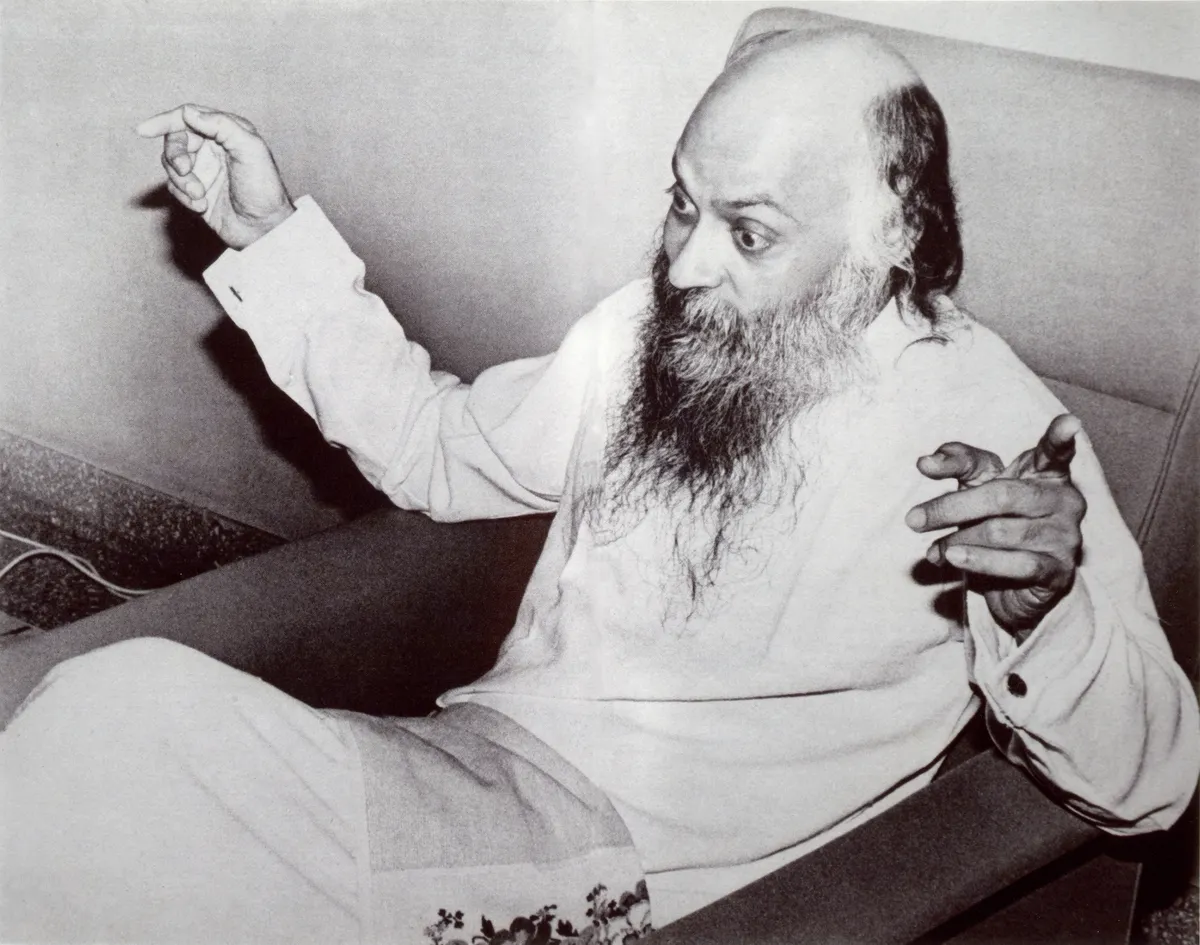
Life goes in circles when you’re asleep inside, but if you truly wake up and pay attention, you can step off the ride and stop repeating the same hurts.
From the Discourses
Passages where Osho speaks to this question — each links to the complete discourse.
Osho, if the movement of life is circular—like day and night, like months and seasons—does it mean we, too, keep merely repeating ourselves again and again?
Strive! Buddha’s last words at the moment of farewell were: Ananda, be ceaselessly engaged in effort! Do not be negligent even for an instant! Do not let even a trace of sloth settle within! For a little sloth, and much is lost. Keep toiling until you awaken; until then, do not grant yourself any rest. Tireless effort! You will have to strike again and again; only then will this darkness break—because you have been maintaining this darkness for so long. Your state has become rock-like, inert. The crust has grown very strong. The soul is hidden within; the spring is within; but the doors are closed. By striking, the doors will break. By striking continuously, the doors will break. Even if the blows are gentle, they must be unbroken. Water falls—gentle blows—and rocks are split. Let the stream of your remembrance fall upon the mechanical rocks within you. If not…
In this regard a friend has also asked: Osho, can we know our past lives?
Sri Aurobindo undertook another experiment. He did not appear to succeed, and did not succeed outwardly, but his direction was absolutely right. His experiment was this: Is it possible for a few souls to rise so high that their very presence begins to lift and call other souls upward? Is it possible that when one person’s soul rises, the overall level of the soul of humanity rises with it? This is not only possible; today it is the only possibility. Nothing else can work now. Man has fallen so low that if we plan to change people one by one, perhaps the change will never happen. In fact, the one who goes to change them is more likely to be changed by their company—to be corrupted along with them. You can see it: those “servants of the people” who go to serve the people—within a short time it is discovered…
Osho, as with the ocean: clouds rise from it, its water rains down, ice forms, and then it all returns to the ocean—so there is a cycle. In the same way, would liberated souls, in some manner, keep going back even to nigod?
No, no. There is no such cycle, no such cycle. Because water, steam, and the ocean are not three things. They are not three things; they are a single thing in a mechanical cycle. A mechanical cycle. No droplet can free itself from water and be outside it; the wheel keeps turning. As far as moksha is concerned, returning from there is difficult. Only when mechanicalness breaks, when the mind becomes fully conscious—wholly conscious—can one reach moksha. From total consciousness, returning is impossible. Yes, within the world one can go round and round—many rounds. A human being can be born a human a thousand times, repeating the same rounds, because he is asleep. If he awakens, he stops circling; he steps out of the wheel. Since moksha means being outside all cycles, one cannot go back into the cycle. And a drop of water is in a stupor; we should…
Osho, when we are reborn, where is the accounting kept? What remains?
We are all bundles of habits. If you want to change these habits, resolve is needed. And the beginning of resolve is this: that it dawns on you that they can be changed. If you think they cannot be changed, your resolve will die completely. A German Jew, Frankl, during the last world war was imprisoned in a great camp. He has written—he has written very astonishing things—in his memoirs. Because he is a psychologist, he kept observing what was happening. December was approaching; the festival days were near. All the prisoners hoped that at least around Christmas there would be release; that around Christmas Hitler would show mercy and people would be freed. Frankl writes: until Christmas, however many tortures the prisoners were given, no one died. People remained ill, but there was a hope—Christmas is approaching. With that hope, there was strength in their life-breath. He writes: the…
The buddha said: "those who are following the way should behave like a piece of timber which is drifting along a stream. If the log is neither held by the banks, nor seized by men, nor obstructed by the gods, nor kept in the whirlpool, nor itself goes to decay, I assure you that this log will finally reach the ocean. If monks walking on the way are neither tempted by the passions, nor led astray by some evil influences, but steadily pursue their course for nirvana, I assure you that these monks will finally attain enlightenment."
THE BUDDHA SAID: "RELY NOT ON YOUR OWN WILL. YOUR OWN WILL IS NOT TRUSTWORTHY. GUARD YOURSELVES AGAINST SENSUALISM, FOR IT SURELY LEADS TO THE PATH OF EVIL. YOUR OWN WILL BECOMES TRUSTWORTHY ONLY WHEN YOU HAVE ATTAINED ARHATSHIP." I am not here fulfilling your ideas. I am not helping you to become better Christians and better Hindus and better Mohammedans. I am trying to drop all obstacles from your path so you can become that which you are. If you can flower to your totality, you will be a Christ, you will be a Buddha. But obstacles are there, Buddha says. Sometimes the banks. Sometimes men around you. Sometimes the gods, the philosophies, theologies. Sometimes your mind's own whirlpool. And sometimes you yourself can go to decay. If you are not alert and intelligent, you are already decaying, you are already dying. Every day your intelligence becomes more and…