
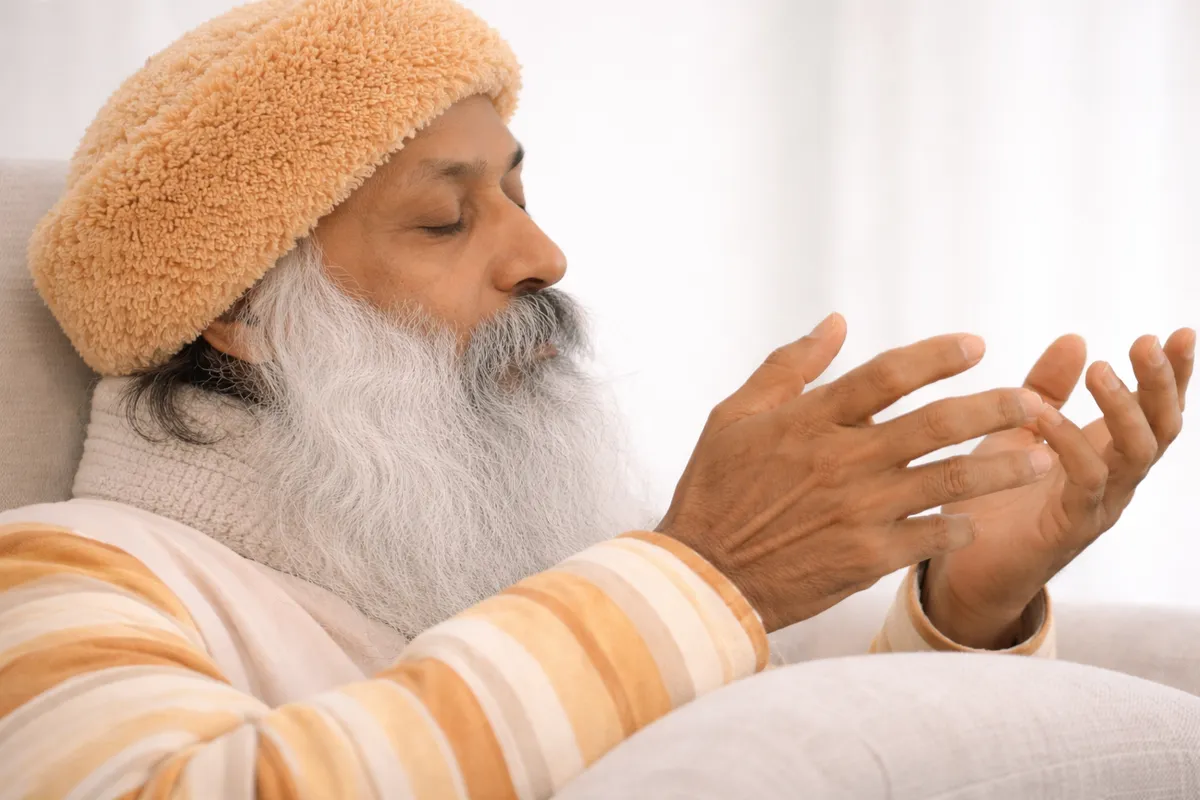
Like a leaf softly letting go, we say a big yes to everything—including dying—so there’s no fear or struggle, only peace.
From the Discourses
Passages where Osho speaks to this question — each links to the complete discourse.
Beloved master, when the moment comes the leaf lets go its tender hold and greets its dying with inner grace. Is it then that the way is open for life to embrace its own e'er the leaf touches down?
Yes, Amitabh, that's the secret of life and death both, the secret of the secrets: how to allow existence to pass through you totally unhindered, unobstructed, how to be in a state of absolute nonresistance. Buddha calls it TATHATA -- suchness. The ego is resistance. Let-go means disappearance of the ego. When you are just a hollow bamboo, existence sings millions of songs through you. It transforms you into a beautiful flute. But you have to be a hollow bamboo, utterly empty, so there is nothing to obstruct the flow. A total yes is sannyas, an unconditional yes: yes to all, to life and to death -- because death is not against life but is life's ultimate culmination, its highest peak. Yes to joy and yes to sadness too, because joy cannot exist without sadness. Joy is possible only if sadness creates the background. They are joined together so intrinsically…
Osho, do you feel that life and death are just two moments of the same thing—the same aspect?
Such a person will be miserable, in pain, because what he wants is impossible. All dualities are linked; you cannot save the half. One who sees this attains bliss—because now there is no sorrow left, no pleasure left. Whatever comes is accepted; whatever does not come is also accepted. If a friend arrives—there is joy. If a friend departs—there is joy. Joy here means: in both situations he does not choose. He has become choiceless. There is no preference, no alternative; all is okay, all is okay. Even yes and no have become equal. As one slowly comes to this total acceptance, trust arises. A theist accepts even atheism—that things are such that someone may say, “God is not.” A supreme theist will not even quarrel with an atheist, because he will say, “Fine—this too can be, that a person may say God is not. Where there are those who…
Osho, we don’t know how to keep the ritual of your gathering; we don’t know how to smear ourselves with the ash of our own body. O Osho, you who teach the way to die, listen: we don’t know how to die before we die.
If you learn the art of dying, each morning you will find you are a child again. Butterflies call again; the dew speaks again; pearls are scattered all around once more; moon and stars turn mysterious. What does childhood mean? Innocence—no self-consciousness yet. Whoever learns to die every day wins the taste and doorway to childhood day after day. The delight that was in self-forgetfulness—where is it? We came to our senses, and we saw. You ask, “Before death we cannot die.” If you die only when you are killed—what art is that! Everyone dies when they are killed—dogs and cats, men and women. If you die only when death slays you, what will be your mastery? What will be your worth? That mighty Bhima, of whom it is told There dwelt the strength of sixty thousand elephants— He could not lift a single piece of wood off his chest…
Osho, you said the truth of life is death. Then what is the truth of death?
Buddha called this the state of suchness—accepting what is, as it is. No yes-and-no. No imposing your desire that it be like this or like that. As it is, let it be as it is. Kabir said: Just as it is—accept it as such. Because as long as you reject, you are fighting life—you are contending with God. You are trying to impose your will. You are not a seeker of truth; your ego is still thick. In accepting what is, as it is, the ego dissolves; there remains no place for it. The struggle is gone, the ego is gone. Ramana lay down. He consented: If death comes, it comes. What is in my hands? “Jih vidhi rākhe Rām, tih vidhi rahiye”—In whatever way Ram keeps you, remain that way. If death has come, it has come. This is how Ram wishes to take me—so be it. He was…
Osho, it seems as if a constant benediction showers from your eyes—sweet and tender. Your eyes move over the listeners, and the moment they fall on me it feels as if a spear has pierced my innermost core. My whole body trembles. Something like death happens. But why does the ultimate death not take place?
The goldsmith puts gold into the fire. If the gold had a little intelligence it would scream and writhe, saying, What are you doing—will you kill me? But how could the gold know that this is the very process of becoming pure? Passing through the fire, whatever remains is kundan, pure gold. What does not die in you even when you die—that is the soul. What is not erased in you even when you are erased—that is your true being. You will have to pass through death. If you go from me having learned anything else, you will have gone collecting trash. If you go having learned death, you have taken the key. We have called India’s supreme mystical scriptures the Upanishads. Upanishad means to be near the master; it means to sit close—just that. What happens by sitting close? By sitting near one who is gone, the courage to…