
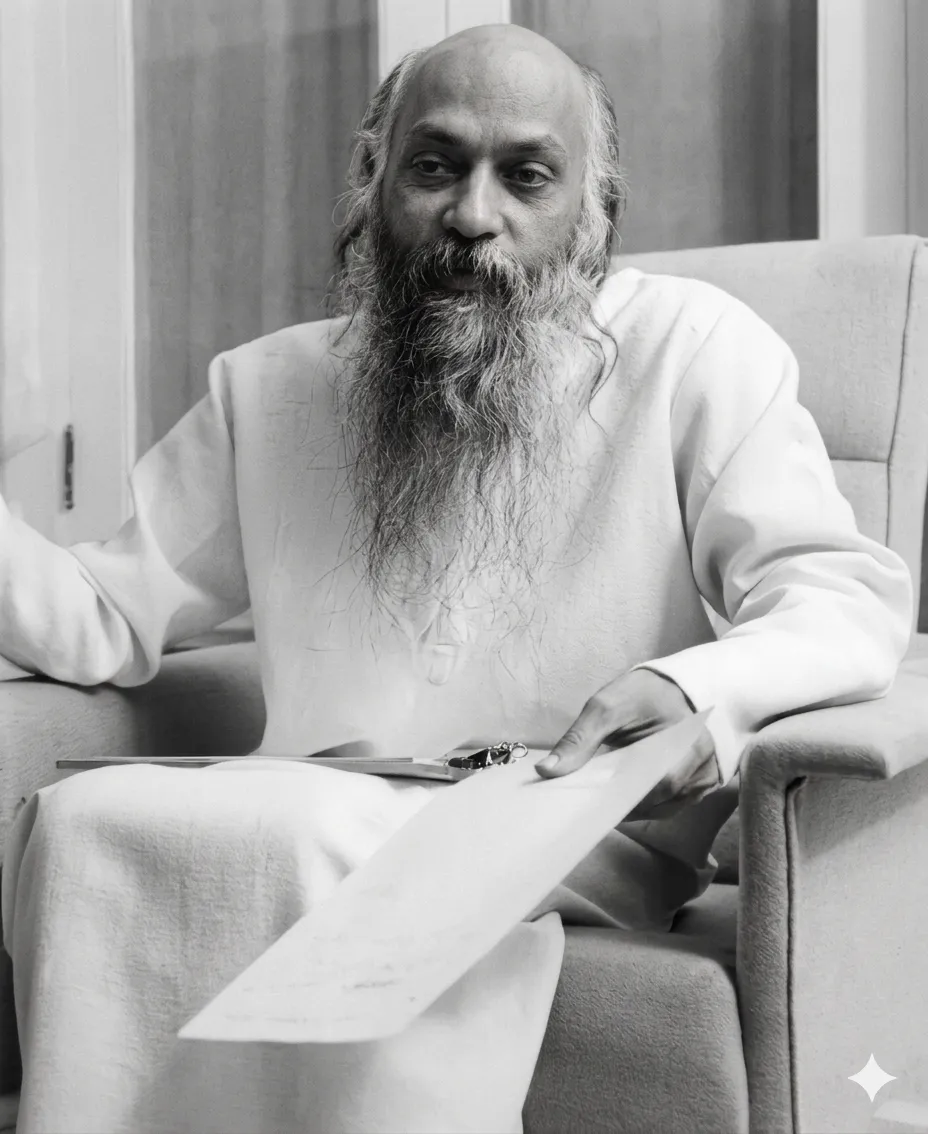
According to Osho, ordinarily thought makes you lost and meditation makes you found, but in true Zen vision there is neither losing nor finding—only silence. The ‘I’ is just a bundle of thoughts; when thoughts cease, you also vanish. What remains is pure consciousness, impersonal bliss. Losing yourself in no-thought is freedom; presence without a self.
Thinking creates a pretend ‘me,’ while meditation lets that pretend ‘me’ drop so only quiet, happy awareness remains.
From the Discourses
Passages where Osho speaks to this question — each links to the complete discourse.
Osho, I too have begun to feel that it is not valuable.
If you decide to do social service—uplift the “Harijan,” redistribute land, do this and that—and you think self-realization will result, you are mistaken. Self-realization will not come from that. You may become a good and popular person; you will taste a subtle pleasure of ego—and nothing more. You will enjoy the pleasure of being “a servant,” but you will not taste the joy of service. The pleasure of the role of “servant” is one thing; the joy of service is entirely another. But if you enter religious practice, which is utterly personal, then a day will come when that sadhana will transform your life into service. Now life is self-interest; then life will be service. In self-ignorance, life is self-centered; whatever you do, some form of self-interest is present. In self-knowledge, life is service; whatever you do, self-interest cannot remain. For me, religion is fundamental; its result will surely come.…
For example, it brings you the experience that not the body, so clearly, so solidly, so categorically, that even if the whole world denies it, it cannot make any difference: you know from your innermost core you are not the body. It brings you the experience that you are not the mind either. And the moment you know you are neither the body nor the mind, suddenly a door opens. You have never been born and you are never going to die because only that which is born can die. The body was born, the mind was born -- they will die -- but you were before your birth and you will be after your death. Once this reality is revealed to you all fears and all miseries disappear. You become part of eternity. Only one thing remains and that is pure consciousness. And pure consciousness is nothing but godliness.
Osho, is there any practical process for being in the realm of existence beyond thoughts, in the void?
The way to thin them out is non-cooperation. Right now we are their makers—that is, we are the ones maintaining them. When we sit idle, some thought or other is running, because without our cooperation they cannot run. Withdraw your cooperation from whatever thoughts are running, and do nothing else; regard just this as samayik, as meditation. If all thoughts dissolve, you will feel no ego and no person within. You will know only being—only being will be known, in which the distinction “I am an individual” or “I am the whole” will not be felt. Only pure being will remain—pure existence. In truth, because of the thoughts accumulated upon that pure existence, we appear to be a person. This sense that I am “A,” you are “B,” you are “C”—the A, B, C we have pasted on—is our thought-power. We commonly say, “I will become liberated”—this is not quite…
Thought and meditation are in diametrically opposite directions. The former moves outward; the latter, inward. Thought is the way to know the other; meditation, the way to know the self. But thought is generally taken for meditation. This is a very serious and widespread mistake and I want to caution you against this fundamental error. Meditation means becoming actionless. Meditation is not action but a state of being. It is being steady in one's own self. In action we come into contact with the outside world; in inaction, with ourselves. When we are not doing anything we become aware of what we are, but we are constantly involved in different activities and do not know ourselves. We do not even remember that we exist. We are deeply preoccupied. At least the body rests but the mind does not rest at all. Awake, we think;p asleep, we dream.
What is meditation?
MEDITATION is A STATE OF NO-MIND Meditation is a state of pure consciousness with no content. Ordinarily, your consciousness is too much full of rubbish, just like a mirror covered with dust. The mind is a constant traffic: thoughts are moving, desires are moving, memories are moving, ambitions are moving -- it is a constant traffic! day in, day out. Even when you are asleep the mind is functioning, it is dreaming. It is still thinking; it is still in worries and anxieties. It is preparing for the next day; an underground preparation is going on. This is the state of no meditation -- just the opposite is meditation. When there is no traffic and thinking has ceased, no thought moves, no desire stirs, you are utterly silent -- that silence is meditation. And in that silence truth is known, and never otherwise. Meditation is a state of no-mind. And…