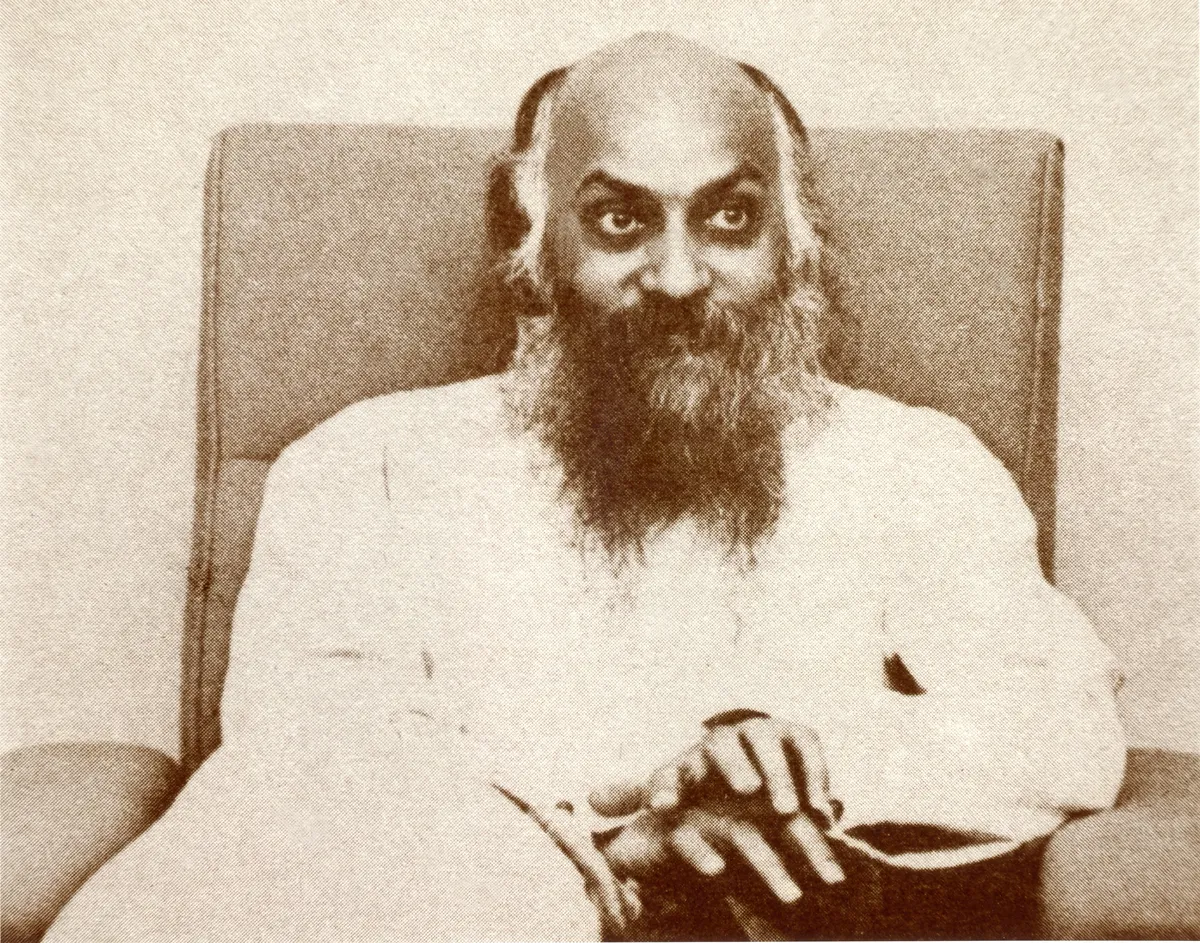
Explore Osho’s teachings across key topics such as meditation, love, ego, and awareness. Each topic contains structured questions, quotes, and insights derived from discourses.
In the pursuit of siddhi, one discovers that while bodily pain persists as an inevitable experience, true liberation lies in transcending suffering; the enlightened witness their sensations with clarity and sensitivity, remaining untouched by the turmoil of identification.
In the vision of Osho, varna emerges not from birth but from one's actions; thus, engineers and doctors embody the shudra spirit through their crafts, while the theoretical and the abstract ascend as brahmins, illustrating the fluidity of purpose over mere classification.
Sin and virtue emerge not from actions but from the depths of consciousness; when awareness illuminates our being, every moment reflects virtue, while in its absence, even noble deeds can be tainted by ego and desire, revealing that true morality thrives in the light of awakened presence.
Living unfolds in choiceless awareness, where one simply observes the self, allowing a natural distinction between memory and consciousness to emerge; in this receptive state, change blossoms spontaneously, inviting the transformative power of paradox to shatter old mind-habits.
The Vedas, embodying saguna knowledge shaped by the three gunas, serve as valuable pointers to the boundless truth of nirguna, reminding us that while scriptures illuminate, only direct, unexpressed realization can transcend their limitations.
In the essence of non-duality, Osho reveals that the visible world, apara, and the unseen consciousness, para, are not separate but rather a harmonious continuum, where true realization transcends their functional asymmetry, merging them into one profound tapestry of existence.
In the practice of samayik, one cultivates a disciplined equanimity that naturally unfolds into vitaragata, a state beyond attachment; this seamless journey reflects the essence of maturity described in the Gita as sthita-prajna, where wisdom remains steadfast as dualities dissolve.
In the essence of Osho's philosophy, the feminine and masculine energies within each individual are not bound by gender; instead, they dance in a harmonious balance, inviting us to consciously choose our expression and embrace the unique worth of our diverse vibrations.
Ahmak Ahmadabadi, on the brink of sorrowful renunciation in Kashi, found liberation in laughter, returning to Osho, whose vision of sannyas transcends grim religiosity, embracing joy through celebration, dance, and ecstatic living—a transformation reflected in Ahmak’s new identity.
In the vibrant tapestry of India, enlightened souls often remain hidden, their profound realizations manifesting through the talents of a Meera who sings and dances, while others, lacking such expressions, dwell in silent anonymity, their wisdom unseen yet deeply felt.
Osho invites us to shift our focus from the question of life after death to the profound exploration of life before death, suggesting that true existence unfolds through inner rebirth, where the fear of death dissolves and it becomes a serene transition, a gateway to new beginnings.
In the spirit of Osho, bhog embodies the joyful celebration of life's essence, serving not as a mere distraction but as the driving force that propels us forward; through embracing abundance rather than renunciation, we effortlessly release what no longer serves us, revealing the diamonds within.
Disturbance reveals not wrongdoing but our own reactivity; when others provoke joyfully, it is their freedom, while our challenge lies in remaining unshaken, for true morality blooms from awareness and inner joy, transforming perceived wrongs into reflections of our attachments.
Bodhidharma’s essence vibrates in the laughter that echoes through our shared moments, inviting seekers to embrace the sacredness of humor and playfulness as pathways to his timeless presence, urging us to listen deeply and connect in the here and now.
Transformation unfolds not through gentle wishes, but through the decisive force of concentrated energy that disrupts old patterns; it is a conscious jolt of clear resolve and unwavering intensity that shatters the familiar, inviting the new and making true change inevitable.
In the spirit of Osho's teachings, Meera emerges as a radiant embodiment of love’s essence, pouring forth her devotion in a world gripped by fear and materialism, celebrating the miracle of divine intoxication that transcends the confines of life and death.
In the Mahabharat, Krishna embodies the essence of fluidity and detachment, revealing that true awareness transcends fixed loyalties; the war itself teaches that even in conflict, one must embrace the interconnectedness of all, recognizing the impermanence of both friend and foe.
In the stillness of a mind surrendered to silence, contemplation fades into insignificance, allowing laughter to free us from the weight of thought, where the essence of truth unfolds beyond words in a boundless ecstasy.
Embracing the present moment, unshackled from the burdens of past and future, dissolves the ego's foundations, unveiling the profound truth of existence as a singular continuum, where each being is but a wave in the vast ocean of interdependence, celebrating both unity and unique individuality.
Repetition in life emerges from our failure to fully experience love and existence, as unfulfilled desires tether us to the past; yet, when we embrace ourselves wholly and authentically, the cycle dissolves, leaving nothing unfinished.
In the stillness of being, where the mind's grasp fades, the ever-elusive feeling of truth emerges from within, revealing that our true essence is not something to be possessed but rather an innate consciousness waiting to be embraced in moments of love and silence.
In the spirit of Osho's teachings, the newborn's brain may be a pristine biocomputer, yet the mind, a tapestry of accumulated conditionings from past lives, veils pure consciousness; true enlightenment emerges from shedding these layers, revealing the essence of being.
Dharana and autosuggestion converge as one, yet true awakening reveals itself only when all dharana fades; the essence of “Aham Brahmasmi” lies not in repetition but in a singular, spontaneous emergence from the profound silence beyond illusion.
Osho suggests that private interviews often stem from fear and ego, as our shared human struggles—anger, desire, and restlessness—are best addressed collectively; in openly sharing our truths, we not only lighten our burdens but also cultivate compassion and solidarity among us all.
Don't have an account? Sign up