
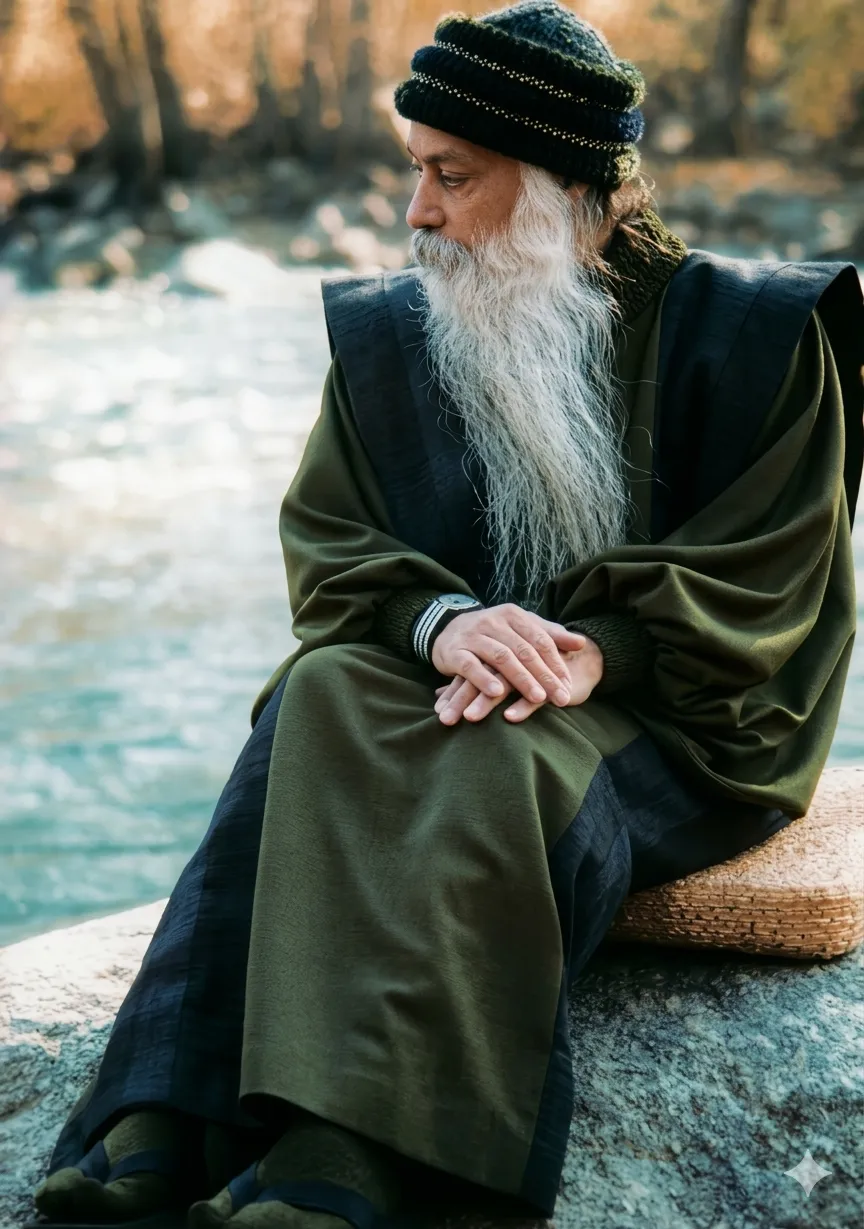
He skipped saying “love” because people had twisted that word, so he used “nonviolence” to keep his message clear and different.
From the Discourses
Passages where Osho speaks to this question — each links to the complete discourse.
Osho, yesterday you said that jealousy is included in respect. I have immense respect for you, but the jealousy inherent in it keeps poisoning it, and I feel guilt and pain. Does reverence transcend this poison-laced respect?
It needs a little explaining—it's a delicate point. Whenever you respect someone, you do so because you see in that person something you do not have. You respect because you glimpse in the other something you would also like to possess. A beggar respects an emperor because he, too, longs to be an emperor. So on the one hand he respects, and inside he also envies. Because he is not yet an emperor but wants to be. You have attained what he wants to attain. He respects you as skillful, successful: “I stand far back in the line; you have gone ahead to where I should have been.” So you are powerful, clever, intelligent, strong—he respects you. But inside a fire of jealousy also burns—if he gets the chance, he would like to be in your place and push you aside. And if the beggar gets that chance, he will…
Osho, you said that when the words of the awakened ones enter popular usage, they lose their meaning. And you mentioned that Mahavira adopted the word “ahimsa,” Jesus “love,” and the Sufis “ishq.” Bhagwan, in the present century, which word would you like to give us?
So all who have traveled the path of negation have only fattened the ego. The soul did not open or blossom in their lives. So I choose love. I am in love with love. I say to you: there may be a thousand flaws in this word—learn something from Mahavira. Seeing the flaws clinging to the word “love,” he chose ahimsa; but the results turned out even worse. The disease was disease—but the medicine too became a disease. I say to you: choose love. And love is so strong it can cross its own mistakes. It is alive—so even if it gets dirty, it can bathe. Ahimsa is a corpse—it will not get dirty, but what is the value of its cleanliness? In its cleanliness there is no fragrance of life. Its cleanliness is clinical. For me there is nectar in the word love. Because as I see it, this…
Osho, what is the constructive, positive form of nonviolence? And why did Mahavira never offer anyone physical help?
From the very word ‘ahimsa’ comes the sense of the negative, the prohibitive, the “no.” It means: no violence. So the word itself is negative. Why did Mahavira choose that word? He could have chosen love. Love is a constructive, positive word. Ahimsa means: do not cause anyone pain. Love means: give someone happiness. Because ahimsa means “do not cause pain,” it is prohibitive. That is, if I simply do not hurt you, I become nonviolent. Love is an affirmative word: it means giving happiness. So if I merely refrain from hurting you, the matter is not complete; did I also give you joy? Only if I give joy is love fulfilled. Thus love is a constructive word. Jesus used love. Ahimsa is a negative word, and Mahavira used it. Therefore it needs to be understood very deeply. Why does Mahavira employ the formula “do not give pain to anyone”?…
Osho, why did Bhagwan Buddha not use the word “love” in place of avair?
Buddha’s words are worth hearing: “I did not love you because you did not spit on me. If that were the reason, then a spit would break love. I love you because I cannot do otherwise. It is my nature. Whether you spit or not is your affair. Whether you accept my love or not is also your affair. My love is like a flower: it blossoms and the fragrance spreads. If an enemy passes by, his nostrils are filled too. He may hold a handkerchief to his nose—that is his matter. A friend passes; his nostrils are filled too. If the friend lingers by the flower and shares its bliss—that is another matter. Even if no one passes on the path, the fragrance keeps falling—in empty solitude. My love is my nature.” Understand this. What you call love is not nature; it is your act, a mood-state of your…
Love is positive — a creative relationship. Ahimsa is negative. Love means: I desire the welfare of the other, the blessing of the other; I become a joy in the other’s life; I lay flowers on the other’s path. Ahimsa means: I do not cause sorrow to the other, I do not give pain. If I do not hurt another, Ahimsa is fulfilled — but love is not. Love cannot rest until it gives joy to the other. Love lays flowers on the other’s way. Ahimsa only says: Do not scatter thorns. But if thorns are already strewn on the other’s path, Ahimsa has nothing to say whether you should pick them up or not. If the other’s path is empty and your hands full of flowers, Ahimsa says nothing about whether you should place them or not. Ahimsa is negative — enough that I do not harm.